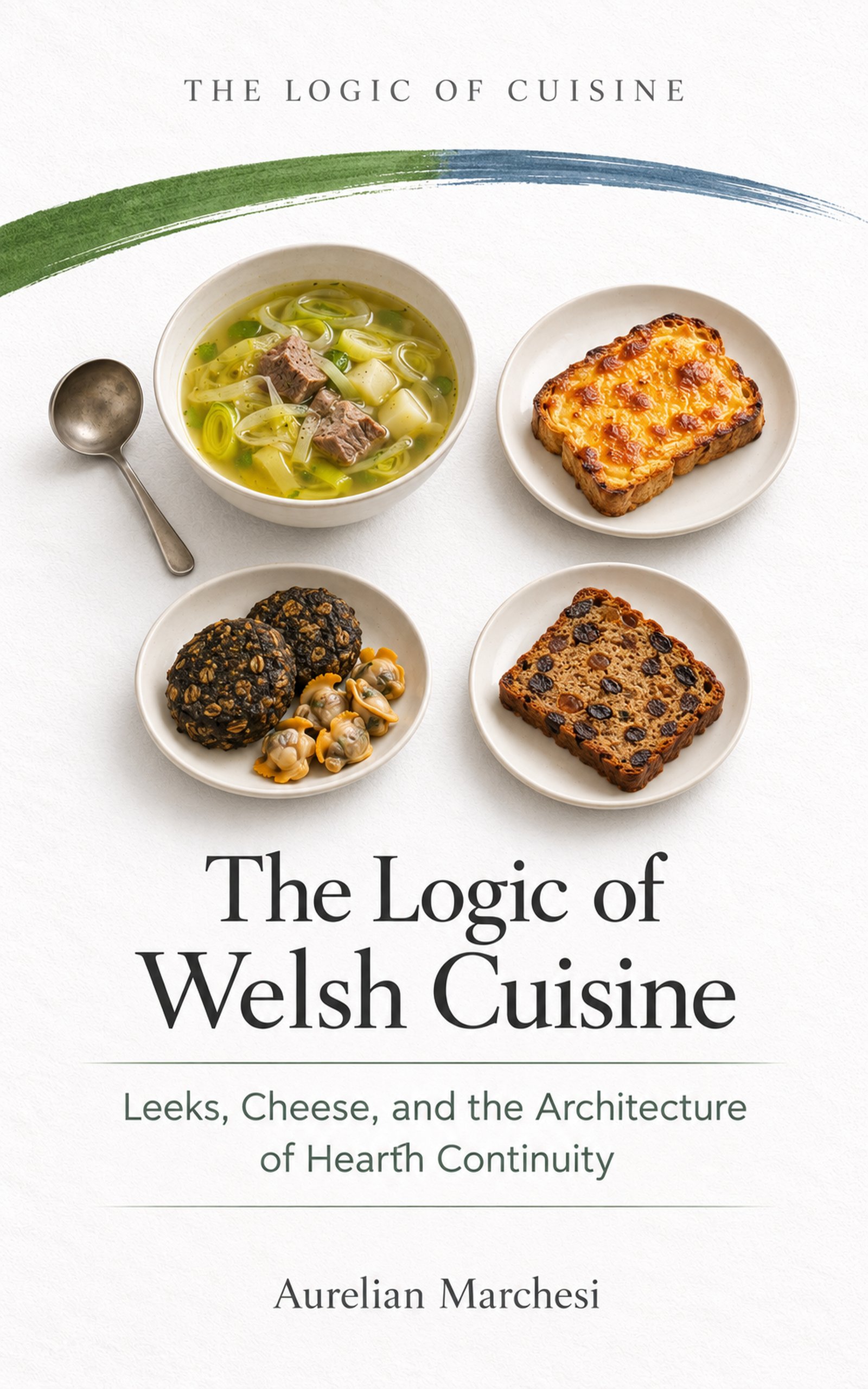
Cover of The Logic of Welsh Cuisine

Book 21 ยท The Logic of Cuisine

The Logic of Welsh Cuisine

Leeks, Cheese, and the Architecture of Hearth Continuity

By Aurelian Marchesi

In the Welsh kitchen, continuity is more revealing than spectacle. A pot breathes at the edge of the fire, bread waits for another use, cheese can turn a carrier into a meal, and a fruit loaf keeps hospitality available after the main table has dispersed. These modest forms are often mistaken for generic simplicity because their achievement appears across hours and days rather than in a single display. The volume asks how food can accept extension, reheating, uneven arrival, and changing means without losing identity. Welsh cuisine becomes legible as a system designed to be returned to: warmth held open, familiar materials renewed, and welcome made durable.

The central question

How do ordinary forms remain warm, coherent, and welcoming when weather, work, fuel, and staggered household rhythms make one-time display less useful than dependable return?

Welsh cuisine is presented as an architecture of hearth continuity. Cawl is less a fixed formula than the position of a pot able to receive bones, leeks, roots, barley, water, and another mouth over time. Leeks dissolve into that continuity; cheese uses controlled heat to bind bread, crumbs, potatoes, or leeks into complete savoury forms. Laverbread and cockles bring a saline, mineral edge without displacing the inland bowl. Bara brith, Welsh cakes, and other tea-table bakes create a second rhythm of availability. The cuisine's distinctiveness lies in forms that bend with the household yet remain recognizable through return.

What this work explores

Cawl as a continuing position

Cawl matters less as a fixed ingredient list than as the temporal position of a continuing pot. Moderate heat lets bones, roots, leeks, barley, scraps of meat, and added water enter at different moments while the broth preserves traces of what has already passed through it. One person can ladle a bowl before work, another at noon, and the pot can be strengthened again in the evening. Its achievement is repetition without resentment: individual bowls vary inside a stable frame, and day-to-day evolution is part of the design. Cawl turns continuity into nourishment by keeping warmth available rather than requiring the household to begin again.
Leeks organize the pot

Leeks organize the pot because they cooperate with time. Their sharpness softens into the broth, their fibres yield without disappearing at once, and their savoury sweetness connects roots, meat, barley, and liquid. They do not sit on top as a national emblem; they help a thin or changing pot remain coherent as ingredients are added and removed. This role also explains why an onion-heavy broth may be comforting without performing the same Welsh function. The leek's importance is not ceremonial exclusivity but its repeated ability to make extension taste intentional, giving the continuing meal a recognisable line through fluctuation.

Cheese as building material

Cheese becomes structure when heat changes its relation to a carrier. In rarebit, the cheese must soften enough to coat and brown while remaining cohesive; too much heat separates fat and protein, while excess liquid leaves the bread sodden. Toast is therefore an engineered surface, dried and strengthened so it can accept the molten layer without disappearing. In Glamorgan sausages and related forms, cheese, crumbs, leek, and seasoning bind into a self-supporting savoury unit. Acidity and seasoning keep dairy and starch awake. Cheese completes modest materials by building a form, not by arriving as an expensive garnish.

Coast corrects pasture

The coast corrects rather than overturns the inland grammar. Laverbread, cockles, mussels, and sea salt enter eating points already organized around bread, bacon, broth, fat, and starch. Their saline and mineral intensity sharpens a field that might otherwise close into soft dairy, roots, and long-held liquid. Because access varies between coast and valley, these materials cannot define every Welsh meal; their significance lies in how they join existing household structures without demanding a separate cuisine. Sea and pasture remain in relation: coastal force provides contrast, while the hearth gives that force a familiar place to land.

The tea table extends the hearth

The tea table extends the hearth into another part of the day. Bara brith holds dried fruit, spice, and tea-softened sweetness in a loaf that can be sliced, toasted, buttered, and revisited for several days. Welsh cakes and crempogau use a hot surface and a pause in household time to create forms available immediately and later. Their role is not simply dessert. They shape intervals of welcome when people do not arrive for one synchronized meal. Because these bakes can bend with available butter, fruit, heat, and company, hospitality becomes a recurring infrastructure rather than a rare performance.

Read the meal across time

Read the Welsh meal across time. Ask whether a form can wait without shame, accept extension without becoming thin, survive reheating, renew a carrier, and remain available to someone arriving later. Cawl answers through a broth that remembers additions; rarebit through a strengthened bread-and-cheese surface; coastal materials through corrective contrast; tea-table baking through portions that return across the day. This model explains why visual plainness is not lack. The cuisine concentrates its intelligence in continuity, correction, and renewal. A form succeeds when yesterday, the present bowl, and the next arrival can remain connected without turning repetition into fatigue or hospitality into spectacle.

Inside the work

The continuing hearth

The opening movement establishes weather, fuel cost, uneven household arrival, and the hearth's steady heat. Cawl and dependable materials are introduced as solutions that stay available, absorb fluctuation, and preserve the memory of earlier additions.

Transformation and correction

The next movement follows transformation and correction. Leeks organize liquid, cheese turns bread or crumbs into complete forms, and laverbread or shellfish bring coastal sharpness into an inland domestic frame without creating a separate grammar.

Benchmark forms

Extended readings of cawl and Welsh rarebit test continuity at two scales: a pot evolving across days and a carrier rebuilt at the moment of service. Glamorgan sausages, bara brith, Welsh cakes, and crempogau widen the evidence.

Identity without spectacle

The closing movement asks how quiet feast, tea-table welcome, public identity, and cooking away from Wales preserve the system. Recognition depends on repeatability, extension, corrective contrast, and return rather than on decorative emblems alone.

Place in the series

This volume contributes a temporal architecture to The Logic of Cuisine. Where Scottish food concentrates and regulates sustaining warmth, Northern English forms distribute industrial burden, and Cornish pastry equips food for travel, Welsh cuisine keeps nourishment and welcome available for return. Cawl holds household time in liquid; cheese renews a carrier; coast corrects pasture; tea-table baking creates another station of hospitality. The work demonstrates that culinary identity can reside in the ability to wait, extend, reheat, and receive another person as powerfully as it resides in rare ingredients, intense seasoning, or a ceremonial centrepiece.