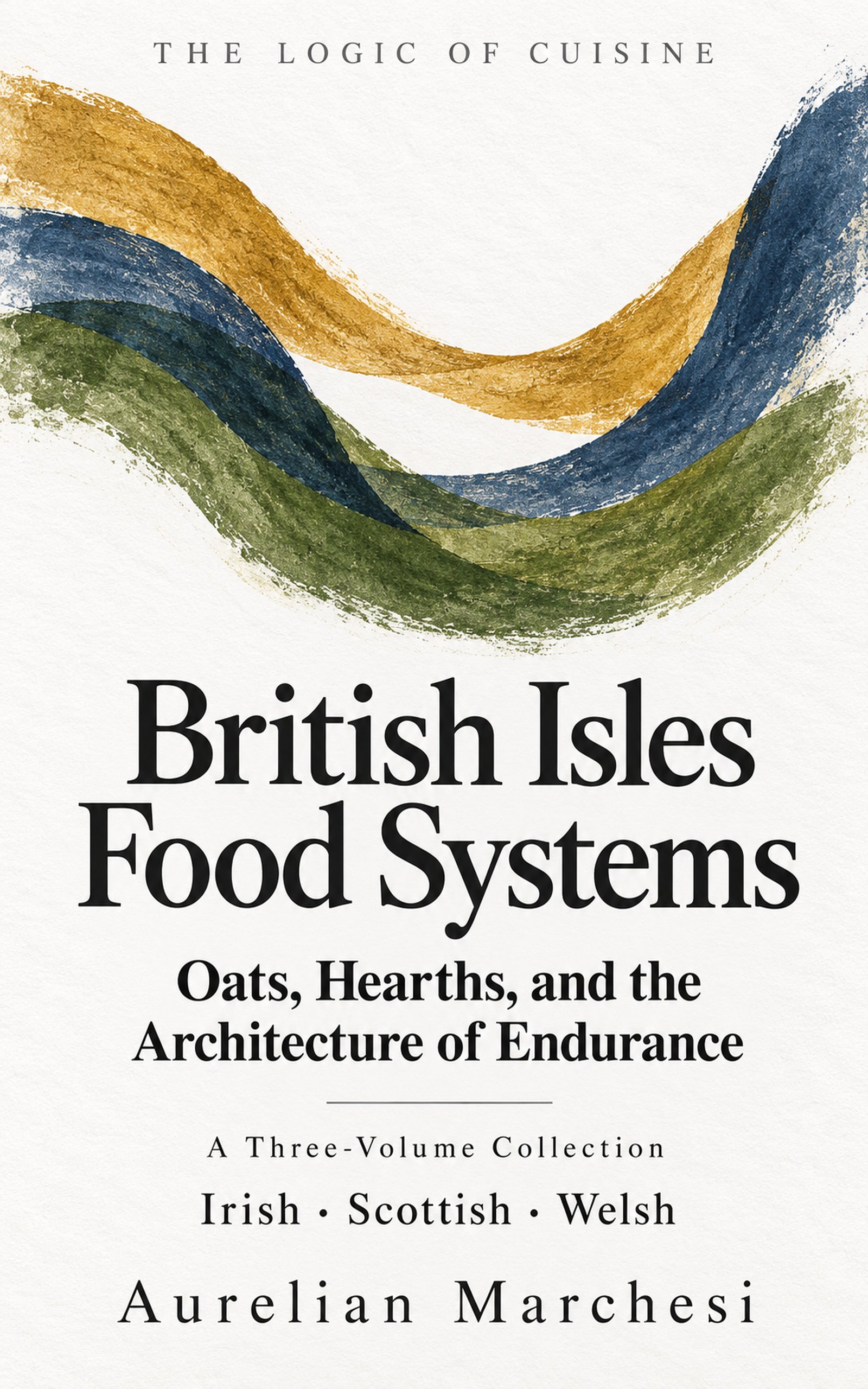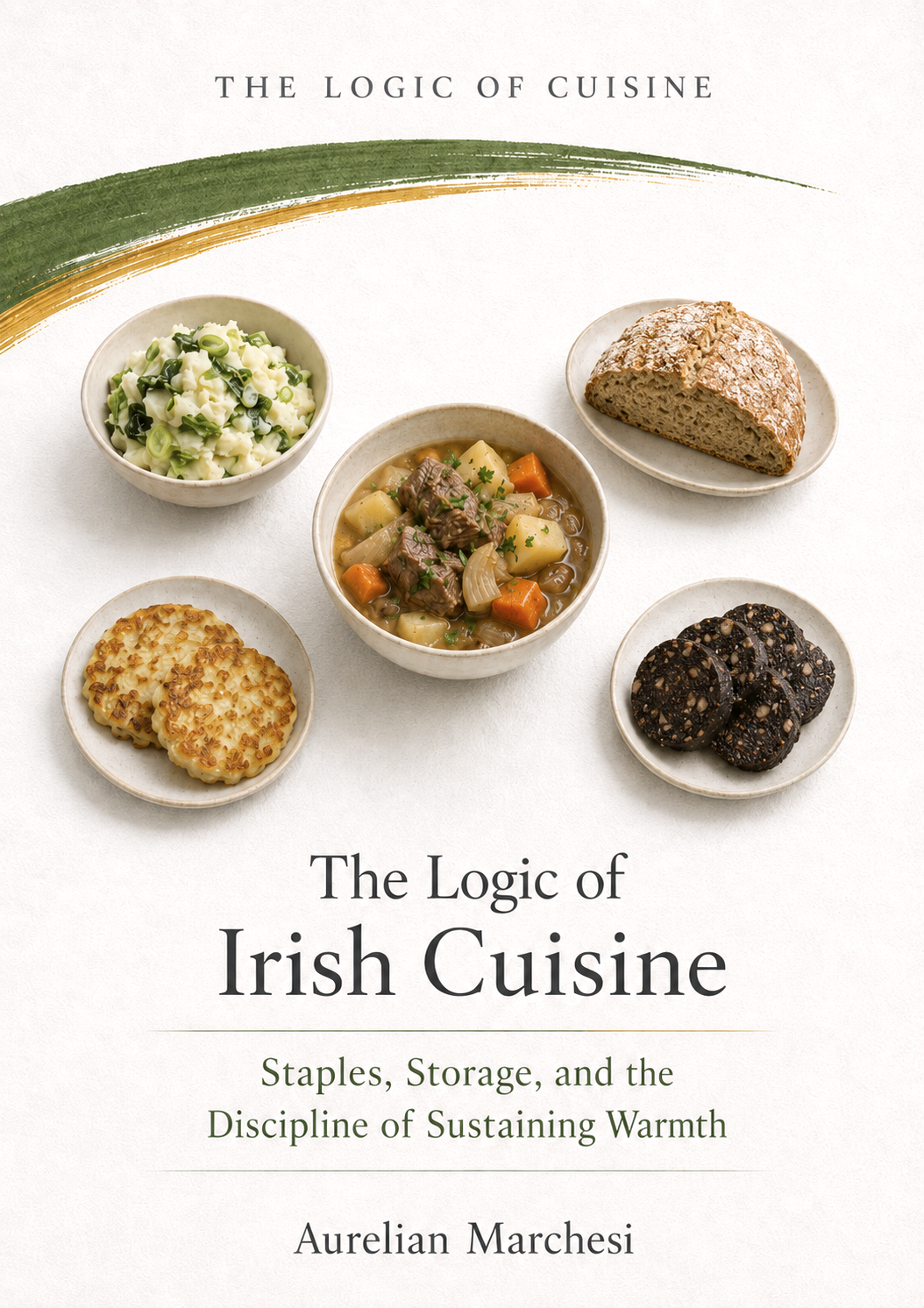
Cover of The Logic of Irish Cuisine

Book 19 · The Logic of Cuisine

The Logic of Irish Cuisine

Staples, Storage, and the Discipline of Sustaining Warmth

By Aurelian Marchesi

Warmth in Irish food is not only a temperature. It is duration: the heat held inside a potato, the density of oats, the slow release of a stew, bread that makes butter and broth carry farther. Short seasons, wet weather, maritime exposure, fuel economy, and storage narrow the field of action. The volume asks what intelligence becomes visible inside that narrowing. Staples supply ballast; preservation moves strength forward in time; moderate heat softens without wasting fuel; communal distribution turns a pot or plate into household continuity. What can be dismissed as plainness is examined as a refusal to spend resources on spectacle when they can be converted into nourishment that lasts.

The central question

How do staples, storage, butter, moderate heat, long simmer, and communal distribution transform cold-climate constraint into sustaining warmth and culinary continuity?

The book proposes that Irish simplicity is load-bearing. Potatoes, oats, barley, and bread absorb flavor, hold heat, and guarantee appetite. Butter binds and carries rather than merely decorates. Salting, curing, pickling, and cellar logic convert seasonal time into dependable reserves. Simmering and moderate browning conserve fuel while creating tenderness and depth. The communal plate then distributes these forms according to household need. Repetition is not emptiness but an architecture that keeps warmth, labor, and food available under constraint.

What this work explores

Staples hold heat and appetite

Potato, oats, barley, and bread are described through what they do. They absorb broth and fat, give a meal mass, carry salt, remain available through difficult weather, and release warmth slowly. The potato can change form—whole, diced into stew, mashed with butter, or griddled as a cake—without surrendering its anchoring function. Oats and barley add other textures and storage capacities. Their recurrence is therefore a record of material fitness: these foods repeatedly solve the problem of sustaining bodies when variety cannot be guaranteed.
Storage is deferred power

Short growing seasons make time a material problem. Salting, curing, pickling, drying, and cellar storage move food from moments of availability into months of need. The volume refuses to treat these practices as a romantic residue of poverty. They are technologies of continuity that protect the household from a volatile calendar. Preserved meats, grains, roots, and acidic accompaniments also give the cuisine concentrated accents capable of animating otherwise restrained staples.

Moderate heat refuses waste

Long simmer and measured browning convert resistant materials without demanding theatrical heat. A pot can tenderize meat, release starch, merge broth and vegetable, and retain warmth while conserving fuel. The objective is not maximal caramelization or refinement into uniform softness. Ingredients should yield enough to share flavor while remaining legible. Irish stew concentrates this principle: endurance is softened and distributed through liquid, roots, and time, producing depth through sufficiency rather than excess.

Distribution completes nourishment

A communal pot or plate encodes choices about who receives meat, broth, potato, bread, butter, or the crisp edge of a cooked dish. Satisfaction is routed through portions and accompaniments rather than assumed to reside in a single luxurious ingredient. At feast scale, additional richness must still remain attached to staples and relief or it becomes distortion. The household system survives because a familiar architecture can expand for ritual and contract again for daily use without losing its logic of shared warmth.

Store, anchor, transform, distribute

The analysis follows resources across time and household use. Climate and season establish the need for storage. Staples provide stable carrying capacity; butter, broth, cabbage, and salt create cohesion or relief; moderate heat and simmer turn durable ingredients into sustaining textures. Colcannon, soda bread, boxty, coddle, black pudding, and especially Irish stew appear as proofs of different conservation and distribution problems. The communal plate then reveals that culinary architecture is social as well as physical. Distortion occurs when excess replaces sufficiency or when caricature mistakes a limited ingredient field for lack of intelligence.

Place in the series

The Irish volume establishes a distinct British Isles logic before the series turns to Scottish, Welsh, Cornish, and Northern English systems. Its contribution is the disciplined continuity created by storage, staple ballast, moderate heat, and household distribution. Similar ingredients recur elsewhere in the islands, but this book resists treating them as one undifferentiated cuisine. It provides a basis for comparing how related climates and materials produce different architectures of warmth.