Primary act of organization
Irish structure foregrounds the anchor that extends; Scottish structure foregrounds concentration and its regulators; Welsh structure foregrounds continuity through pot, carrier, and recurring return.
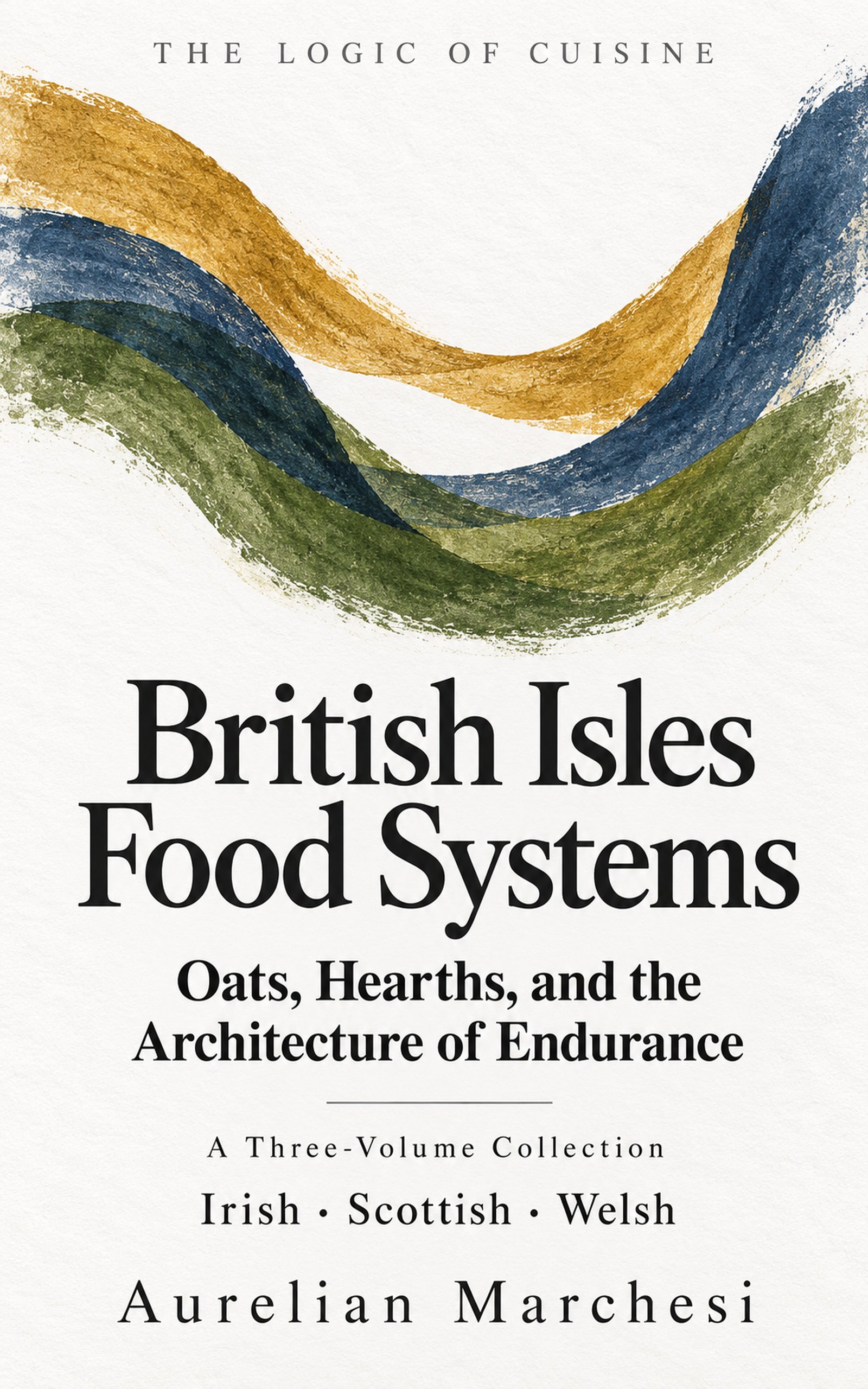
Collection 3 · The Logic of Cuisine
Oats, Hearths, and the Architecture of Endurance
By Aurelian Marchesi
‘Hearty’ names the visible weight of Irish, Scottish, and Welsh food but leaves its design unexplained. This collection asks how substantial materials become livable, shareable, and repeatable rather than merely filling.
Three neighboring systems turn endurance into pleasure through different architectures: Irish anchors give richness reach, Scottish compression gathers fragments into authority and then softens their force, while Welsh pot and tea table carry welcome through staggered household time.
Volume 1
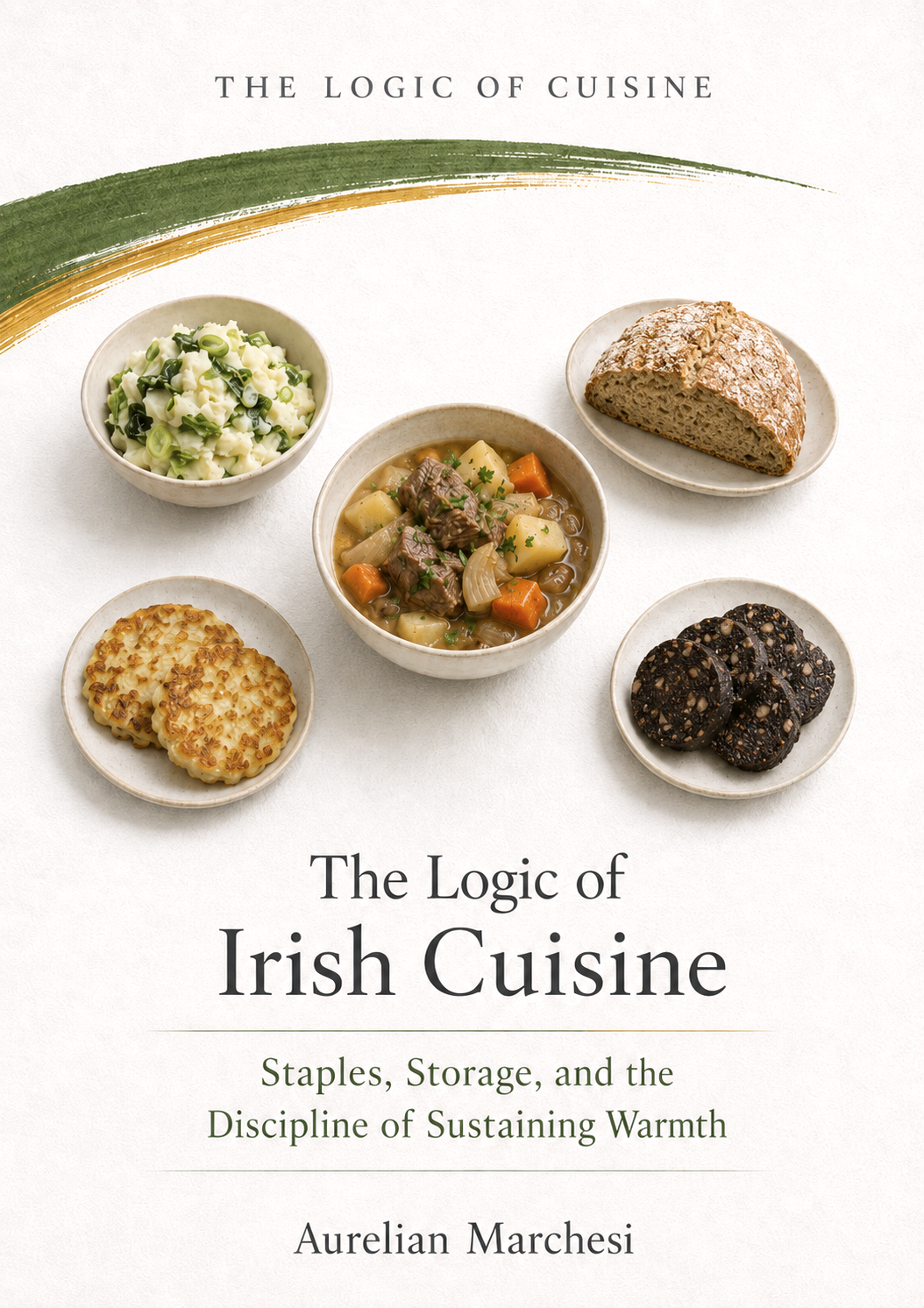
Irish cuisine establishes endurance through the anchor. Potato, oat, bread, broth, and dairy give concentrated meat, fat, or smoke enough reach to organize a meal beyond the prized component.
After Irish staples demonstrate how an anchor distributes richness, the sequence moves to Scottish forms that gather fragments and preserved depth into denser authority, then regulate that concentration.
Volume 2
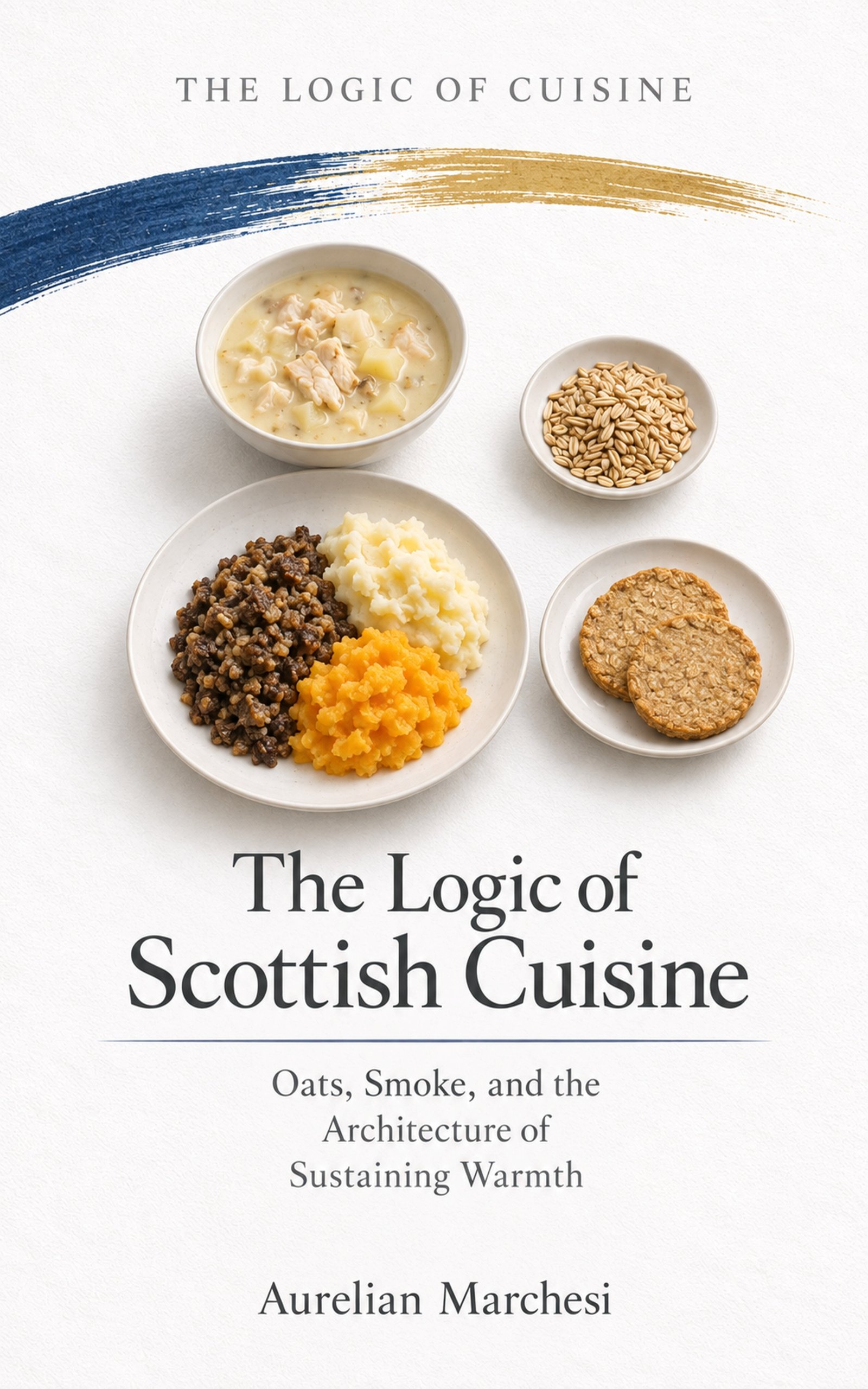
Scottish cuisine shifts from extension to concentrated authority. Oats, enclosure, offal, smoke, fish, mash, and broth show force being compressed, preserved, and then softened for return.
From Scottish compression and softening, the collection changes temporal scale. Welsh cuisine asks how pot, carrier, hearth, and baking can remain open to extension, reheating, and a later arrival.
Volume 3
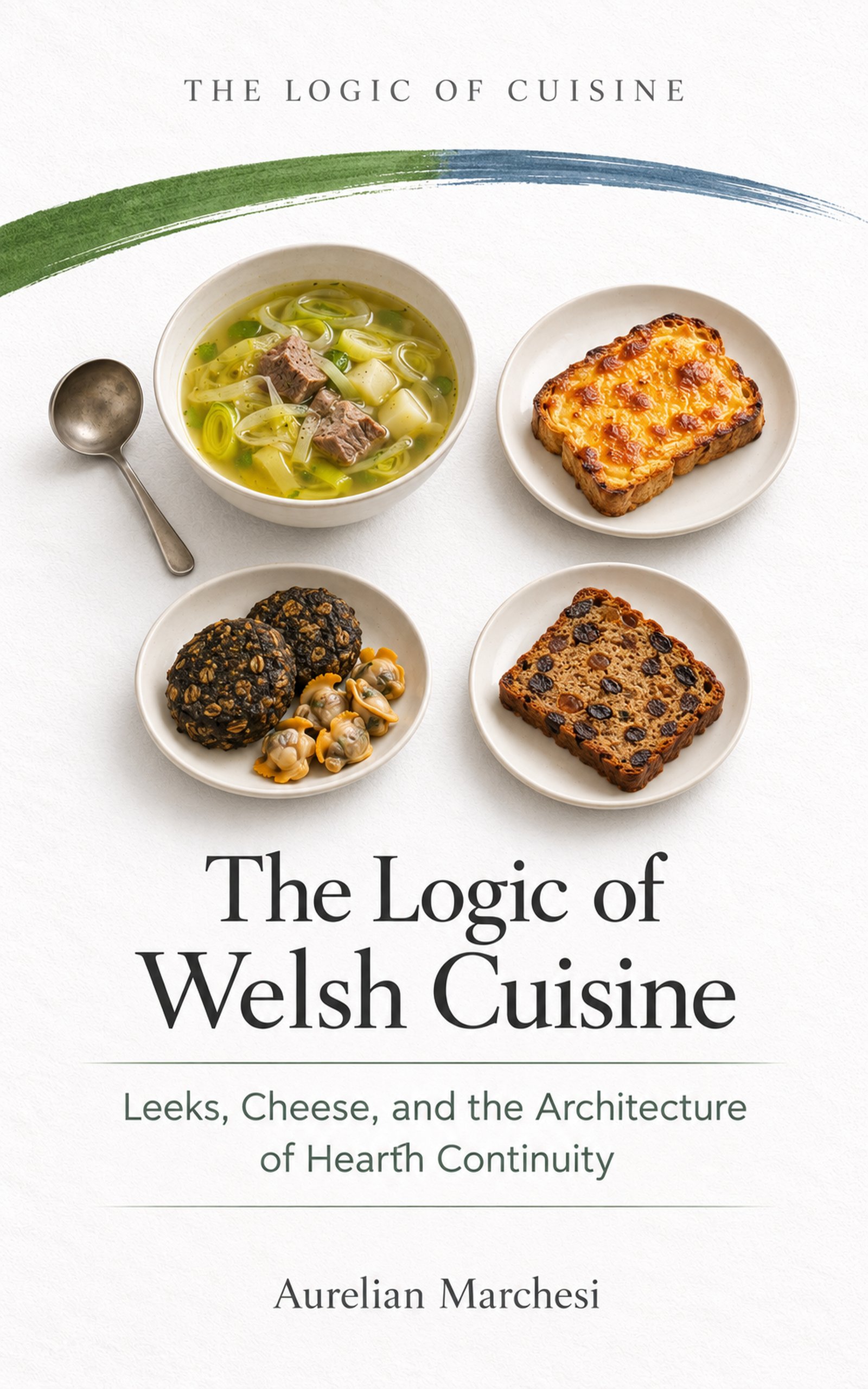
Welsh cuisine completes the movement through continuity. Cawl, bread, cheese, coastal correction, hearth, and tea-table baking keep nourishment and hospitality available across staggered household time.
Irish structure foregrounds the anchor that extends; Scottish structure foregrounds concentration and its regulators; Welsh structure foregrounds continuity through pot, carrier, and recurring return.
Density remains livable through staple distribution in Ireland, through alternating compression and liquid or soft relief in Scotland, and through forms able to wait, evolve, and reappear in Wales.
Hospitality progresses from feeding reach, through portionable shared authority, to an explicitly continuous hearth-and-tea rhythm. Access and return matter more than display alone.
The canonical order changes the reader's account of endurance. Irish cuisine begins with an anchor that stretches nourishment through a meal. Scottish cuisine makes force more concentrated, then shows the devices that prevent compression from becoming fatigue. Welsh cuisine extends endurance across household time, keeping pot, bread, cheese, and baking available for return. The movement is from reach, through regulated authority, to continuity—not from simplicity to complexity and not toward a single British Isles essence.
The collection replaces a generic idea of British-and-Irish heartiness with three complete arguments about endurance whose recurring ingredients sharpen rather than erase difference.
Endurance needs a carrier. In the Irish volume, potato, oat, bread, dairy, and broth extend concentrated richness so a limited prized element can reach the meal. Scottish oats, enclosure, smoke, mash, and liquid compress or soften intensity under cold and storage pressure. Welsh cawl, bread, cheese, hearth, and tea-table baking keep food available for return. The recurring materials are therefore not proof of one “hearty” cuisine. Their jobs reveal three different structures: an anchor that gives reach, forms that gather and regulate force, and a household rhythm that holds welcome open through time.
Hospitality becomes infrastructure when a form can feed beyond the ideal synchronized table. An Irish anchor lets broth, dairy, meat, or fat travel through staples to more people. Scottish compressed forms can be portioned and shared, while soups and mash make concentrated food livable in larger encounters. A Welsh pot can accept another ingredient or another arrival; a loaf or cake remains available later in the day. Generosity is therefore measured not only by feast size but by extension, portionability, waiting, and return—the practical conditions that let nourishment remain accessible under ordinary pressure.
Coastal materials alter each system without erasing its inland grammar. Irish fish and sea products meet potatoes, bread, dairy, broth, and established meal anchors. Scottish smoke transforms vulnerable fish into stored authority, then Cullen skink releases it through potato, milk, and liquid. Welsh laverbread, cockles, and mussels enter a domestic field organized by bread, bacon, cawl, and hearth, bringing saline correction rather than a separate seafood cuisine. The coast is comparative evidence because storage, warmth, carrier, and table position give marine materials a different role in each volume.
Irish stew and black pudding, haggis and Cullen skink, cawl, rarebit, and bara brith are tests of structure rather than a parade of emblems. The Irish examples show anchor and extension; the Scottish pair contrasts compressed authority with softened smoke; the Welsh examples move from a continuing pot to transformed cheese and tea-table time. Named dishes matter only when their carrier, moisture, enclosure, preservation, or capacity for return is explained. They let the reader recognise three forms of endurance while preventing “comfort food” from becoming the collection's only analytical language.
Read from visible weight to the system that makes it livable. Ask what carries substance, what concentrates it, what softens or corrects it, how the form can be divided or extended, and over what span of time hospitality remains available. Irish cuisine answers through anchors and reach; Scottish cuisine through compression, preservation, and regulating softness; Welsh cuisine through pot, carrier, hearth, and return. The framework integrates the themes by holding endurance constant while locating its work differently. It also prevents oats, potatoes, dairy, broth, or fish from being treated as a shared identity merely because they recur.
Within The Logic of Cuisine, this collection replaces “heartiness” with three inspectable architectures of endurance. It shows how neighboring traditions can share oats, potatoes, dairy, broth, fish, and weather pressure while locating nourishment in anchor, compression, or continuity. Its comparative role is to sharpen those differences and to make hospitality legible as material access, portioning, waiting, and return rather than as sentiment alone.