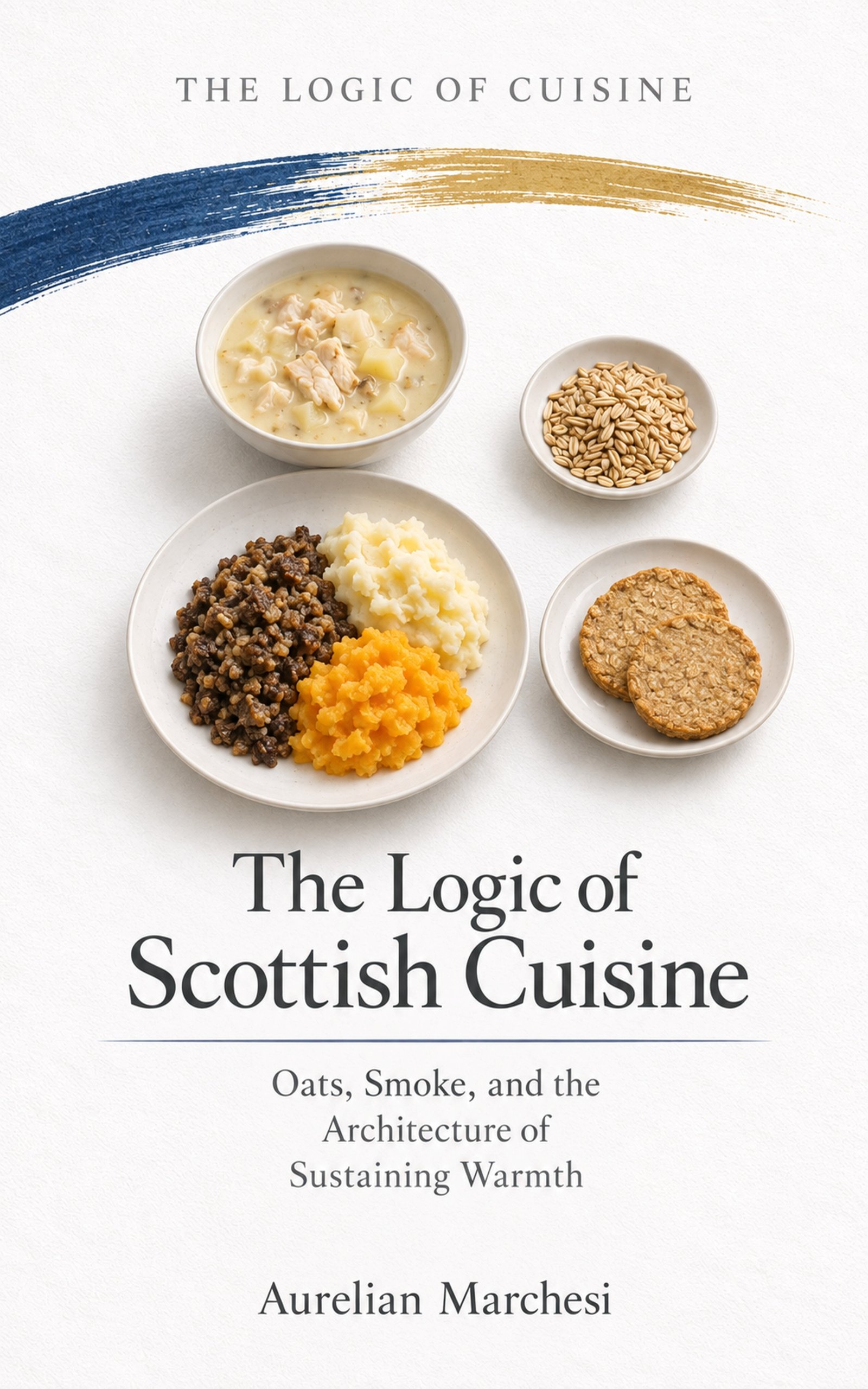
Cover of The Logic of Scottish Cuisine

Book 20 · The Logic of Cuisine

The Logic of Scottish Cuisine

Oats, Smoke, and the Architecture of Sustaining Warmth

By Aurelian Marchesi

Scottish food is often reduced to a few dense emblems, as if severity were an aesthetic preference. This volume begins instead with damp cold, work, thin soils, uneven supply, and the need for food that can wait without surrendering its warmth. Thick broth, enclosed forms, mash, oats, and smoke emerge as practical answers to that pressure. The editorial question is not why the cuisine is heavy, but how concentrated grain, offal, fish, fat, and preserved flavour are made repeatable. Density becomes sustaining warmth only when the system can carry it, soften it, share it, and make the eater willing to meet it again.

The central question

How does a cuisine built for cold, labour, distance, and uneven supply turn concentrated grain, offal, smoke, and fat into meals people can welcome repeatedly?

Scottish cuisine is read here as an architecture of sustaining warmth. Oats and potatoes provide ballast, absorb fat, thicken liquid, and bind fragments into usable forms. Salt, air, drying heat, and smoke convert a vulnerable catch into food able to wait. Haggis compresses offal, oat, fat, and seasoning into sliceable authority, while Cullen skink releases preserved fish into potato, milk, and broth. Mash, onions, greens, dairy, and grain-thickened liquids do not negate that concentrated core; they route it across the meal so endurance does not harden into fatigue.

What this work explores

Oats as load-bearing structure

Oats are not a polite accompaniment but a dependable material with several working states. With more water and gentle heat they soften into porridge or thicken broth; toasted with fat and onion they retain texture and carry scarce roast flavour; inside haggis they absorb rendered fat, bind irregular fragments, and make offal sliceable. The same grain can therefore expand, contain, or distribute richness according to moisture and heat. Potatoes and barley extend this ballast system by holding warmth and giving smoke, meat, or broth somewhere to land. Grain and root are the conditions that let stronger elements feed many people without becoming either wasteful or blunt.
Smoke as stored time

At the coast, a heavy catch creates a race against spoilage. Salt draws water outward and firms flesh; moving air and low drying heat reduce the moisture on which decay depends; smoke deposits an aromatic surface while giving the preserved fish a sensory identity. The flavour is therefore a record of transformed perishability, not an ornamental finish. Preservation also changes later cooking: a smoked fish carries concentrated salt and aroma that need liquid, potato, or dairy to become a full meal. Smoke stores time, but the cuisine must still decide how that stored force will be released when it returns to the table.

Two answers to concentration

Haggis and Cullen skink are complementary tests of concentration. Haggis begins with unstable fragments—offal, trimmings, fat, oat, spice—and subjects them to enclosure and slow cohesion until the mixture can be cut, portioned, and shared. Cullen skink begins with fish already concentrated by smoke and moves in the opposite direction: potato, milk, onion, and broth spread that authority through a bowl. One makes thrift publicly legible through compression; the other makes preserved intensity welcome through softening. Read together, they prevent either enclosure or soup from being mistaken for the single definition of Scottish cuisine.

Softness regulates force

Mash, broth, dairy, onions, greens, and grain-thickened liquids are active regulators of force. A mass of mash retains heat at its core while receiving drippings; broth gives salt and smoke room to travel; onions add moisture and sweetness; dairy rounds preserved fish without erasing it; greens or turnips create intervals around dense protein and grain. These devices do not make the core less Scottish by diluting it. They protect the eater's willingness to return. The cuisine's balance is measured by whether concentrated food remains desirable across a bowl, a plate, a day, and the next encounter.

Everyday logic in collective time

Collective occasions enlarge an everyday grammar rather than replacing it. Burns Night places haggis at the emotional centre because its ordinary form is already able to hold, slice, travel to the table, and feed a group. Hogmanay, pies, bakery forms, and other public foods similarly scale compression, sharing, and return. Ceremony adds procession, memory, and symbolic attention around structures that remain materially familiar. This relation keeps identity from becoming costume: the ritual dish is credible because oats, enclosure, smoke, preserved depth, and soft regulators already organize weekday nourishment. Public time makes that architecture visible without inventing a separate festive cuisine.

The sustaining-warmth test

The sustaining-warmth test reads each form through four connected operations. First, identify the durable carrier—oat, barley, potato, crust, or thickened liquid—that holds heat and distributes substance. Next, locate the concentrated authority, whether offal, fat, smoke, fish, or long-cooked meat. Then ask how time is stored through enclosure, drying, salting, smoke, or reheating. Finally, identify the soft or liquid route that keeps concentration livable. The framework explains why haggis, skirlie, stovies, pies, broth, and Cullen skink can look unlike one another while answering the same pressure field. It is an interpretive model, not a universal claim about Scottish life.

Inside the work

Pressure before preference

The opening movement replaces the vague label of heaviness with a pressure field: damp cold, work, thin soils, fuel, storage, and delayed eating. It establishes why retained heat, durable carriers, and forms that survive waiting become prior decisions.

Structural ingredients

The argument then follows oats, barley, potatoes, offal, fish, salt, air, drying heat, and smoke through the jobs they perform. Materials become culinary structure when they bind fragments, store time, carry fat, or preserve a brief abundance.

Benchmark forms

Full readings of haggis and Cullen skink test two different solutions. Inland compression turns fragments into sliceable authority; coastal softening releases smoked intensity into a bowl. Their contrast clarifies the regulating work of mash, broth, dairy, onions, and greens.

Meal, ritual, and travel

The closing movement widens from meal architecture to Burns Night, Hogmanay, portable bakery forms, cliché, and travel. It asks which relations remain recognizable when scale, setting, or ingredients change, and why function must survive the name.

Place in the series

Within The Logic of Cuisine, this volume gives density a precise internal standard. It shows that substantial food is not explained by weight alone: grain and root carry, smoke stores time, enclosure compresses, liquid releases, and soft regulators preserve appetite. That combination separates Scottish sustaining warmth from Irish anchor-and-extension, Welsh hearth continuity, Cornish portability, and Northern English industrial burden-sharing. The book's contribution is therefore not another regional example of “hearty food,” but a model for reading how concentrated forms remain shareable, repeatable, and welcome under cold, work, and collective time.