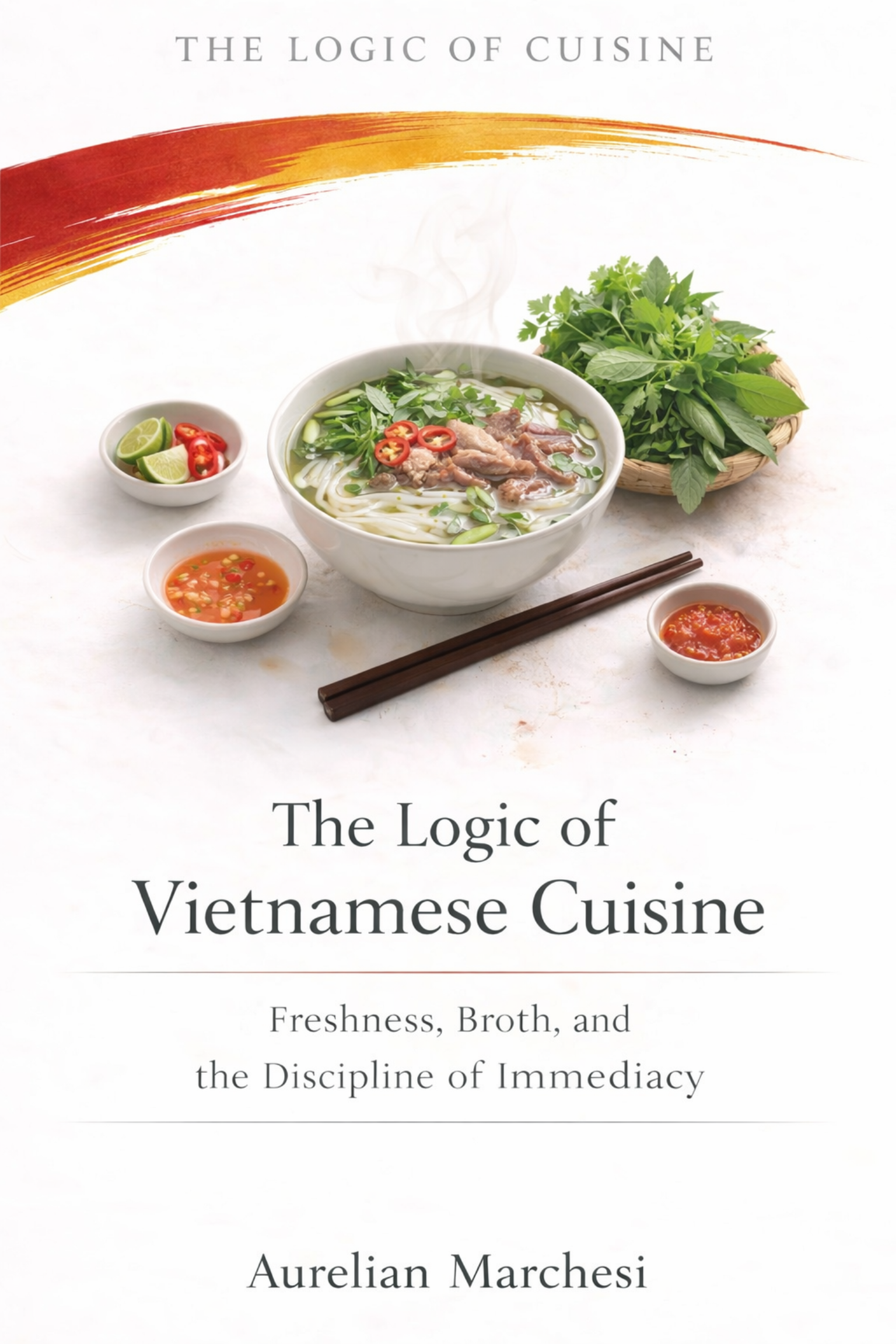
Cover of The Logic of Vietnamese Cuisine

Book 12 · The Logic of Cuisine

The Logic of Vietnamese Cuisine

Freshness, Broth, and the Discipline of Immediacy

By Aurelian Marchesi

Freshness is easy to praise and harder to explain. In this volume it is not a decorative virtue but a narrow interval that must be protected. Heat and humidity shorten the life of ingredients; a heavy meal continues to burden the body after appetite should have returned. Vietnamese cuisine answers by making timing visible. Broth carries depth without coating, herbs remain alive because they enter late, acid sharpens and releases, and rice or noodles provide enough calm for intensity to pass through. A bowl or plate can feel complete without feeling closed. The book explores that achievement as a discipline of immediacy: not haste, but a precise control of how long aroma, heat, texture, and richness are allowed to remain.

The central question

How can a cuisine create satisfying depth under tropical volatility while preserving freshness, legibility, and the bodily invitation to eat again?

The volume argues that Vietnamese lightness is produced by active controls rather than by absence. Broth extracts and distributes depth; herbs and aromatics keep volatile character through late timing; acid creates definition and then recedes; sweetness steadies sharper forces; noodles and rice buffer without muting. Assembly near the moment of eating preserves distinctions that prolonged holding would erase. The cuisine's coherence lies in letting each component arrive clearly, do its work, and leave room for the next sensation.

What this work explores

Volatility sets the clock

The manuscript begins from an environment in which delay has consequences. Warmth accelerates spoilage, while dense fat and long holding can make food feel tired before it reaches the table. Markets, street kitchens, and home assembly respond by compressing the interval between preparation and eating. This does not produce carelessness. It demands that materials be staged so a meal can be completed quickly without losing order. Immediacy becomes an operating condition that shapes texture, temperature, portion, and the division between prepared foundations and last-moment additions.
Broth makes depth mobile

Broth offers a way to carry simmered, aromatic, and savory information without turning it into a heavy sauce. Its fluidity matters as much as its flavor. It warms, distributes, and releases rather than clings indefinitely. In noodle soups, the broth joins starch, protein, herbs, and condiments while allowing each to remain perceptible. The book treats this clarity as constructed: extraction must be sufficient to satisfy, yet the resulting depth must still leave space for fresh elements introduced at service.

Freshness depends on sequence

Herbs, citrus, crisp vegetables, and aromatic leaves retain their identity because they are not asked to survive every stage of cooking. Their late arrival is structural. A herb can lift steam, a squeeze of acid can draw a boundary around broth, and a raw texture can interrupt softness precisely because heat has not already absorbed them. The volume therefore shifts attention from ingredient possession to timing. Freshness is the sensory record of something introduced at the point when its most volatile qualities can still be read.

Balance clears rather than settles

Fish-sauce salinity, sweetness, sourness, chili, broth, and starch are not driven toward one thick equilibrium. They are calibrated so the mouth can distinguish tension and release. Sweetness stabilizes an acid or salty edge without becoming the destination; rice and noodles absorb enough intensity to make another bite possible; herbs reopen aroma after cooked depth. Satisfaction arrives through movement. The meal feels light not because it lacks force, but because force does not remain trapped on the palate.

Control by timing and release

The work reads Vietnamese food through the lifespan of sensations. Climate establishes a short working window; prepared broths and other foundations hold depth; final assembly introduces fragile aromas and textures only when they can be perceived; acid, sweetness, starch, and herbs govern how quickly intensity clears. Pho, noodle bowls, salads, and street foods become evidence of different solutions to the same problem rather than a list of specialties. The reader learns to ask when an element enters, what it carries, and how it leaves the palate. That temporal framework explains why apparent delicacy can rest on considerable preparation and discipline.

Place in the series

This volume gives The Logic of Cuisine a distinct model of control: where some cuisines preserve by extending time, Vietnamese cuisine often protects coherence by shortening exposure and staging assembly. Its Southeast Asian neighbors share tropical pressures, rice anchors, fermentation, and trade, yet this book places unusual emphasis on broth clarity, volatile herbs, and immediate release. That makes it central to the series' comparison of how depth can be built without weight.