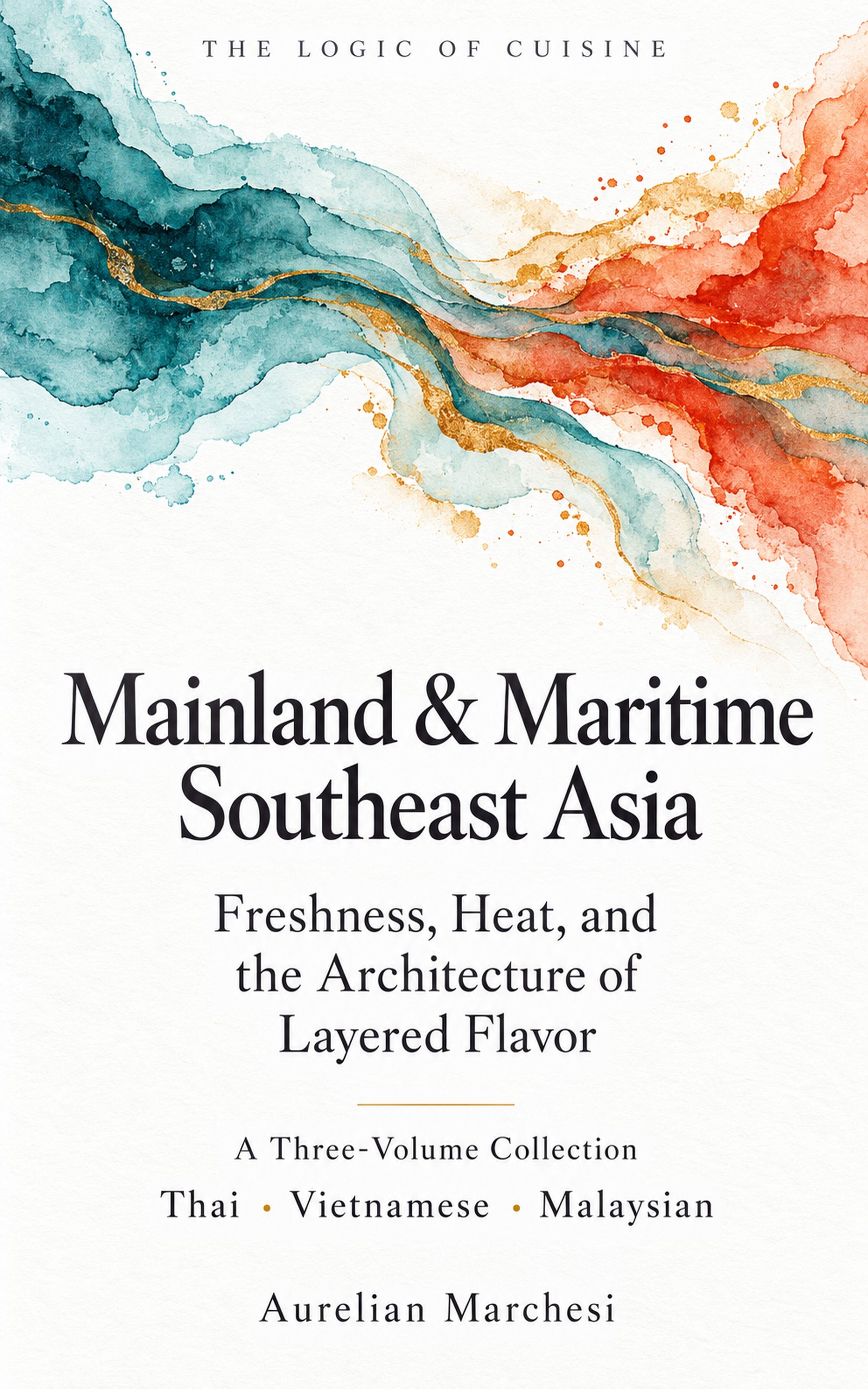
Cover of Mainland & Maritime Southeast Asia

Collection 5 · The Logic of Cuisine

Mainland & Maritime Southeast Asia

Freshness, Heat, and the Architecture of Layered Flavor

By Aurelian Marchesi

Coming Soon

Fresh, spicy, and complex are impressions, not explanations. Thai, Vietnamese, and Malaysian cuisines produce layered flavour through different distributions of work: across a shared table, beneath a late layer of herbs, or inside a paste built before it meets fire and liquid.

The collection thesis

The collection argues that layered flavour is organized rather than accumulated. Thai cuisine coordinates contrast across the meal, Vietnamese cuisine makes freshness depend on prepared depth and late immediacy, and Malaysian cuisine gathers aromatics into pastes and sambals that establish depth before final assembly.

The three-volume progression

  1. Volume 1

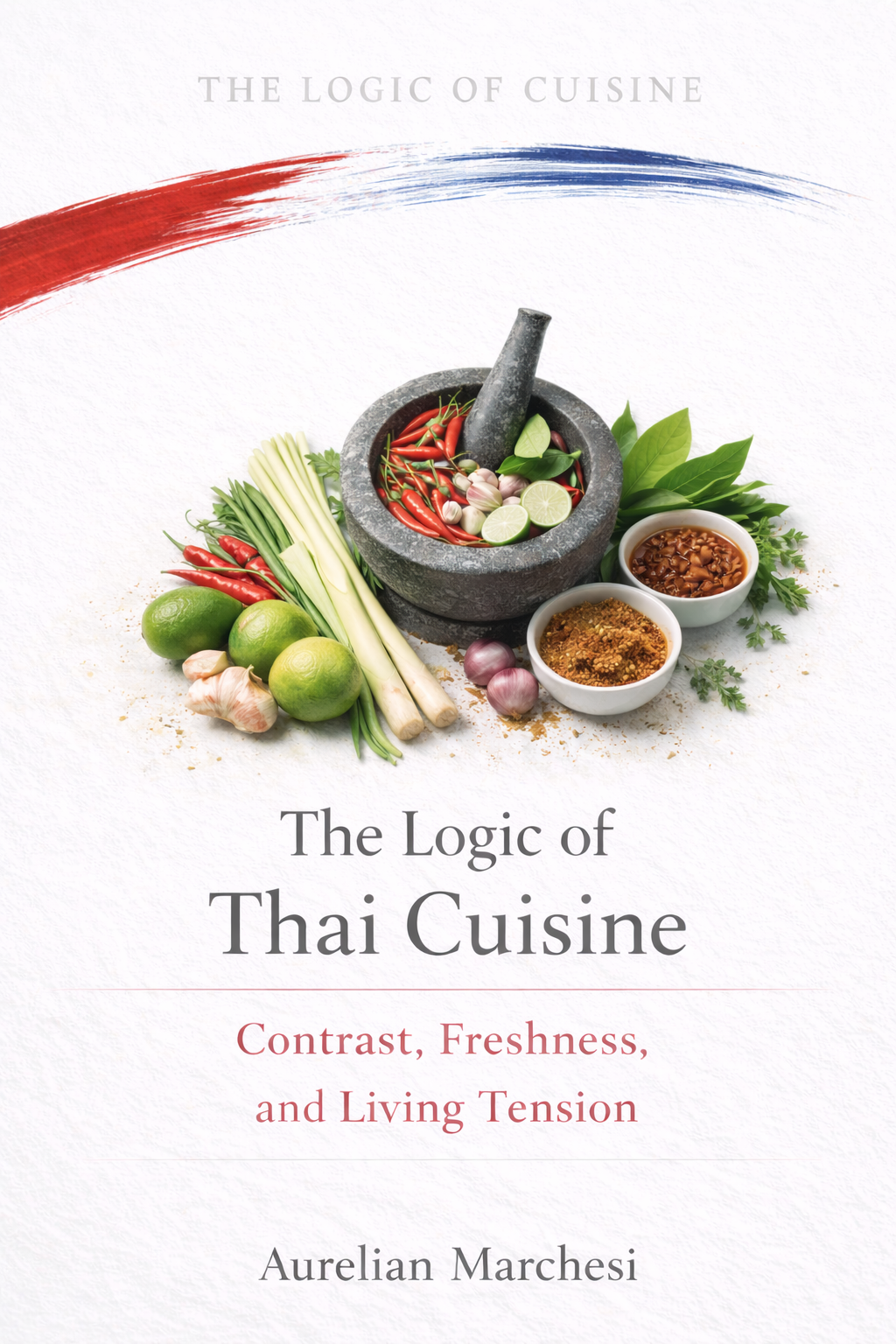
    Cover of The Logic of Thai Cuisine

    The Logic of Thai Cuisine

    Contrast, Freshness, and Living Tension

    Thai cuisine opens at table scale. Rice and shared eating stabilize contrasts among dishes, while acid, herbs, fermentation, heat, and other forces let balance emerge beyond any single preparation.

    From contrast distributed across a Thai shared meal, the sequence narrows to the Vietnamese assembled form, where prepared depth and late freshness must meet without cancelling one another.

  2. Volume 2

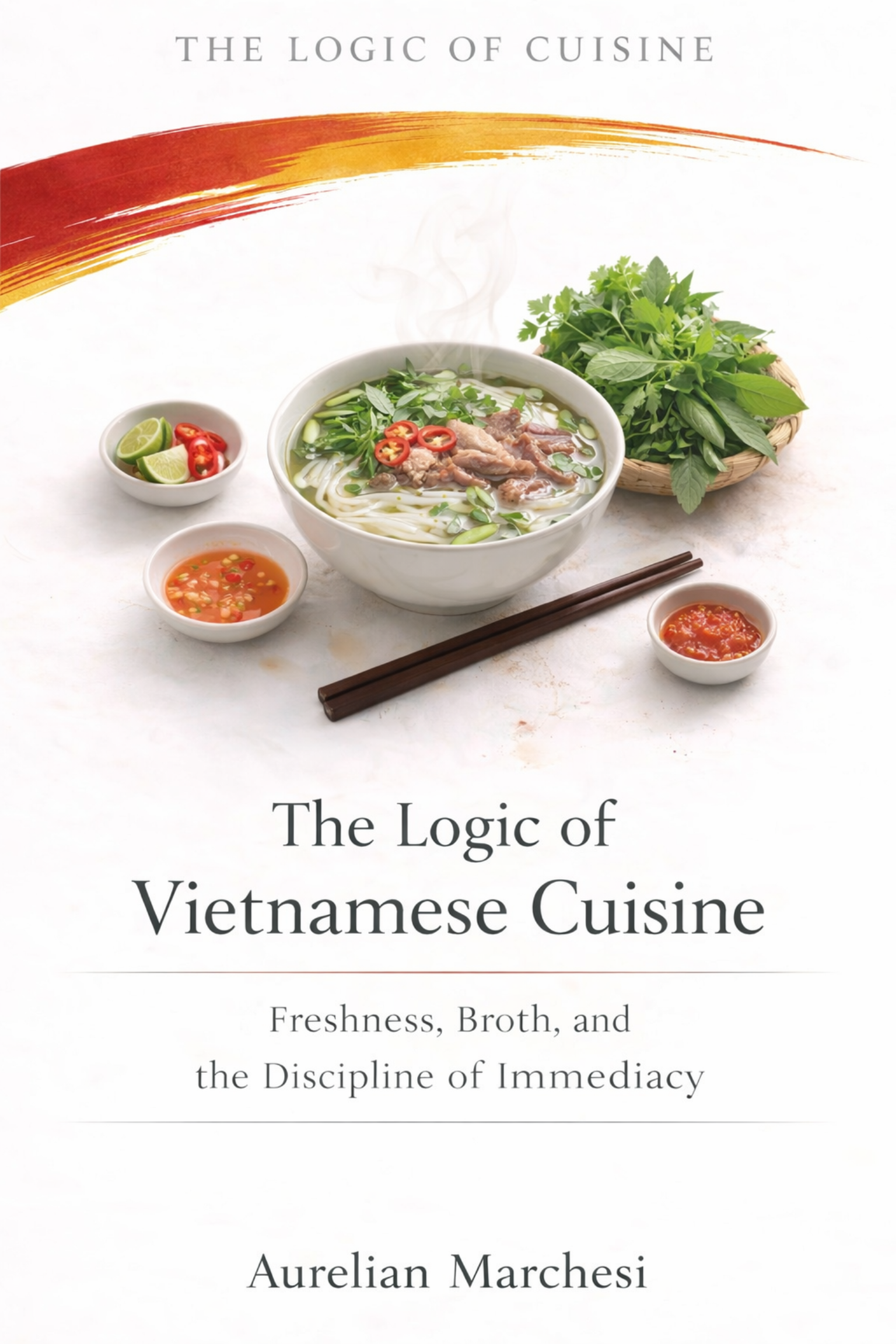
    Cover of The Logic of Vietnamese Cuisine

    The Logic of Vietnamese Cuisine

    Freshness, Broth, and the Discipline of Immediacy

    Vietnamese cuisine changes the temporal focus. Broth and other preparations can hold long labour, while noodles, bread, herbs, vegetables, and final assembly release freshness at the moment of eating.

    It then moves upstream from the final moment of freshness to Malaysian paste work, locating complexity in an aromatic foundation organized before the finished dish takes shape.

  3. Volume 3

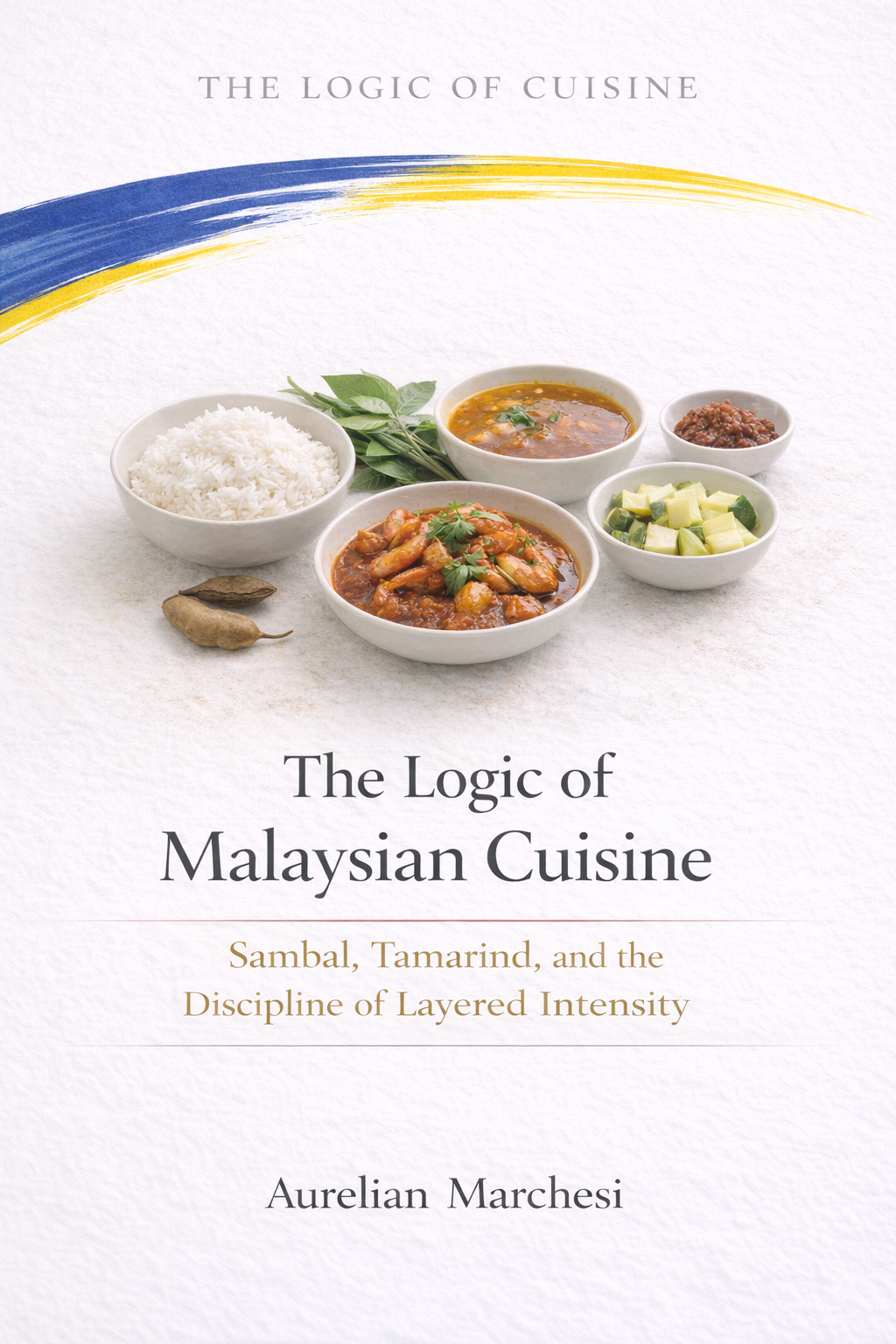
    Cover of The Logic of Malaysian Cuisine

    The Logic of Malaysian Cuisine

    Sambal, Tamarind, and the Discipline of Layered Intensity

    Malaysian cuisine completes the movement by going upstream to pastes and sambals. Aromatics are gathered into a foundation before fire, liquid, coconut, rice, noodles, and later assembly distribute their depth.

Comparative framework

Primary scale of balance

Thai balance is especially visible across the shared meal; Vietnamese balance is visible in the bowl or carrier where prepared and fresh layers meet; Malaysian balance is visible in the foundation capable of generating several finished forms.

Where preparation hides

Work is distributed among coordinated dishes, stored beneath herbs in broth and preparation, or concentrated in paste before final cooking. Similar sensory complexity arises from different production sequences.

Role of the carrier

Rice and noodles stabilize a field of contrasts, receive broth and late freshness, or carry paste-built depth. Their recurrence sharpens the change in function rather than proving a common cuisine.

The reader moves from a social field to a final assembly and then upstream to a prepared foundation. Thai cuisine first makes balance visible among dishes and diners. Vietnamese cuisine concentrates attention on the moment when accumulated depth meets fresh elements. Malaysian cuisine reveals how part of that complexity can be organized before heat and liquid complete it. The progression changes the location of analytical attention without ranking the cuisines, claiming direct descent, or extending the comparison beyond the selected three studies.

The collection replaces broad regional adjectives with three differentiated accounts of culinary work, while explicitly limiting its comparison to the selected Thai, Vietnamese, and Malaysian studies.

What this collection explores

Carriers make intensity readable

Rice and noodles are carriers because they give broth, paste, acid, herbs, and heat somewhere to land while keeping those forces distinguishable. At a Thai shared table, rice stabilizes contrast among several dishes rather than passively sitting beside one. In Vietnamese bowls and carriers, noodles, rice, or bread receive long-prepared depth and late freshness in a timed assembly. In Malaysian systems, rice or noodles accept paste-built intensity after aromatics have been concentrated through oil, fire, liquid, and other ingredients. A common staple therefore reveals different scales of balance: meal, assembled form, and prepared foundation.

Freshness is produced

Freshness is produced by preparation rather than by the absence of labour. Thai herbs, acid, and crisp elements enter a meal whose contrasts have already been coordinated across dishes. Vietnamese freshness can arrive late over broth that has held long work, or through vegetables and herbs arranged so their immediacy remains legible at service. Malaysian pastes reverse the visible sequence: aromatic depth is assembled earlier, allowing later acid, herbs, or accompaniments to open the finished form. The collection asks where labour is stored and when freshness is released, preventing “fresh” from becoming a vague regional adjective.

Heat belongs to an arrangement

Heat becomes meaningful only through its arrangement. At the Thai table it is one force among acid, sweetness, fermentation, rice, and shared choice; its intensity can be redistributed between dishes and bites. In Vietnamese forms, broth, carrier, herbs, and late assembly determine whether heat supports or obscures freshness. In Malaysian cuisine, paste and sambal gather heat with aromatics before coconut, liquid, acid, rice, noodles, or final accompaniments place it. Comparison therefore follows regulation and sequence rather than ranking the cuisines on a single spicy scale.

Selection is not regional totality

Tom yum and som tam, phở, bún bowls and bánh mì, nasi lemak and assam laksa are evidence for selected mechanisms, not a regional inventory. The Thai examples show contrast coordinated across dish and table; the Vietnamese examples show prepared depth meeting late assembly; the Malaysian examples show aromatic foundations generating layered finished forms. Their recognisability helps a reader test carrier, broth, paste, acid, heat, and timing. The selection remains explicitly limited to three complete studies and does not claim to represent every mainland or maritime Southeast Asian food tradition.

Locate the work beneath the layer

Locate where the work beneath layered flavour is stored. Ask what rice or noodles carry, when depth is prepared, when freshness enters, how heat is regulated, and whether balance belongs principally to one dish, the sequence of assembly, or the table as a whole. Thai cuisine foregrounds a social field of contrasts; Vietnamese cuisine foregrounds the meeting of long-prepared depth and late immediacy; Malaysian cuisine foregrounds aromatic concentration before final cooking and assembly. The framework integrates the comparison without treating similar ingredients as the same system and keeps the selected three-cuisine scope explicit.

Place in the series

Within The Logic of Cuisine, this collection demonstrates that broad sensory labels become useful only when their production is located. “Fresh,” “spicy,” and “complex” are resolved into carriers, preparation order, table scale, broth, paste, acid, heat, and moments of contrast. Its comparative role is to show three distinct architectures of layered flavour while keeping Thai, Vietnamese, and Malaysian systems complete and the collection's regional scope explicitly limited.