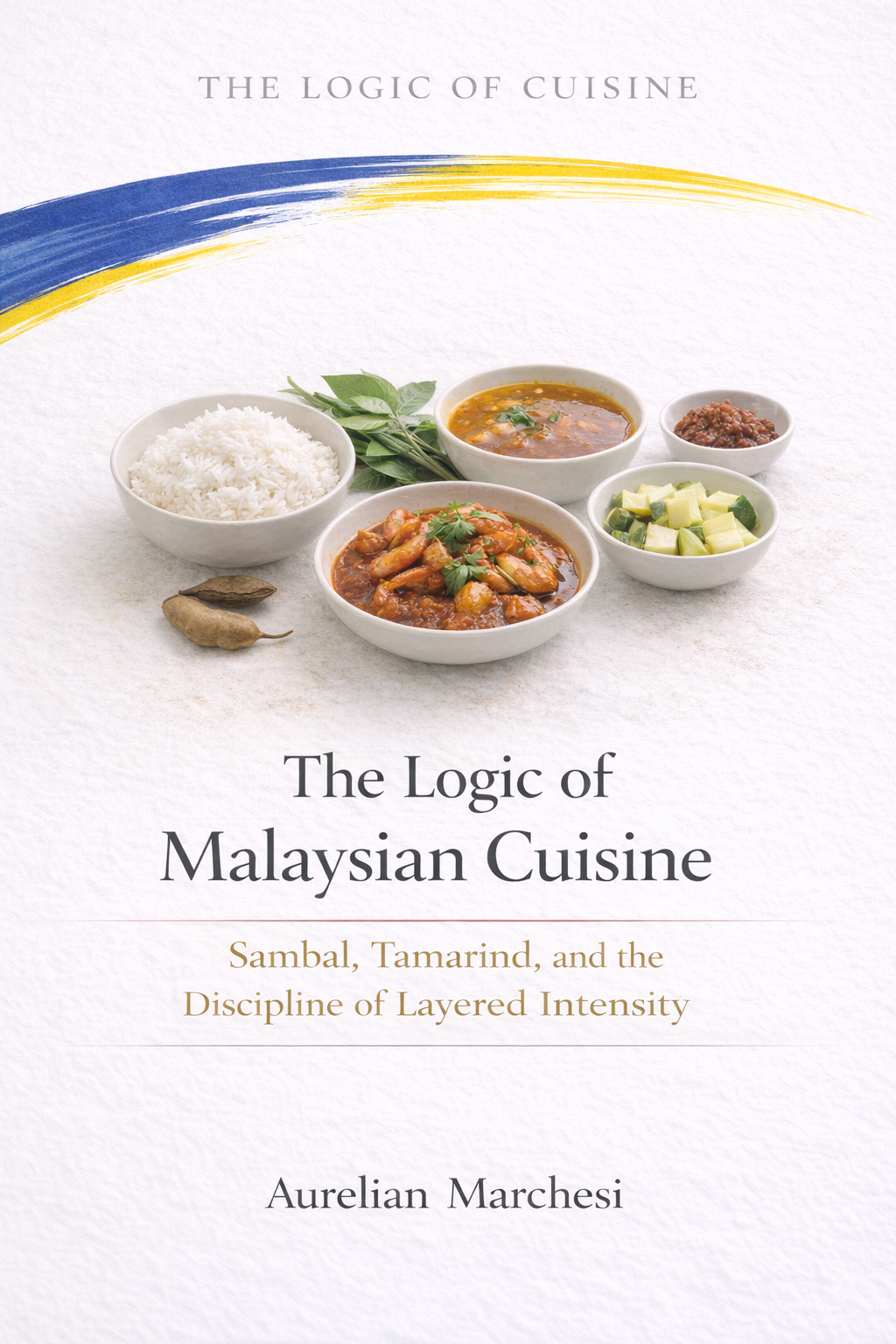
Cover of The Logic of Malaysian Cuisine

Book 16 · The Logic of Cuisine

The Logic of Malaysian Cuisine

Sambal, Tamarind, and the Discipline of Layered Intensity

By Aurelian Marchesi

At a Malaysian hawker center, coherence is not supplied by a single kitchen or inherited sequence. Smoke, broth, rice, noodles, sambal, coconut, fermented savor, and sharp tamarind may arrive from different stalls, yet the meal can still hold. The volume locates that stability in a grammar stronger than the diversity of its components. Rice anchors; pastes compress depth; fire, frying, simmer, and reduction transform; coconut cushions selectively; acid and herbs reopen the palate. Port circulation and cultural layering do not disappear from the story, but neither are they allowed to stand in for explanation. The question is how a cuisine under tropical and commercial pressure regulates intensity so variation remains recognizable and daily appetite survives it.

The central question

How does Malaysian cuisine absorb port circulation, tropical volatility, and multiple culinary lineages while keeping layered intensity anchored, breathable, and repeatable?

The work argues that Malaysian complexity is governed by a hierarchy of anchors and corrections. Rice stabilizes the plate; fermented pastes and sambal provide concentrated backbone; tamarind, lime, herbs, and raw accompaniments interrupt density; coconut carries flavor but must remain regulated; hawker modularity permits speed and choice without surrendering a common grammar. Layering becomes coherent when every force has a counterforce and every branch returns to a stable center.

What this work explores

Rice creates a common center

When sauces, sambals, fried elements, grilled proteins, pickles, and coconut-rich preparations compete for attention, rice supplies a stable measure. It absorbs oil and concentrated seasoning, extends small amounts of intense food, and allows the eater to regulate each bite. Its importance is especially clear in a plural system: dishes may reflect different lineages, but their relationship to rice creates a shared meal logic. Nasi lemak becomes a focused proof of how a rice center can coordinate fat, heat, salt, crunch, and correction.
Pastes and heat build the backbone

Sambal and other paste structures concentrate aromatic, fermented, salty, sweet, and hot elements before they meet the rest of the dish. Their treatment through fire, frying, broth, or reduction determines whether intensity remains sharp, smoky, rounded, or deep. Transformation is not a generic application of high heat. Each engine releases a different possibility from the base, and the manuscript attends to the point where a paste stops tasting like separate ingredients and begins to carry the dish as one structural force.

Acid and herbs reopen layered richness

Tamarind and lime are not interchangeable sour notes, but both can place boundaries around coconut, oil, smoke, and fermented depth. Herbs add a more volatile lift, while crisp vegetables and condiments alter texture and temperature. These corrections preserve appetite in heat and allow successive forms of intensity to remain distinct. Assam laksa provides the sharpest test: broth, fish, sourness, aromatics, and noodles remain suspended in productive tension rather than merging into a heavy center.

Hawker modularity turns speed into order

Urban service fragments production across specialized stalls and compresses the time available for choice and assembly. Rather than treating that speed as a threat to integrity, the book reads specialization as a modular advantage. Rice plates, noodle dishes, breads, broths, grilled foods, and drinks can coexist because each follows a legible internal form and the diner can construct a meal among them. Repetition under commercial pressure reinforces recognizable structures, making the hawker environment a daily system rather than a spectacle of miscellaneous fusion.

Anchored pluralism under tropical pressure

The volume begins with heat, humidity, port movement, and material hierarchy, then identifies rice as the first stabilizer. Paste, fire, broth, frying, and reduction build concentrated forms; acid, coconut, herbs, and accompaniments determine whether they remain breathable. Nasi lemak and assam laksa serve as contrasting proofs—one coordinated around a rice center, the other holding intensity in a sour aromatic broth. Hawker modularity then shows the grammar operating across specialized urban production. The framework interprets plurality through repeated functions instead of reducing it to a list of cultural influences.

Place in the series

The Malaysian volume gives The Logic of Cuisine a study of pluralism disciplined by anchors rather than simplified into one origin story. It shares paste, coconut, rice, heat, and tropical pressure with Indonesian cooking, and sour aromatic release with other Southeast Asian systems, but its hawker architecture and port-shaped layering make the coexistence of branches central. The book shows how cultural multiplicity can remain structurally legible without being flattened.