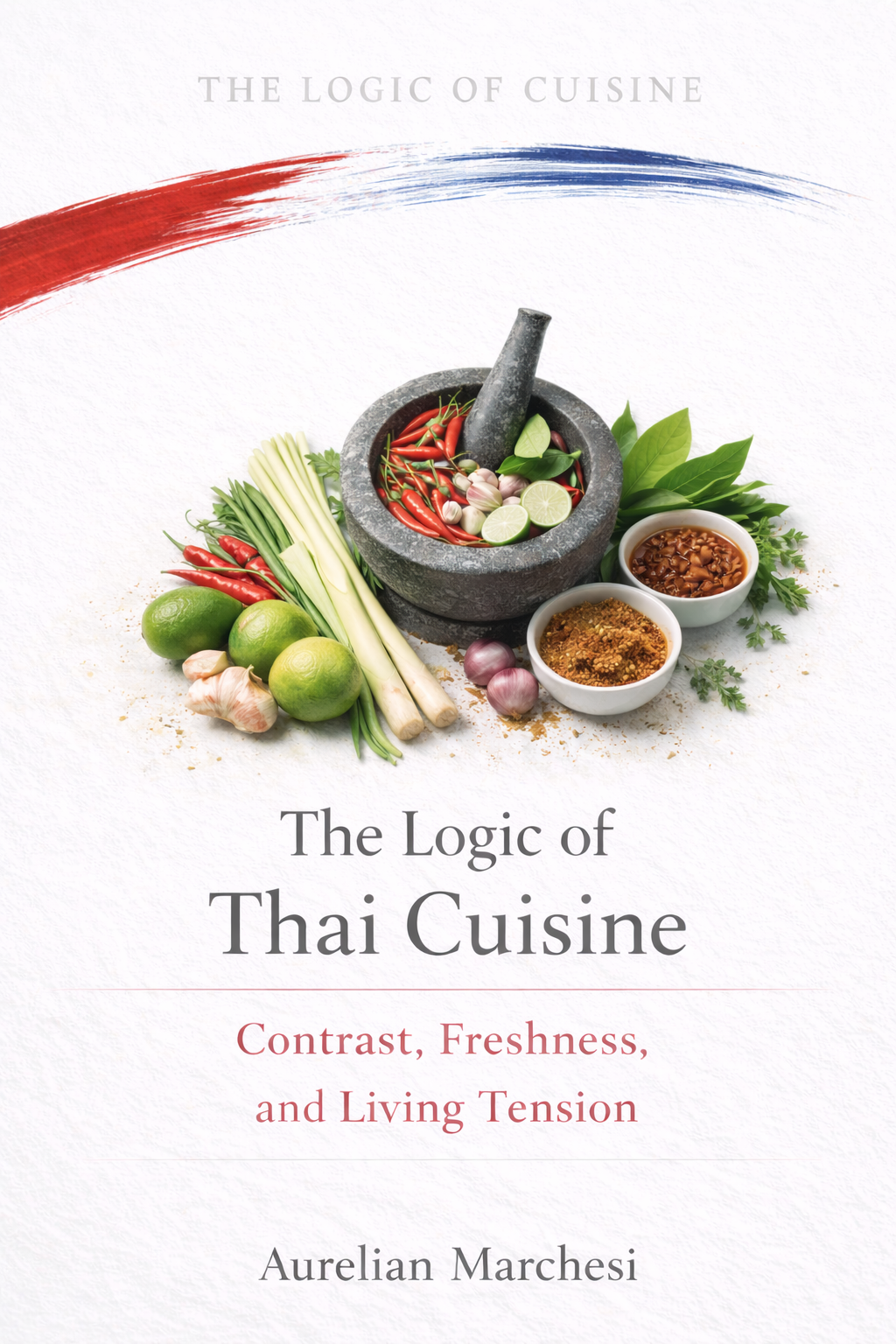
Cover of The Logic of Thai Cuisine

Book 7 · The Logic of Cuisine

The Logic of Thai Cuisine

Contrast, Freshness, and Living Tension

By Aurelian Marchesi

The first mouthful sharpens; the second cools; the third returns with fermented depth and chile heat; rice opens enough space to begin again. Thai cooking is often explained as a balance among sweet, sour, salty, and spicy tastes, but this volume argues that the more revealing experience is movement. Under tropical pressure, freshness cannot be passive. Herbs release volatile aroma, acid cuts before weight settles, heat rises quickly, fermentation supplies a durable undertone, and the shared meal lets diners oscillate among several dishes rather than proceed through a fixed sequence. Stability comes from repeated correction, not from stillness. The cuisine remains coherent because its tensions are timed and given places to resolve.

The central question

How does Thai cuisine use freshness, acid, volatile heat, fermentation, sweetness, and rice to sustain appetite through continuous sensory tension?

The volume proposes that Thai balance is dynamic rather than static. Contrasts are introduced, intensified, and released across both dish and table: herbs provide immediacy, lime and tamarind create directional acidity, chile excites without imposing lasting weight, fermented ingredients maintain depth, sweetness rounds an edge, and rice restores capacity. Shared eating multiplies those transitions. A successful meal does not flatten competing signals into one midpoint; it keeps them distinct enough to produce rhythm.

What this work explores

Freshness is active structure

Herbs, leaves, roots, and aromatics are not finishing decoration laid over a completed base. Their volatile compounds supply lift and immediacy that diminish quickly, making freshness a time-sensitive part of construction. Bruising, slicing, pounding, and the moment of addition determine whether an aroma remains bright or disappears into heat. Tropical abundance and spoilage pressure make this immediacy practical as well as sensory. The cuisine depends on materials that announce the present moment, preventing fermented depth, sweetness, or fat from settling into monotony.
Sourness gives the meal a spine

Lime and tamarind do more than balance sweetness. They direct attention, cut through density, and create a point of return around which other tastes can move. Different acids arrive and endure differently: fresh citrus offers quick aromatic brightness, while tamarind provides a darker, broader sourness that can remain inside a cooked structure. Used with precision, acid releases appetite before richness or heat can accumulate. The book therefore treats sourness as an organizing force, one that makes clarity possible without demanding mildness.

Depth remains beneath brightness

Fish sauce, shrimp paste, and other fermented bases create continuity below the cuisine's most immediate sensations. They carry salt and savory concentration while also preserving the memory of materials that cannot remain fresh indefinitely. Their role is structural precisely because they need not dominate the aroma. When calibrated against herbs, acid, and chile, fermentation gives brightness somewhere to return from. This lower register prevents the meal from becoming merely sharp or fleeting, demonstrating that lightness can rest on materials of considerable age and concentration.

Rice and sharing reset intensity

Rice is not an empty filler beside expressive dishes. Its absorption and relative neutrality make repeated contrast possible, giving the palate relief without ending the meal's movement. At a shared table, diners can alternate rice with a sour soup, a fragrant stir-fry, a curry, or a cooling element in changing proportions. The meal therefore oscillates instead of progressing linearly. Appetite is managed collectively, one corrective bite following another. This rhythm turns balance into an ongoing activity performed by the table rather than a fixed ratio completed in the kitchen.

Introduce, oppose, reset

The book's framework follows the life of a sensory signal. An ingredient first introduces brightness, heat, sweetness, salt, or fermented depth. Another element opposes or redirects it rather than erasing it. Rice, acid, freshness, or movement to a different shared dish then resets the diner's capacity. The cycle can happen within one preparation or across the table. This approach explains why listing four tastes is insufficient: the cuisine's intelligence lies in the timing, duration, and recurrence of contrasts, not merely in their presence.

Place in the series

This book contributes a model of cuisine as controlled volatility. In the series, it stands apart from architectures that seek stability through reduction, codification, or prolonged integration. Thai logic shows how coherence can be renewed moment by moment through contrast, freshness, fermentation, and shared pacing—a system designed not to settle, but to remain alive.