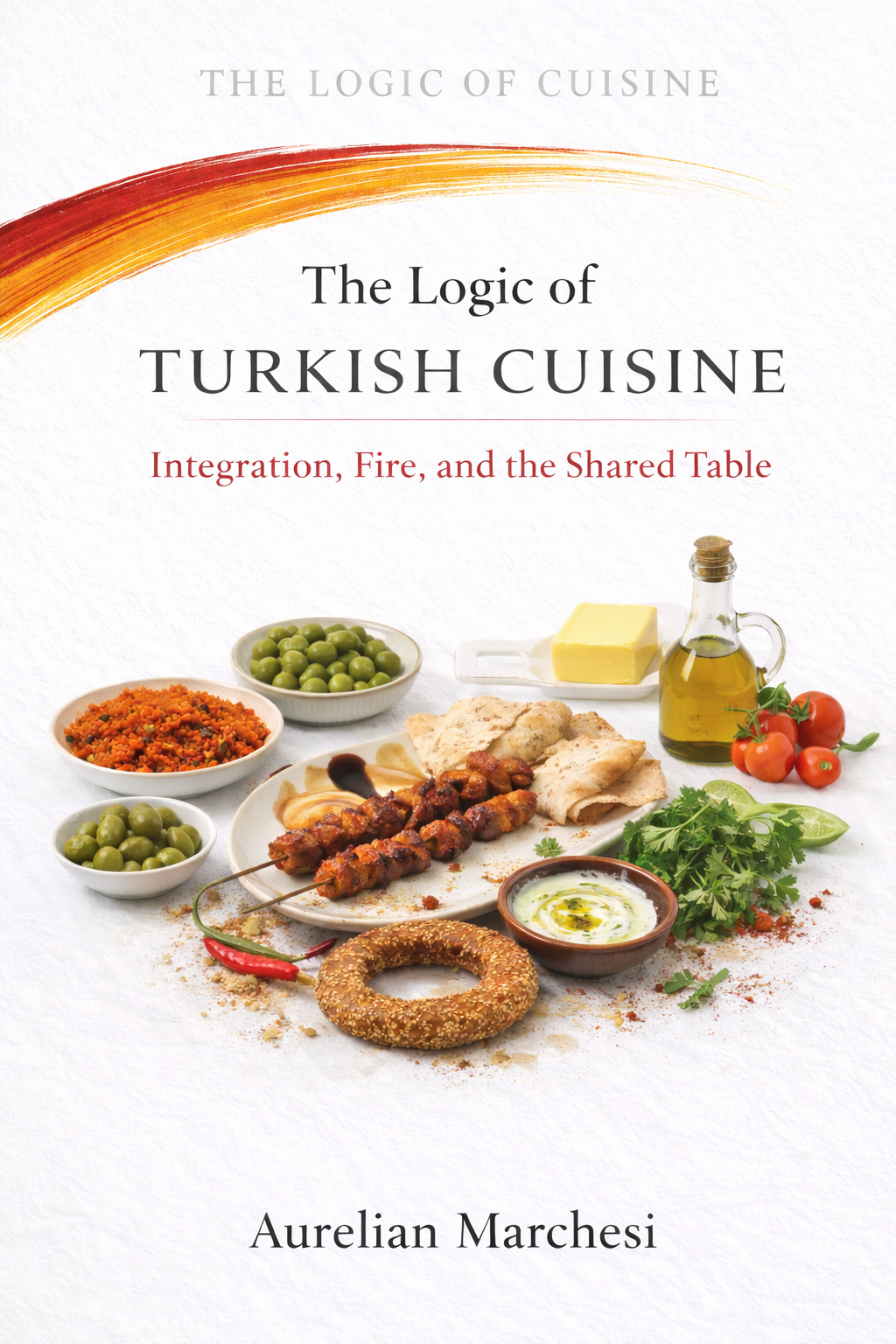
Cover of The Logic of Turkish Cuisine

Book 10 · The Logic of Cuisine

The Logic of Turkish Cuisine

Integration, Fire, and the Shared Table

By Aurelian Marchesi

At a crossroads, purity is a fragile idea. Ingredients, techniques, populations, and institutions arrive from different directions, yet a meal must still hold together. This volume studies Turkish cuisine as an integration system rather than as a catalogue of kebabs or an image of unchecked abundance. Bread receives juices, carries food, and anchors energy; controlled fire concentrates meat and vegetables; yogurt cools, binds, and corrects; sumac and herbs sharpen; meze slows appetite into conversation. Public street food and domestic dishes remain connected because they use the same structural vocabulary. Variety does not require hierarchy, and generosity does not require fatigue. Coherence emerges from giving difference a place at the shared table.

The central question

How does Turkish cuisine absorb materials and techniques from multiple climates, migrations, and empires while preserving clarity, continuity, and a common social rhythm?

The book proposes that Turkish coherence is built by complementary regulators. Bread and grain stabilize; fire concentrates; dairy cools and binds; acid and herbs return clarity; meze distributes appetite and participation across time. These roles allow vegetables, meat, street foods, domestic dishes, and regional influences to coexist without being forced into sameness. Integration succeeds when the system preserves difference while preventing any one source of intensity from governing the whole meal.

What this work explores

Bread turns difference into a meal

Bread and dough function as utensil, vessel, surface, and caloric anchor. They receive grilled juices, wrap portable fillings, accompany meze, and connect public eating with the domestic table. Variations in hydration, shaping, and heat create many forms, but their structural role remains stable: grain makes concentrated foods shareable and sustaining. The book therefore places bread before meat in its account of Turkish architecture. Fire may produce the most immediate aroma, yet dough is what allows that aroma to enter a repeatable daily system.
Fire is controlled exposure

Kebab is reframed as a family of decisions about distance, surface area, smoke, fat rendering, and duration. Meat or vegetables are exposed to heat strongly enough to char an edge and release aroma, but not so indiscriminately that fire erases texture. Skewer size, cut, rotation, and dripping fat all alter the result. The logic is one of constraint: concentration through contact, then removal at the point when smoke has become part of the material rather than a mask over it. Spectacle is incidental to precision.

Dairy corrects intensity

Yogurt is not confined to a side dish or garnish. Its acidity, proteins, water, and cool temperature allow it to bind, soften, and redirect foods marked by smoke, pepper, oil, or long heat. It can become sauce, drink, cooking medium, or direct accompaniment. The sensory relief it offers does not cancel intensity; it makes another encounter with intensity possible. This corrective authority is central to the cuisine's integrative power, because dairy creates continuity between strongly differentiated elements without requiring them to taste alike.

Meze governs abundance through time

Meze allows many preparations to appear without converting variety into simultaneous excess. Shared plates are sampled in changing order; bread mediates stronger bites; acid, herbs, vegetables, dairy, and preserved foods establish alternating weights. Conversation and drink slow the meal, giving appetite time to register. Governance here is social rather than bureaucratic: diners negotiate pace and selection together. The abundance remains generous because it is distributed, and coherent because each element enters an already understood rhythm of sharing and correction.

Anchor, intensify, correct, share

The volume maps integration as a cycle. Grain anchors the meal and gives it a common material base. Fire, oil, preservation, and slow heat intensify particular ingredients. Dairy, acid, herbs, or a quieter grain preparation correct that intensity before it becomes tiring. Sharing distributes the cycle among diners and across time. The framework makes room for historical layering without treating every influence as equal or interchangeable. A technique belongs when it can enter these relationships and support continuity across street, household, and ceremonial settings.

Place in the series

Within the series, this book offers a model of coherence produced by encounter. It does not treat hybridity as a modern exception or search for a single pure origin. Instead, Turkish cuisine demonstrates how bread, fire, dairy, seasoning, and shared pace can integrate difference over long historical time. Its contribution is a theory of continuity without uniformity, built at the crossroads rather than at the protected center.