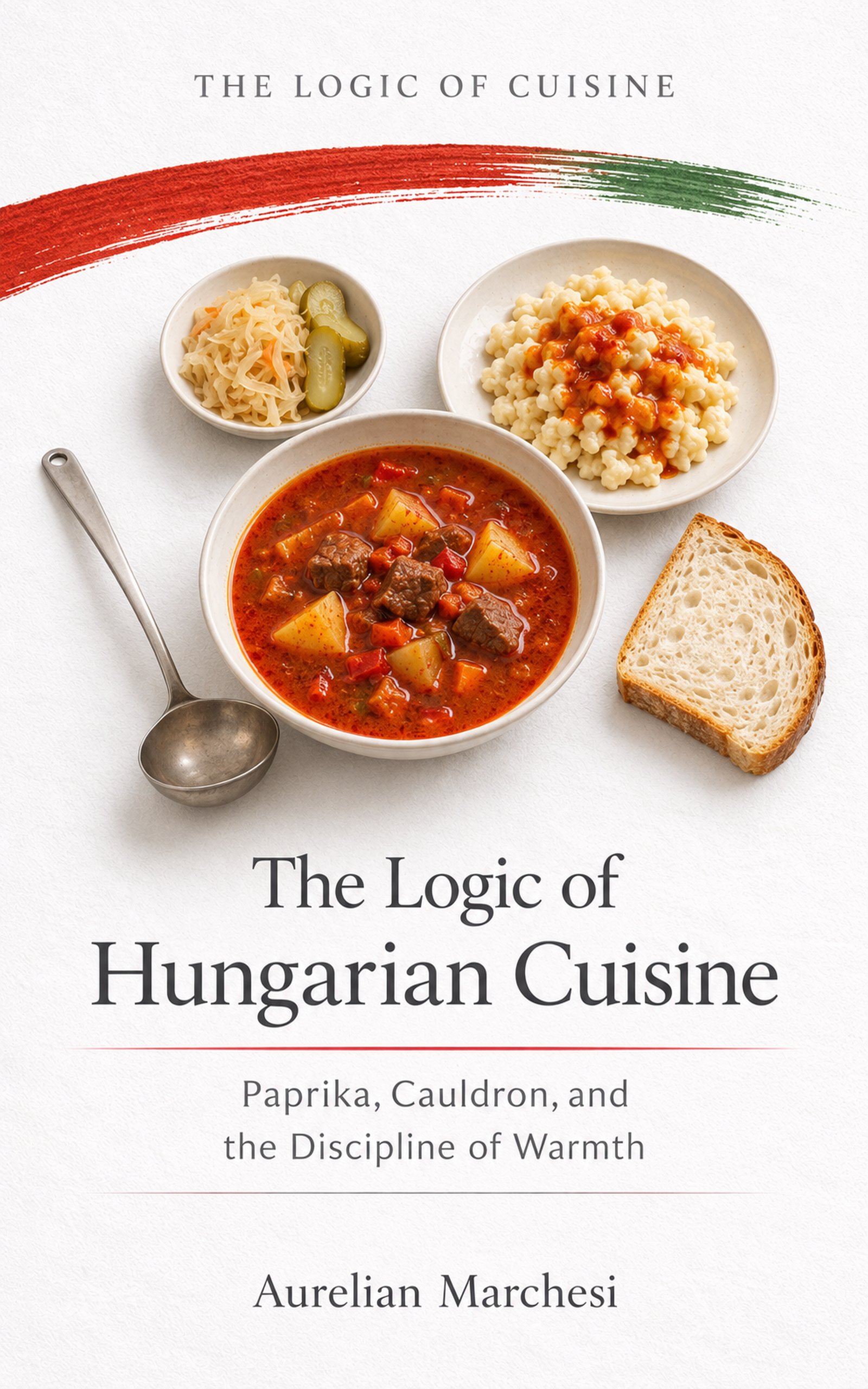
Cover of The Logic of Hungarian Cuisine

Book 26 · The Logic of Cuisine

The Logic of Hungarian Cuisine

Paprika, Cauldron, and the Discipline of Warmth

By Aurelian Marchesi

Coming Soon

A Hungarian pot does not begin with weight. It begins by deciding where warmth will live: onion softened in fat, paprika opened without scorching, liquid admitted in the right proportion, and a carrier ready to receive what the pot has built. Cold, physical work, costly fuel, seasonal abundance, and a pantry designed to wait make that decision consequential across several meals. Onions, potatoes, dried peppers, smoked meat, rendered fat, fermented cabbage, and pickles can sustain return, but only if concentration remains mobile. The volume follows that control from cauldron to bowl and plate, asking how starch, sourness, dairy, and service sequence prevent sustaining warmth from hardening into static density.

The central question

How does Hungarian cooking build enough concentration to warm and sustain, then support and reopen that density so desire survives beyond the first few bites?

Hungarian cuisine is read as a discipline of distributed warmth. Onion softened in fat creates sweetness and body; paprika blooms into that carrier and colours the liquid or sauce that follows. Proportion then changes the medium: mobile broth suspends warmth in gulyás or halászlé, reduction makes pörkölt cling, and sour cream cushions paprikás without replacing its red foundation. Bread, potato, noodles, dumplings, tarhonya, beans, or cabbage give concentration a landing surface. Pickles, fermented cabbage, and cultured dairy correct by cutting or rounding. Sequence determines whether the same stored intensity arrives as sustaining warmth or exhausting weight.

What this work explores

Paprika becomes an environment

Paprika becomes an environment when it is integrated into onion, fat, and liquid rather than scattered over a finished dish. Slowly softened onion provides sweetness and body; hot fat receives the pepper's colour and aroma; liquid determines how freely that red medium can move. The cook must avoid scorching and judge whether the base has become coherent rather than grainy or pale. Paprika can then saturate broth, cling to reduced meat, survive beneath sour cream, or fuse with softened vegetables. Its governing role lies in controlling the state and reach of warmth across the pot, not in making every preparation equally hot or visually red.
The base is protected before prestige

The base is protected before prestige because the system must feed many mouths and return across time. Onion, fat, paprika, and an appropriate amount of liquid establish a strong medium before a prized cut of meat is allowed to define the meal. When resources are tight or guests arrive, the pot is extended through potatoes, noodles, dumplings, beans, cabbage, bread, or more carefully balanced liquid—not by watering the base until it becomes faint. Smoked meat or rendered fat can contribute concentrated flavour even when large pieces are absent. Generosity therefore depends on preserving the medium's integrity while increasing the surfaces through which it can be shared.

Starch is a landing surface

Starch is a landing surface for concentrated warmth. In a bowl, potato and small dumplings suspend within broth and make each ladle substantial. On a plate, nokedli, noodles, tarhonya, bread, or potatoes catch reduced paprika sauce so its fat, onion, and pepper are distributed across bites rather than consumed as an isolated mass. Beans, cabbage, and layered forms can receive smoke and rendered richness while keeping their own body. These supports are not inert bulk. Their absorption, texture, and portioning determine whether a smaller amount of intense base can feed generously and whether the eater remains willing to return the next day.

Sourness and dairy relieve differently

Sourness and dairy relieve concentration in different ways. Pickles and fermented cabbage arrive with crispness and acid that interrupt a dense sequence, creating a new path through fat and starch. Sour cream adds tang but also rounds heat, loosens texture, and cushions the paprika medium; in paprikás it succeeds only when the red base remains strong enough to be recognisable beneath that softness. Neither correction is equivalent to dilution. One cuts from the edge of the meal, while the other integrates into or beside the sauce. Their shared function is to reopen appetite without denying the warmth the meal was built to deliver.

Sequence releases weight into time

Sequence releases weight into time. Gulyás and halászlé make paprika mobile in a bowl; pörkölt concentrates it on a plate where bread or dumpling completes the circuit; paprikás inserts dairy into the same field; pickles or sour cabbage wait as recurring correction. The difference between soup, stew, sauce, and layered form is therefore not naming alone but the movement of liquid and concentration. A meal can begin with warmth that travels easily, gather density later, and restore contrast at the edge. Course order and vessel manage how fast force reaches the body and whether repetition feels sustaining rather than monotonous.

Concentration, support, relief, time

Read Hungarian warmth across four linked decisions. First, locate the paprika-bearing medium and ask whether onion, fat, pepper, and liquid have become coherent. Second, identify its state: freely suspended in broth, reduced to cling, integrated with vegetables, or cushioned by dairy. Third, find the support—bread, potato, noodle, dumpling, grain, bean, or cabbage—that receives and distributes it. Finally, observe the correction and timing that keep appetite open across bowl, plate, day, and reheating. This model explains why gulyás, pörkölt, paprikás, halászlé, lecsó, and layered forms can differ sharply while sharing a discipline of concentration, support, relief, and return.

Inside the work

Material pressures

The opening movement establishes cold, labour, plain, river, garden, smoke, fuel, and storage as the pressure field. It shows why one strong fire, foods that keep, and a pot able to return across days become structural priorities.

Transformation engines

The next movement follows onion, fat, paprika, cauldron, pan, oven, fermentation edge, broth, and starch through transformation. It distinguishes a mobile red medium from reduced sauce and explains how support prevents concentration from becoming dead weight.

Benchmark dishes

Extended readings of gulyás and töltött káposzta test suspended warmth and enclosed endurance. Pörkölt, paprikás, halászlé, lecsó, lángos, rakott krumpli, and főzelék show how medium, vessel, support, and correction change.

Scaling and return

The closing movement widens to meal and feast sequence, reheating, mass-market distortion, substitution abroad, and recognition. It asks which relationships survive changed ingredients and which names become empty when the governing medium or corrective system is lost.

Place in the series

This volume gives The Logic of Cuisine a precise account of hearty food as managed concentration. Paprika is neither a surface emblem nor a universal taste; it becomes governing medium through onion, fat, liquid, vessel, and timing. Starches distribute its force, while pickles, fermented cabbage, and dairy reopen the meal in different ways. This distinguishes Hungarian suspended warmth from Romanian storage-and-sour correction and Turkish shared-table integration, even where ingredients or forms overlap. The work's specific contribution is to show how a cuisine makes weight mobile across broth, sauce, support, sequence, and time so that endurance remains desirable rather than merely impressive.