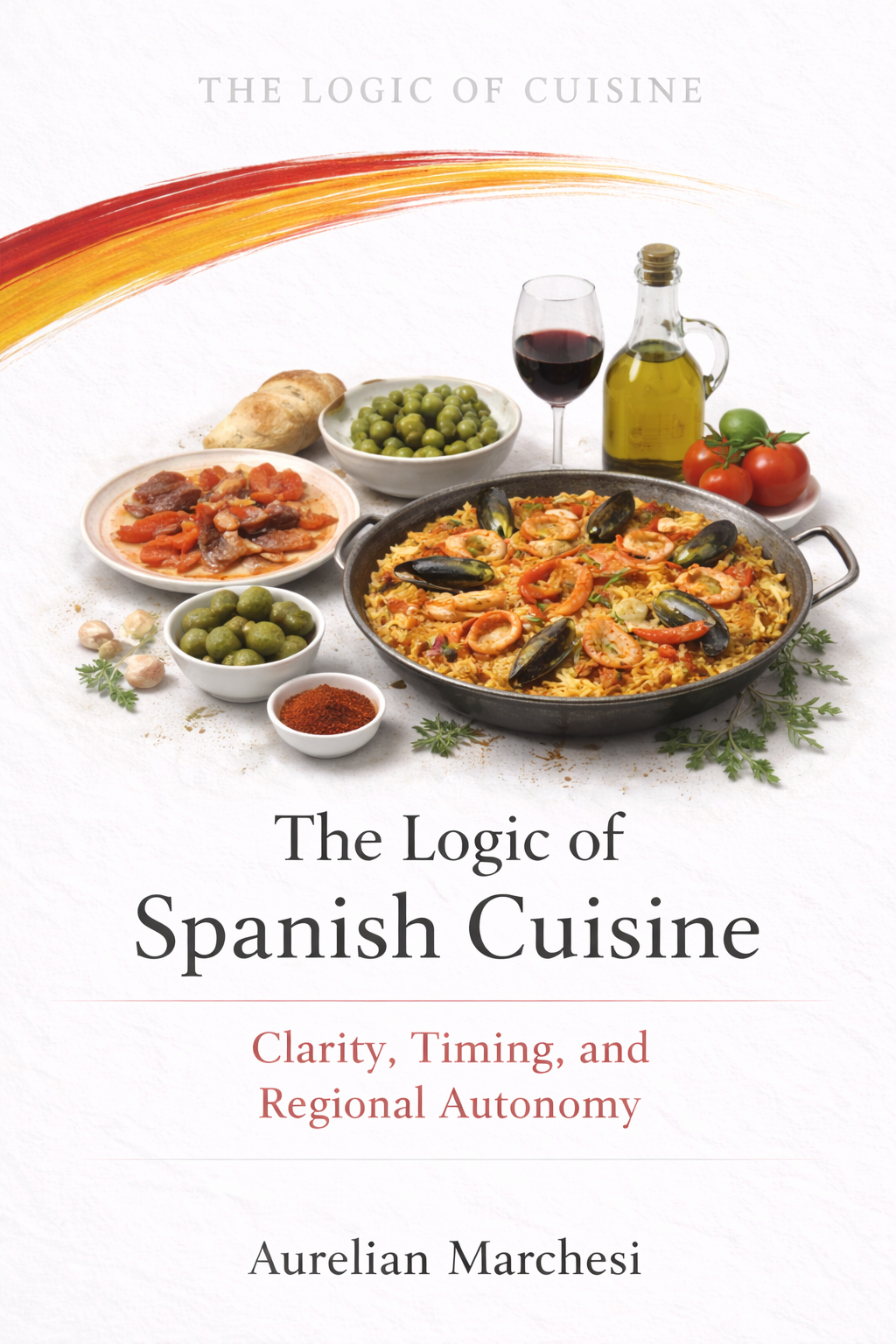
Cover of The Logic of Spanish Cuisine

Book 8 · The Logic of Cuisine

The Logic of Spanish Cuisine

Clarity, Timing, and Regional Autonomy

By Aurelian Marchesi

Spain does not resolve itself into a single culinary center. Coasts, mountains, plains, islands, pastoral interiors, and trading cities retain systems confident enough to remain distinct. This volume finds coherence not in uniformity, but in a shared refusal to obscure. Olive oil carries without disguising; direct fire marks surfaces and stops; salt and curing intensify the material they preserve; rice records territory, fuel, and timing. Even tapas, commonly read as a parade of small plates, are reconsidered as a social technology that lets choice, hunger, and conversation proceed in intervals. The cuisine's clarity depends on knowing when an ingredient has been worked enough. Restraint appears not as austerity, but as trust in place and in the reader's ability to perceive it.

The central question

How can multiple autonomous regional cuisines remain recognizably connected through clarity, direct treatment, preservation, and social timing without being reduced to one national style?

The volume proposes that Spanish culinary durability comes from legibility. Geography is allowed to produce parallel systems; olive oil, fire, salt, cure, and timing reveal rather than homogenize their materials. Rice and tapas show two scales of the same discipline: one absorbs place into a bounded cooking interval, while the other distributes appetite across an open social rhythm. Unity is therefore procedural and ethical rather than stylistic—the confidence to leave ingredients and regions intelligible.

What this work explores

Geography remains plural

The coastline, high plateau, mountains, wet north, dry south, and island environments impose different ingredients and preservation pressures. The book does not arrange Basque, Andalusian, Catalan, Galician, and other systems as colorful variations around a dominant center. Each is treated as having its own internal logic. Their coexistence demonstrates that a national cuisine can be coherent without collapsing regional authority. What travels between them is less a fixed flavor profile than a recurring commitment to directness, timing, and the material evidence of place.
Direct heat edits the surface

Grilling, roasting, and the plancha bring food into immediate contact with fire or hot metal. The objective is not continuous transformation, but an exact change at the surface: char, aroma, concentrated sweetness, or a crisp boundary around a moist interior. Because the method is exposed, timing is unforgiving. Heat must stop before clarity becomes dryness or smoke becomes concealment. The cuisine's apparent rusticity thus contains a precise editorial act—remove moisture, add a mark, intensify an edge, then leave the ingredient recognizable.

Preservation intensifies without disguise

Salt, drying, and curing allow seasonal or perishable materials to travel through time while becoming more concentrated versions of themselves. Water leaves, texture changes, and flavor deepens, but the starting material remains legible. This differs from preservation systems that rely primarily on heavy spicing or enclosing sauces. The book links the practice to scarcity and distance, then follows its sensory consequence: jamon, cured fish, and other preserved foods are powerful enough to be served in measured amounts, often with bread, oil, or acid that gives concentration a context.

Rice and tapas organize different clocks

Rice dishes bind cooking to a finite material sequence: grain, liquid, pan, fuel, landscape, and the moment when intervention must cease. Tapas organize a more open clock. Small portions arrive iteratively, letting appetite and conversation redirect the next choice without the closure of formal courses. One form rewards exact stillness at the end of cooking; the other rewards social responsiveness. Together they reveal why timing is more than technical accuracy in this cuisine. It coordinates food with territory in one case and with shared life in the other.

Place, exposure, stopping point

The book reads Spanish food through three questions. What pressures and materials does a place make available? Which direct operation—oil, fire, cure, acid, or absorption—will make those materials more legible? At what moment must the cook stop? This last question gives the framework its force. Overworking is not merely a technical fault; it weakens the evidence of place. Regional autonomy, ingredient clarity, and timing are therefore connected. The cuisine endures because its methods can intensify difference without needing to erase it.

Place in the series

In The Logic of Cuisine, this volume is a study in coherence without centralization. It challenges the assumption that a durable food culture requires one dominant national grammar. Spanish cuisine instead contributes a federated model: regions preserve authority while methods of clarity, preservation, and timing make their differences mutually intelligible.