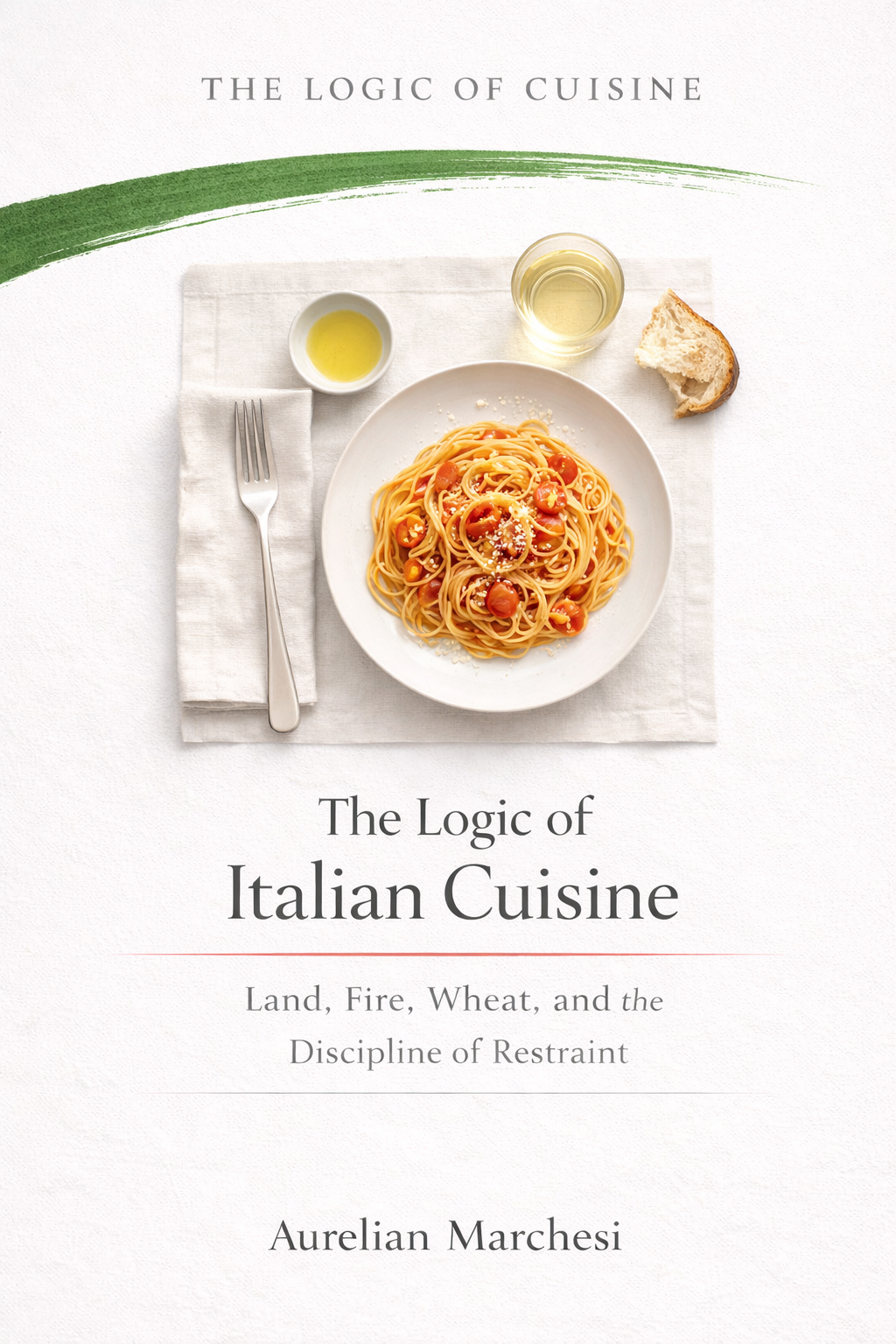
Cover of The Logic of Italian Cuisine

Book 1 · The Logic of Cuisine

The Logic of Italian Cuisine

Land, Fire, Wheat, and the Discipline of Restraint

By Aurelian Marchesi

The book begins from an apparent contradiction. Italian food is repeatedly described as simple, yet the simplicity it examines is demanding rather than casual. A table with bread, oil, tomatoes, cured meat, or cheese becomes legible only when each element has a clear function and none is allowed to blur the others. Season, land, preservation, wheat, fat, acid, and heat limit what can be done; restraint turns those limits into coherence. The result is a cuisine in which abundance is measured less by the number of things present than by the intensity and clarity of what has been chosen. This volume follows that discipline from landscape and pantry to sauce, dough, household repetition, and adaptation abroad. It asks the reader to see familiar forms as consequences of a system that keeps addition under control.

The central question

How do land, season, scarcity, preservation, wheat, fat, acid, and fire produce a cuisine whose apparent simplicity depends on disciplined selection and structural control?

The volume reads Italian cuisine as a constraint-driven system rather than a repertory of famous dishes. Its central proposition is that clarity emerges when ingredients and techniques are assigned exact roles: the land determines the pressure, the pantry stores time, sauce binds rather than decorates, dough is tuned to a purpose, and the daily table repeats reliable structures without becoming static. Familiar dishes appear as evidence of those relationships. Their force lies in how well they preserve a center of gravity, not in how many ingredients or techniques they can display.

What this work explores

Land and season set the terms

The first pressure comes from place and timing. The manuscript presents the Italian table as responsive to what the land makes vivid at a particular moment, not as a stage on which every available ingredient should appear. Peak produce, regional fats, grains, and preservation practices create different local systems, while a shared respect for clarity holds them together. Seasonality therefore does more than refresh a menu. It limits the field of action and gives the meal a center. Scarcity and preservation extend the same logic across time: what can be dried, cured, fermented, or stored becomes part of the cuisine's structural memory. The book treats terroir as a working constraint rather than a decorative claim about origin.
Sauce carries structure

Liquids are judged by what they can hold together. The book distinguishes a sauce that merely wets from one that clings, cushions, and carries flavor across pasta, grain, vegetable, or meat. Fat first receives aroma; starch, gelatin, proteins, and suspended solids then help water and fat remain in relation. The visible signs are movement and sheen, but the argument is larger than texture. Sauce becomes a load-bearing part of the dish because it binds separate materials into a continuous experience without flooding them or covering their identity. This is why sauce belongs to the cuisine's architecture rather than to its decoration, and why excess fat or a separated liquid is treated as a failure of relation rather than simply a matter of taste.

Wheat becomes a family of textures

Wheat is not a single identity in the volume. It is a material whose internal network can be directed toward pasta, bread, or pizza by changing hydration, work, rest, temperature, shaping, and heat. The manuscript begins this discussion with resistance under the hand: dough moves from rough and tearing to elastic and responsive as its structure develops. That bodily reading matters because the series is not offering a formula. It is showing how the same limited materials acquire different purposes. Pasta must hold a shape and meet sauce; bread must support a crumb; pizza must balance stretch, gas, and a heated surface. The theme demonstrates how Italian restraint can contain considerable complexity without displaying that complexity as ornament.

Repetition is a domestic intelligence

The daily table replaces the restaurant's parade of novelty with a smaller repertoire that can be repeated, adjusted, and trusted. A sauce, soup, frittata, legume dish, or meal pattern returns because the household already knows how it fits time, cost, appetite, and season. Variation occurs inside that stability: a vegetable changes, a pasta shape shifts, or one functional role absorbs another. The manuscript's treatment of primo, secondo, and supporting elements is therefore less about rigid service than about an underlying distribution of starch, protein, vegetables, and continuity. Repetition reduces decisions and preserves expectation. It is one of the places where the book's idea of restraint becomes social, because a cuisine survives through forms that can work on an ordinary Tuesday as well as at a ceremonial table.

Integrity can survive substitution

The volume does not make geographic purity the only test of integrity. Its later movement asks what can change when Italian food is made elsewhere and what must remain. Exact ingredients may be unavailable, but their functions can still be understood: a fat must carry aroma, an acid must correct richness, a grain must behave appropriately, and a sauce must bind rather than smother. Substitution succeeds when it preserves the relationship that gave an ingredient its place. It fails when names and appearances remain while the system's proportions collapse. This makes adaptation a test of understanding rather than a license for imitation. The reader is asked to translate the logic of a place without pretending that another place is identical to it.

Constraint, relation, and sensory recognition

The book brings three kinds of attention into one frame. Environmental and historical pressure explain why certain materials and forms become necessary. Physical mechanisms explain how dough, fat, water, acid, heat, and time behave. Sensory recognition shows when those relations have succeeded: the resistance of dough, the cling of sauce, the clarity of an ingredient, or the rhythm of a familiar meal. None of these strands is presented as an independent lesson. They converge on a practical interpretive question: what is this element doing, and does its presence strengthen the meal's governing idea? That question allows the volume to discuss technique without becoming a manual, history without becoming a chronology, and sensation without becoming nostalgia. Its distinctive framework is the discipline of keeping the system readable.

Inside the work

From land to governing relationships

The opening movement establishes the pressure of season, region, pantry, fat, acid, and preservation, then shows how sauce and heat turn those conditions into relationships on the plate.

From material control to the lived table

The middle movement follows dough, tools, proteins, vegetables, grains, household repetition, and ritual. It shifts the inquiry from what Italian food contains to how its materials are handled and distributed through everyday and ceremonial life.

From proof to adaptation

The closing movement tests the framework against emblematic dishes, misreadings, and cooking outside Italy. It ends by asking which relations remain durable when ingredients and settings change.

Place in the series

As the first volume in The Logic of Cuisine, this work establishes the series' governing method in a particularly legible form. It begins with a cuisine that many readers believe they already understand and shows how familiarity can conceal structure. The terms that recur across later volumes - pressure, carrier, balance, preservation, heat, and adaptation - are introduced here through the specific Italian discipline of restraint. The volume does not claim that every cuisine organizes itself by subtraction. Its role is to demonstrate that a cuisine can be read as a coherent response to constraint, and that the response becomes visible when dishes are treated as outcomes rather than as isolated objects.