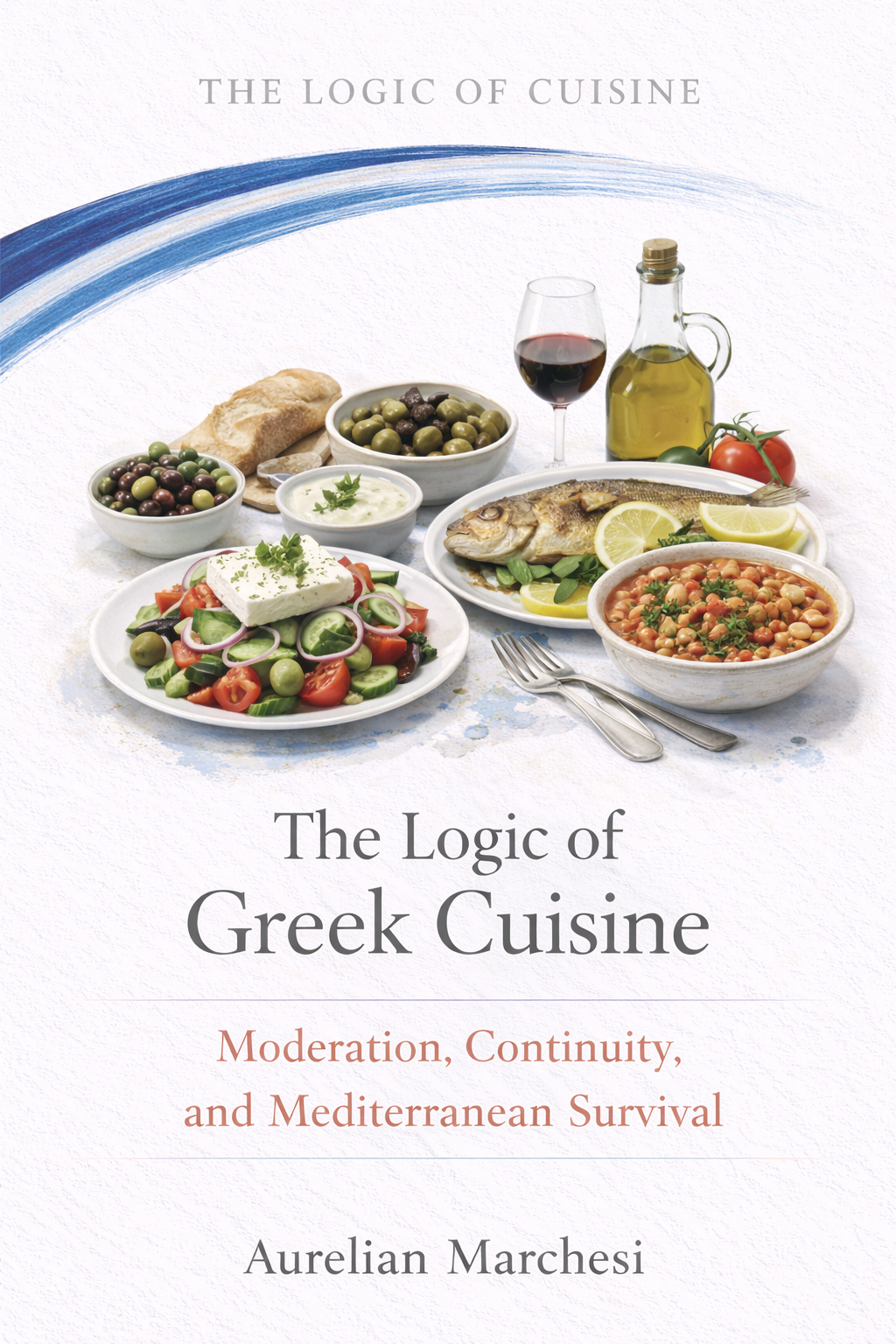
Cover of The Logic of Greek Cuisine

Book 9 · The Logic of Cuisine

The Logic of Greek Cuisine

Moderation, Continuity, and Mediterranean Survival

By Aurelian Marchesi

The celebrated outcome—health, balance, longevity—can obscure the conditions that produced it. This volume returns to rocky ground, limited pasture, fragmented islands, seasonal uncertainty, and the daily need to feed households without exhausting land or labor. Greek cuisine emerges as a long-duration survival system before it becomes a modern dietary ideal. Olive oil supplies energy and preservation; bread and grains stabilize; vegetables create volume; fish, dairy, and meat enter within limits; lemon, vinegar, salt, and herbs sharpen without requiring dense layers. Shared meals extend time so appetite can regulate itself. Moderation is not presented as abstract virtue. It is accumulated knowledge about what a community can repeat and still sustain.

The central question

How did Greek cuisine turn scarcity, fragmented geography, and repeated daily need into a durable pattern of nourishment organized around moderation?

The book proposes that the familiar benefits of Greek eating are consequences of a system designed for continuity. Olive oil, bread, grains, vegetables, fermentation, and measured protein distribute calories, preservation, flavor, and satiety without asking any one element to dominate. Regional isolation produces variation, while shared pacing and repetition keep those local systems socially durable. The cuisine's intelligence lies in maintaining enough—enough energy, enough acid, enough preservation, enough pleasure—without converting abundance into the governing expectation.

What this work explores

Olive oil is stored capacity

Olive oil is treated as infrastructure because it answers several needs at once. It provides concentrated energy where animal fat is limited, carries herbs and aromatics, mediates the texture of vegetables and grains, and helps preserve seasonal materials. Its usefulness depends on care: heat, air, and time can degrade it, so the ingredient belongs to a cycle of cultivation, storage, and measured use rather than unlimited richness. The book's argument shifts attention from oil as a flavor signature to oil as a durable technology connecting landscape, household economy, and the sensory continuity of meals.
Bread and vegetables make moderation possible

Grains anchor daily energy, while vegetables supply water, fiber, sweetness, and volume. Their combined presence changes the role of meat and dairy: protein can remain intermittent or concentrated because the meal already possesses body and satiety. Vegetables are not treated as marginal sides but as cooked centers of the table, often softened with oil, acid, herbs, or legumes. Moderation therefore does not require a meal to feel sparse. It emerges from arranging abundant plant volume around a stable grain base, allowing density to appear where it has the greatest effect.

Preservation becomes identity

Cheese, yogurt, brine, salt, and fermentation extend foods that would otherwise be lost to heat, distance, or seasonal surplus. The transformation concentrates nourishment and creates flavors now read as cultural signatures, but the book keeps their practical origin visible. Fermented dairy turns perishable milk into transportable and portionable food; acid and salt clarify other ingredients while delaying waste. Identity forms around successful preservation because the same solution can be repeated across generations. Continuity is material before it becomes symbolic.

Pace regulates the shared table

Meze distributes food across time and among diners. Small shared preparations invite alternating tastes, conversation, and pauses, allowing appetite to respond before quantity is fixed. This social pace complements the cuisine's material moderation: bread, vegetables, cheese, fish, or a stronger preserved element can each take a turn without one plate becoming a total meal. Regional and island differences remain present in the selection, but the table gives them a common rhythm. Moderation is experienced as continuity and company rather than as deprivation.

Constraint becomes a repeatable allowance

Rather than measuring the cuisine by what it lacks, the volume asks what each constraint permits repeatedly. Rocky land favors certain plants; limited pasture changes protein frequency; sun and salt enable preservation; bread and oil make vegetables sustaining; shared time helps modest portions satisfy. The framework follows this conversion from environmental limit to practical allowance and then to cultural continuity. Health appears at the end of that chain, not as the original design brief. This ordering protects the subject from romanticization while explaining why moderation can remain pleasurable over generations.

Place in the series

This volume supplies the series with its clearest long-duration account of moderation. It shares Mediterranean materials with neighboring cuisines, but organizes them around survival, repetition, and the ecological cost of daily nourishment. Its distinctive claim is that continuity can be a cuisine's central achievement, and that beneficial outcomes may arise from structural limits rather than explicit optimization for health.