Where the limit sits
Italy foregrounds proportional control among components; Spain gives vessel, region, service scale, and shared order greater authority; Greece places greater weight on recurring foundations and preservation across meals.
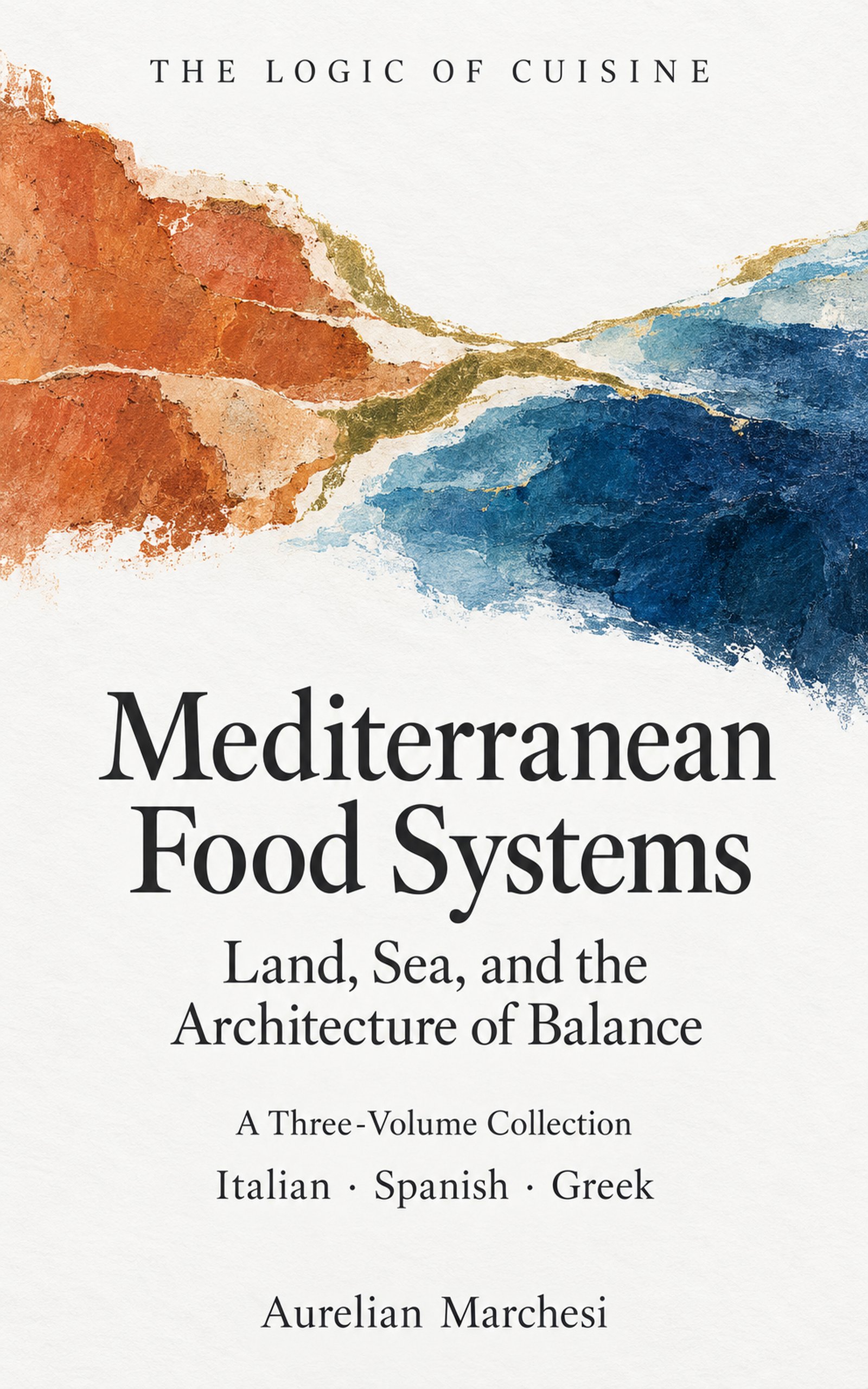
Collection 2 · The Logic of Cuisine
Land, Sea, and the Architecture of Balance
By Aurelian Marchesi
A shared Mediterranean pantry is a beginning, not an explanation. Grain, oil, vegetables, legumes, fish, and preserved foods enter neighboring cuisines whose meals are governed by different limits, timings, and ideas of balance.
The collection argues that Mediterranean resemblance makes comparison possible but not uniformity inevitable. Italian restraint coordinates grain, sauce, and heat; Spanish systems give region, shared ordering, timing, and scale distinct authority; Greek foundations connect plants, grain, preservation, and recurring meals across time.
Volume 1
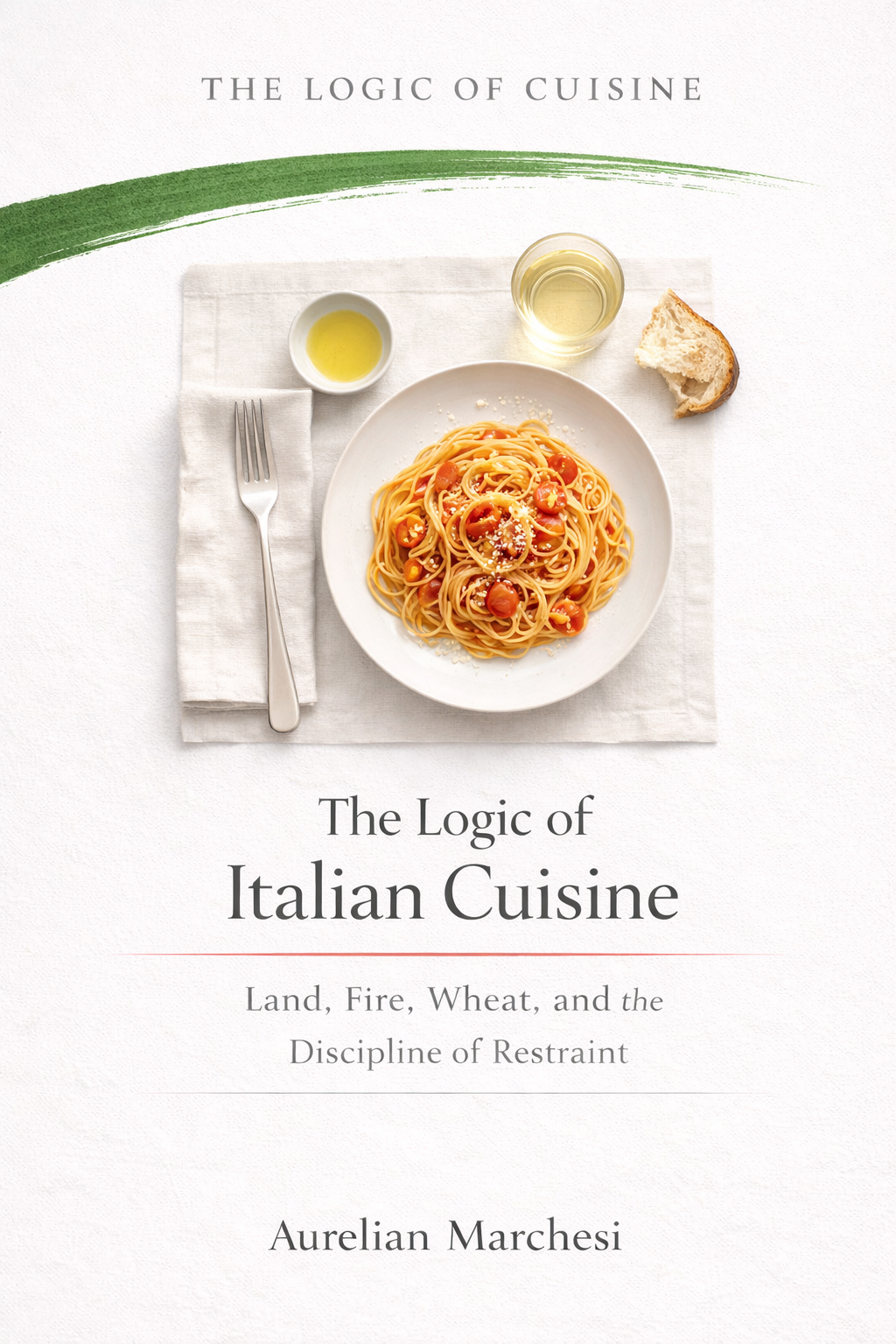
Italian cuisine opens the collection with balance inside a composed relationship. Grain, sauce, fat, and heat must answer one another, so restraint becomes an active control of proportion rather than a lack of abundance.
Once proportion is visible inside a composed form, the sequence widens to Spain, where vessel, region, scale, and shared service determine how abundance remains coherent beyond a single plate.
Volume 2
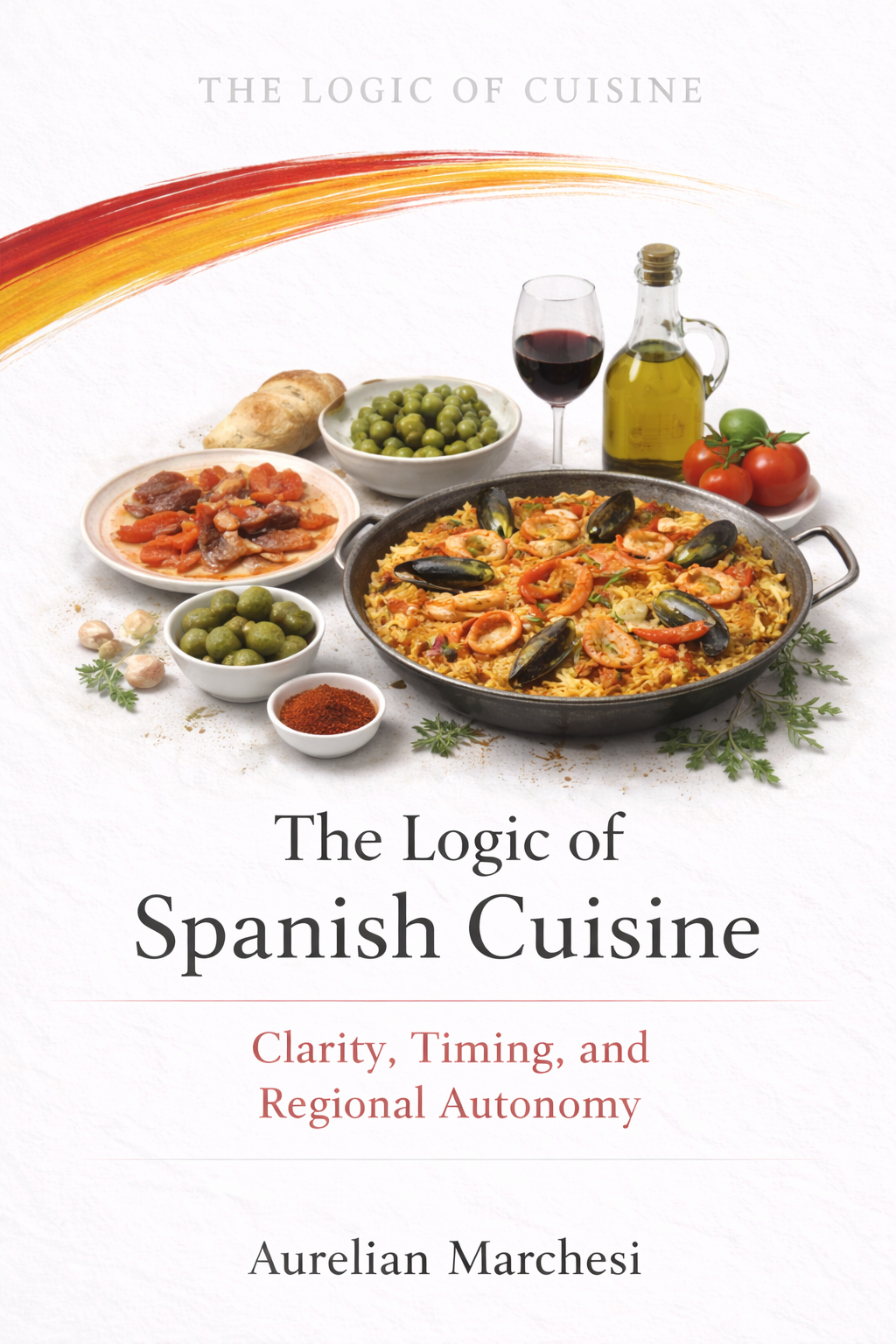
Spanish cuisine moves the inquiry outward to region, vessel, timing, and shared ordering. A shallow pan or a table of shared plates distributes decisions across space, service, and more than one eater.
After balance negotiated in the present meal, the collection moves to Greek systems in which staple foundations and preservation make the relation between today's table and later return explicit.
Volume 3
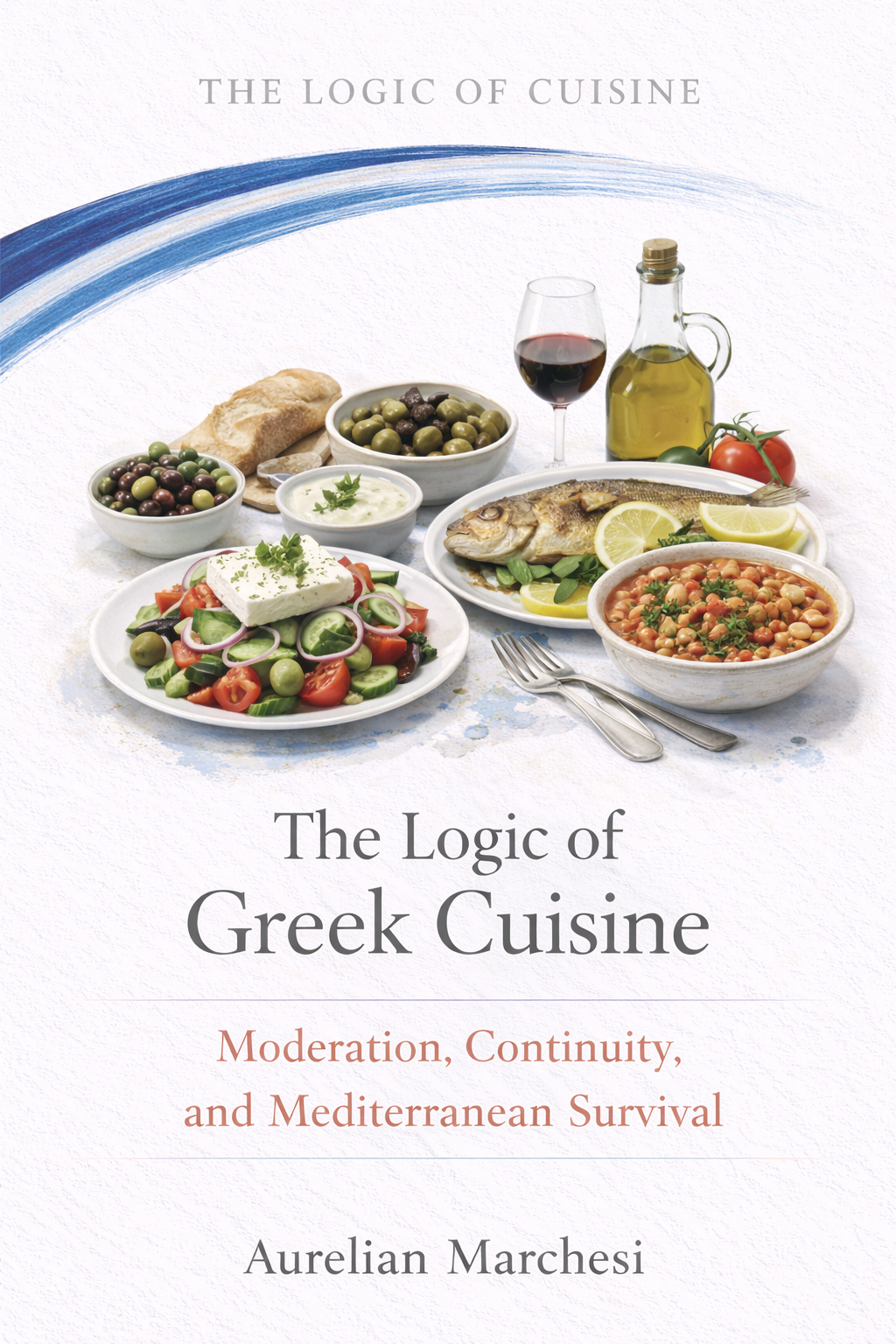
Greek cuisine completes the sequence by extending balance across recurring meals. Plants, grain, legumes, bread, oil, preserved foods, and repetition turn continuity itself into a culinary achievement.
Italy foregrounds proportional control among components; Spain gives vessel, region, service scale, and shared order greater authority; Greece places greater weight on recurring foundations and preservation across meals.
The next decision remains principally with the cook in Italian composition, becomes more visibly distributed among vessel and diners in Spanish shared service, and is partly inherited from pantry, staple, and preservation cycles in Greek continuity.
Grain may demand a restrained sauce, accept the spatial and evaporative limit of a rice pan, or join legumes, bread, and preserved foods in a recurring foundation. Shared material becomes evidence of different work.
The reader moves through three scales of balance. Italian cuisine first locates control inside a composed relation among ingredients and heat. Spanish cuisine expands that relation across vessel, region, service timing, and shared choice. Greek cuisine extends the horizon again, showing balance sustained through staple recurrence and preservation beyond one meal. The progression does not rank the systems or imply historical descent. It changes the scale at which the reader asks where limits, decisions, and continuity reside.
This is not a survey of one Mediterranean diet. It is a controlled comparison of three complete culinary arguments that uses proximity and shared materials to make structural difference sharper.
No ingredient guarantees balance by itself; balance is produced by a relationship that sets a limit. Italian restraint asks grain, sauce, and heat to remain proportionate, so an element carries without smothering. A Spanish shallow rice pan turns surface area, evaporation, timing, and scale into boundaries that abundance cannot simply override. Greek bread, legumes, vegetables, preserved foods, and recurring meals place balance across a longer cycle. The shared pantry makes these differences visible because oil, grain, produce, and fish acquire authority through different proportions, vessels, and rhythms rather than through Mediterranean identity alone.
Land and sea do not divide the three cuisines into clean inland and coastal halves. Their materials enter different grammars. Italian systems make a regional fat, grain, vegetable, or fish answer the chosen form with clarity; Spanish regions coordinate direct heat, curing, rice vessels, and shared ordering at different scales; Greek foundations join plants, grain, oil, fish, and preservation to recurring meals. Proximity to the same sea therefore creates a useful control for comparison: materials may overlap, while the sequence that receives them and the table that distributes them remain structurally distinct.
Time enters before, during, and after service. Italian restraint places decisions in preparation, heat, and the final relation between grain and sauce. Spanish vessels and shared plates make timing public: a rice pan has a finite window, while tapas let diners participate in sequence and scale. Greek preservation and recurring plant-and-grain foundations connect one day's table with another. The collection treats time as part of the meal's architecture because it decides when concentration is built, who can alter it, and whether today's abundance becomes tomorrow's continuity.
Risotto, paella, tortilla, fasolada, and moussaka appear as structural tests rather than recipes or national trophies. Risotto tests liquid and grain relation; paella tests the limit imposed by a shallow pan; tortilla tests how modest materials become a bounded shared form; fasolada tests recurring legume and liquid foundations; moussaka tests layered abundance. Each example matters because it reveals where heat, moisture, starch, vessel, preservation, or service order places control. The dishes make the comparative argument recognisable without pretending that one example exhausts its cuisine.
Compare the governing relationship rather than counting shared ingredients. For each component, ask where the principal limit sits, what carries flavour and substance, when the decisive choice is made, who can make the next adjustment, and how the meal connects present abundance to future use. That sequence reads Italian proportion, Spanish vessel and shared order, and Greek recurring foundations as different answers to the same analytical questions. The framework adds value beyond the themes by turning the comparison into a method: shared materials establish a common field, while decision order, scale, and time reveal three architectures of balance.
Within The Logic of Cuisine, this collection demonstrates why a common pantry cannot stand in for a common system. It uses proximity and shared materials as analytical controls, then shows proportion, vessel and shared order, and recurring foundations assigning those materials different work. Its series role is comparative: it makes balance legible as a relationship whose location and time scale change from one complete cuisine to another.