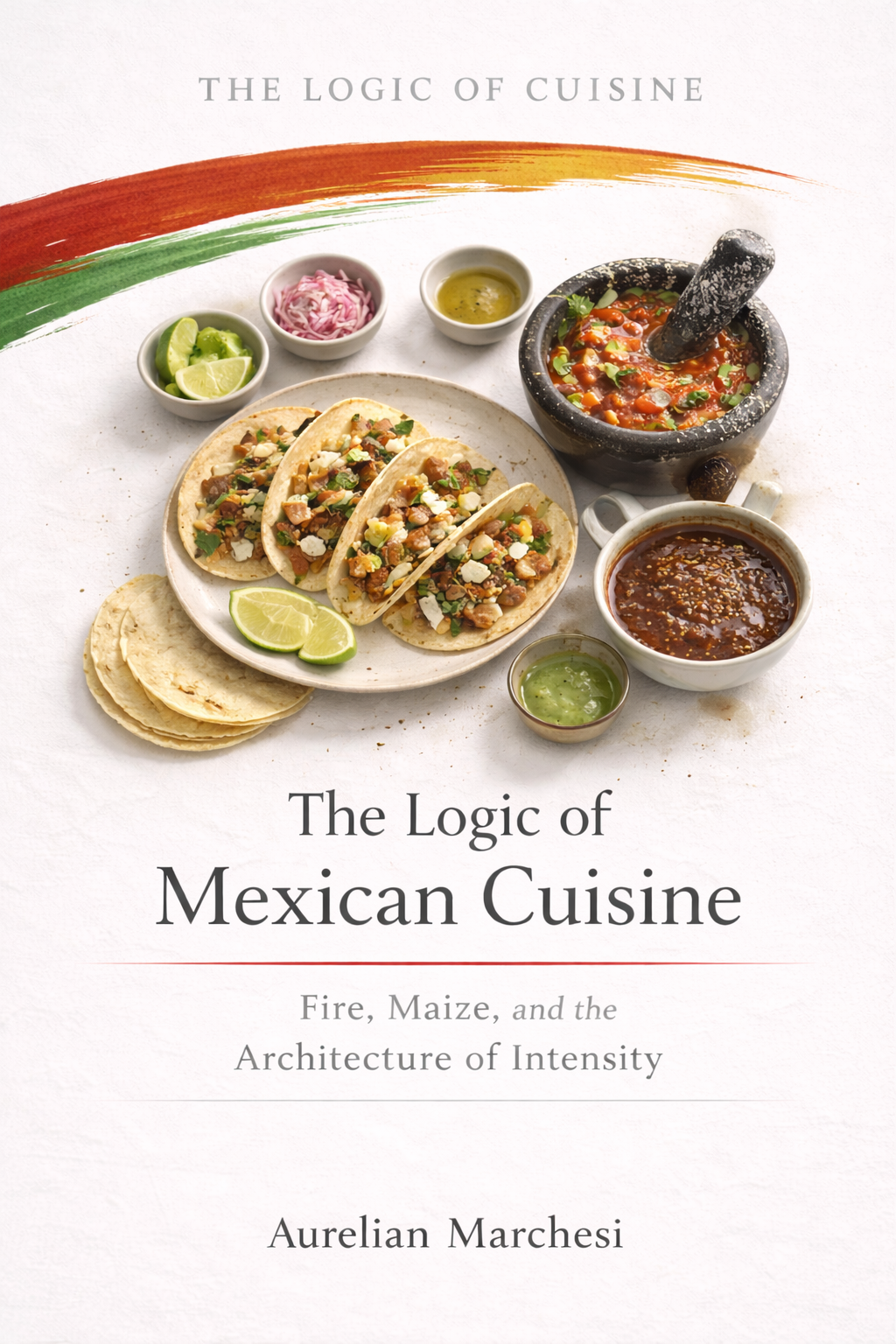
Cover of The Logic of Mexican Cuisine

Book 3 · The Logic of Cuisine

The Logic of Mexican Cuisine

Fire, Maize, and the Architecture of Intensity

By Aurelian Marchesi

Before the chile, before the salsa, there is maize altered by lime, water, labor, and heat. The transformation called nixtamalization turns a grain into masa, and masa into an infrastructure that can be pressed, folded, steamed, carried, shared, and eaten every day. This volume begins from that civilizational foundation rather than from the spectacle of spiciness. It treats Mexican intensity as engineered: bitter, sweet, acidic, smoky, fresh, fermented, and hot signals enter at different moments, each assigned a function. Fire calibrates those signals; condiments complete rather than decorate; long preparation can integrate formidable complexity without letting it become noise. What looks exuberant at the table is held together by a disciplined system of grain, contrast, memory, and repetition.

The central question

How does Mexican cuisine convert maize, chile, fire, fermentation, and contrast into sustained intensity without allowing power to become chaos?

The volume argues that intensity is a managed architecture. Maize supplies nutritional and physical continuity; families of chiles separate aroma, bitterness, sweetness, smoke, and burn; sauces use sequence and time to integrate many elements; acids and fresh condiments reopen the palate at the table. Portable forms such as the taco reveal how this architecture can remain flexible without becoming arbitrary. The cuisine's endurance lies in its capacity to transform materials deeply while preserving a recognizable grammar of contrast.

What this work explores

Nixtamalization makes maize an infrastructure

Maize becomes fully legible only after alkaline processing changes its chemistry, handling, nourishment, and flavor. The book treats nixtamalization as a technology with consequences far beyond one preparation: it creates masa, and masa creates tortillas, tamales, and a range of forms that can function as food, utensil, plate, and portable energy. The tortilla is therefore not understood as a local equivalent of bread. It is part of a distinct material system linking agriculture to everyday sustenance. Repetition does not diminish its importance; repetition is precisely the proof that the system can carry a society.
A chile is a set of functions

The text separates chile from the crude measurement of how much a dish burns. Fresh and dried forms can contribute fruit, grassiness, smoke, earth, bitterness, color, or a delayed heat; toasting and rehydration alter those roles again. This functional vocabulary lets the cook distribute intensity instead of simply escalating it. Capsaicin becomes one signal among several, while fire determines whether aromatic depth is released or bitterness is pushed too far. The result is a heat architecture in which different sensations can arrive, recede, and support one another without requiring every dish to reach the same temperature on the palate.

Mole turns accumulation into sequence

A long ingredient list can suggest indiscriminate abundance, but mole demonstrates the opposite: complexity remains coherent only when ingredients are toasted, ground, introduced, diluted, and rested in an ordered way. Bitterness must be managed rather than erased. Spices enter according to release and endurance, not all at once. Time smooths sharp transitions until no single component claims the whole sauce. The book uses this process as intellectual proof that Mexican complexity is disciplined. Mole does not work because everything is present; it works because every stage limits what the next stage is allowed to do.

The table finishes what the kitchen leaves open

Salsas, acids, herbs, and other condiments are not optional ornaments applied to a completed plate. They allow a meal to remain deliberately unfinished until the eater supplies freshness, sharpness, texture, or additional heat. Raw and cooked salsas answer different needs; acid cuts fat; the molcajete changes texture as it combines ingredients. This table-side agency also explains the taco's modular strength. Tortilla, filling, and condiment can be calibrated in each bite, preserving contrast and adapting to appetite. Completion becomes participatory without surrendering structure.

Foundation, transformation, release

The book's analysis moves through a recurring three-part rhythm. Foundation identifies the durable carrier, above all maize and the forms made from masa. Transformation follows what lime, fire, grinding, fermentation, and time do to raw materials. Release explains how acid, fresh salsa, texture, and shared assembly keep concentrated flavor from becoming exhausting. The framework clarifies why endurance and intensity are not opposites. A stable caloric and social base makes stronger sensory contrasts possible, while the mechanisms of release restore appetite and keep repeated eating viable.

Place in the series

This volume gives the series a model of transformation under pressure. Where other systems preserve clarity through minimal intervention, Mexican logic demonstrates how deep alteration, long integration, and sharp contrast can also remain ordered. Its contribution is the proposition that intensity can be repeatable and nourishing when grain, fire, condiment, and time are assigned stable roles.