Receiving structure
Mesoamerican staple relationships receive introduced animals; Cuban ballast and correction receive ingredients within creole continuity; curry-house infrastructure receives diverse orders through a shared prepared base.
Collection 6 · The Logic of Cuisine
Colonial Legacies and the Architecture of Culinary Transformation
By Aurelian Marchesi
An ingredient may cross an ocean in a season; the relationships that make it belong are rebuilt over generations. Culinary Adaptation follows that rebuilding through three histories that cannot be collapsed into one another: an established Mesoamerican system receiving colonial materials, a Cuban table formed under conquest, enslavement, plantation inequality, and creole continuity, and a British restaurant culture remade by South Asian migrant labor and entrepreneurship. The collection begins not with influence as a decorative list, but with agency: who receives what has arrived, who gives it a new role, and whose work makes the result repeatable.
The collection argues that adaptation is neither passive borrowing nor evidence that unequal histories become harmless at the table. A durable cuisine receives materials, techniques, and demands through an existing or newly built system of staples, correction, labor, service, and social use. Mexican maize and chile relationships redirect introduced livestock; Cuban ballast, citrus, braise, and shared distribution make continuity under unequal conditions; the British curry house converts advance preparation and fast finishing into a locally established public cuisine. What persists is not purity but the authority to make change coherent.
Volume 1
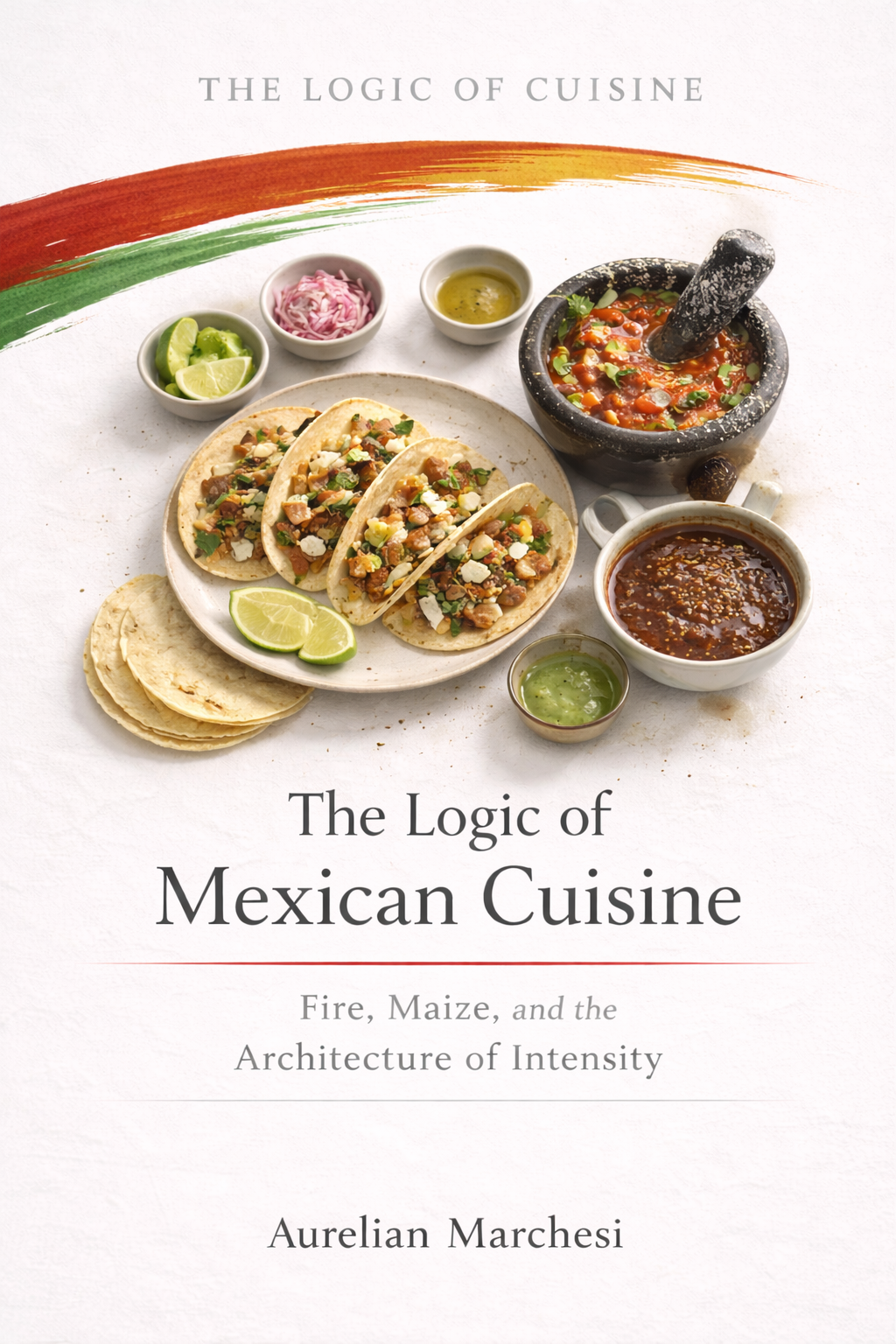
The Mexican volume establishes continuity as active authority: maize, nixtamalization, chile, fire, and adjustable condiments absorb introduced materials without surrendering the system that gives them proportion.
The sequence moves from an established staple system receiving colonial materials to a creole table whose coherence was built through unequal contributions, scarcity, and the preservation of knowledge.
Volume 2
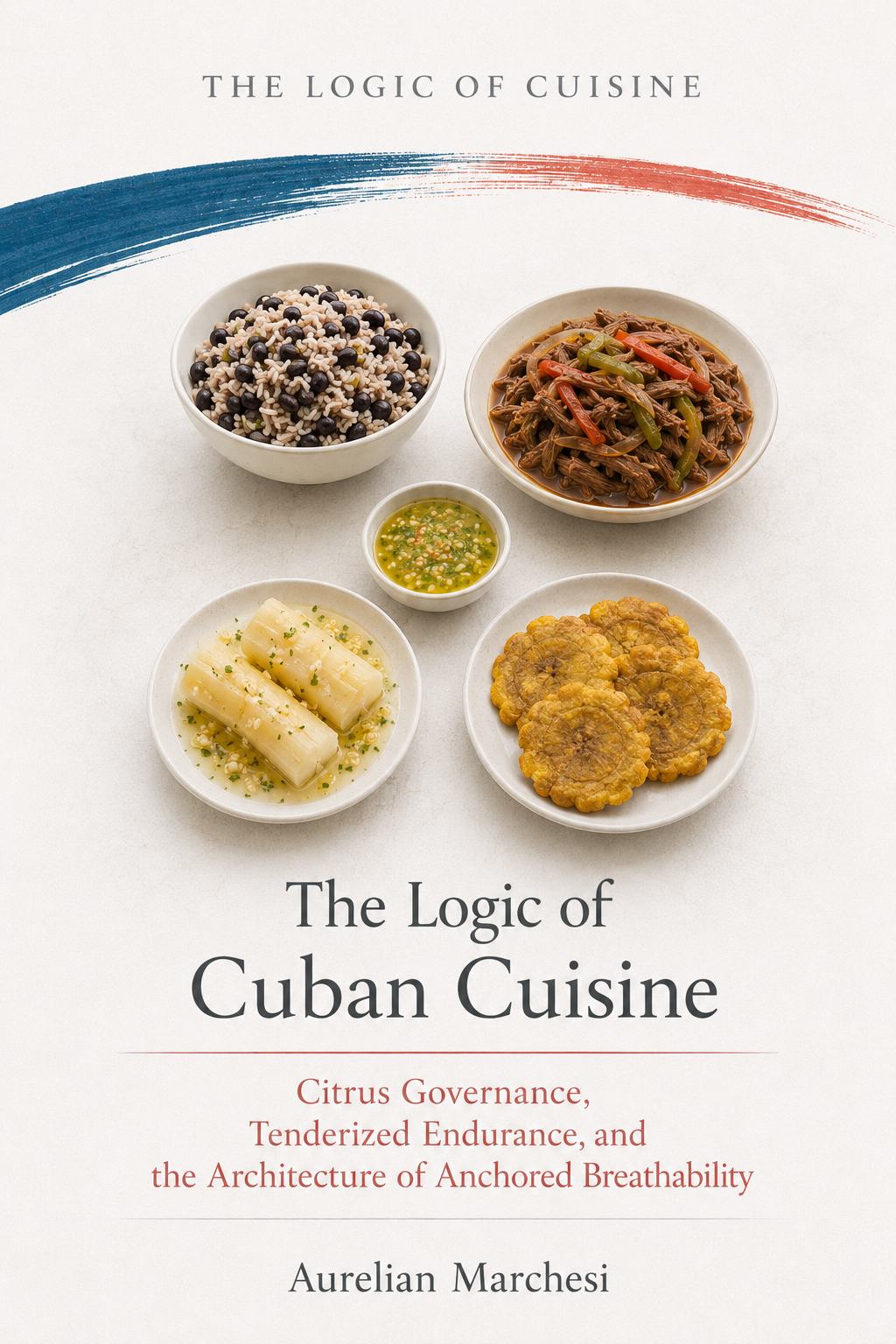
The Cuban volume shows rice and beans, roots, plantains, slow transformation, and citrus governance forming anchored continuity while keeping Afro-Cuban labor and colonial inequality inside the account.
The final movement changes direction: from a Caribbean cuisine shaped under empire to migrant restaurant enterprise that alters everyday eating in the former imperial center.
Volume 3
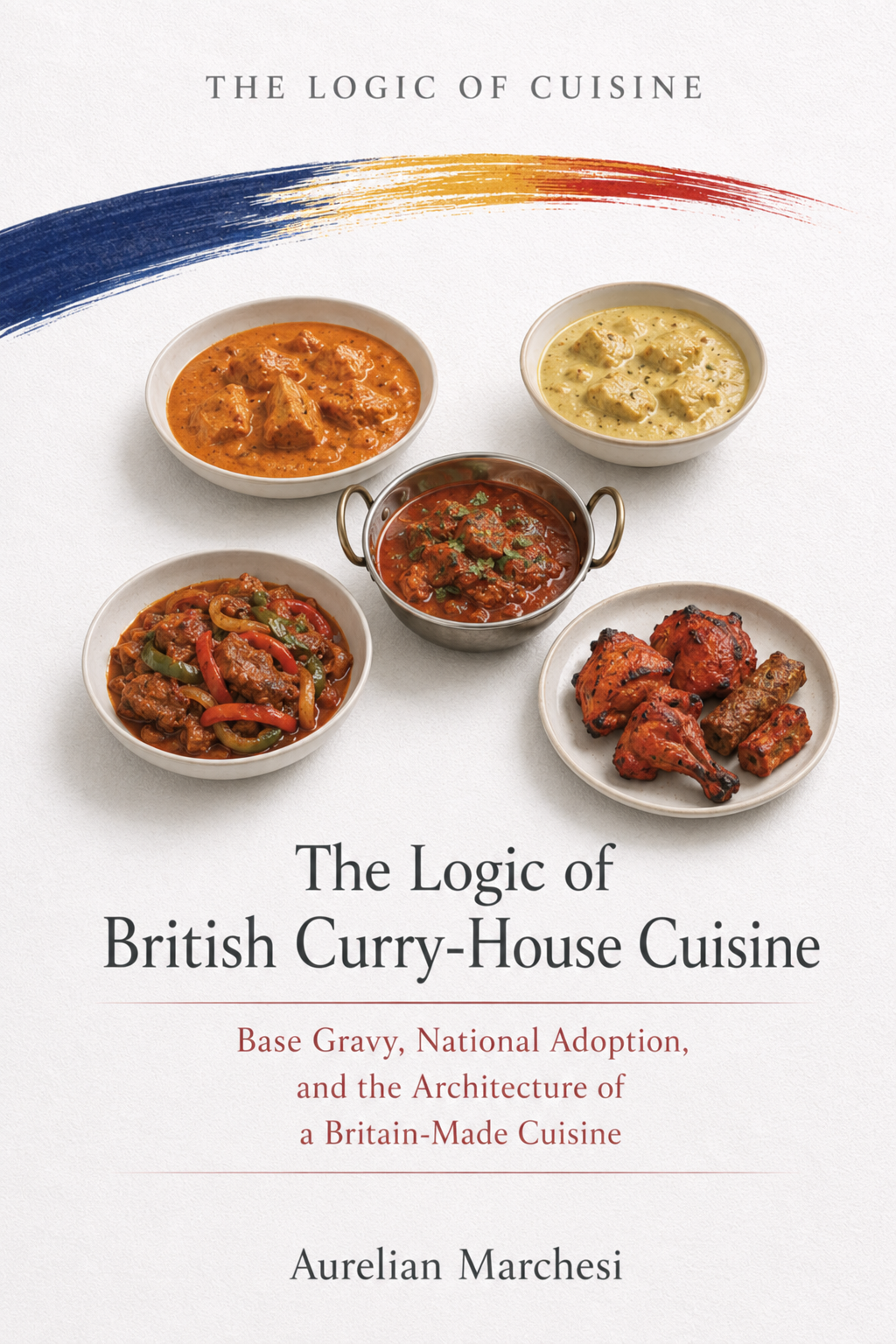
The British curry-house volume completes the route through base gravy, batching, fast finishing, menu families, and group ordering: a migrant-built restaurant system becomes a recognizable part of British public life.
Mesoamerican staple relationships receive introduced animals; Cuban ballast and correction receive ingredients within creole continuity; curry-house infrastructure receives diverse orders through a shared prepared base.
Authority rests respectively with Indigenous continuity under colonial change, Afro-Cuban and other communities working within unequal creole formation, and South Asian migrant cooks and entrepreneurs reshaping British restaurant culture.
The sequence distinguishes incorporation into an older system, continuity formed under colonial entanglement, and a postcolonial return in which migrant enterprise changes the metropolitan table itself.
The canonical order changes the reader's position three times. It begins inside a pre-existing Mesoamerican architecture that redirects arrival; enters a Cuban system where continuity must be read alongside forced movement and unequal labor; and ends in Britain, where migrant restaurant knowledge becomes part of the receiving society's own ordinary identity. The progression is not a chronology of improvement. It enlarges the meaning of adaptation from persistence, to creole formation, to reciprocal transformation of the center.
This collection's distinctive claim is that reinvention becomes intelligible only when the receiving system and the people doing the receiving remain visible. It rejects both purity and frictionless fusion. Culinary change can preserve deep structure, create coherence under unequal conditions, or return through migration to alter the culture of a former imperial center. Comparison reveals those different movements without pretending that their histories are equivalent.
The Mexican volume refuses a history that starts with European ingredients. Nixtamalized maize, the milpa, chiles, grinding, fire, and communal practice already form a complete material intelligence. Introduced pork can become legible because masa receives it, chile directs it, and condiments leave adjustment with the diner. This is not proof that conquest spared the food system; it is evidence of people preserving authority within disruption. The collection uses that prior structure to distinguish adaptation from replacement.
The Cuban volume places rice, beans, roots, plantains, braising, and citrus beside the unequal histories that shaped access and labor. Afro-Cuban knowledge is not an ornamental contribution to an otherwise Spanish kitchen, and the plantation's export wealth is not confused with household nourishment. Ballast and bright correction make dense food livable across ordinary meals and feasts, while the collection keeps the conditions of enslavement and colonial power visible rather than redeeming them through culinary harmony.
The British curry-house volume reverses the usual direction of an imperial story. Migrant cooks, workers, and restaurant families adapt knowledge to rents, supply, service speed, group ordering, and British appetite. Base gravy stores labor before the order; small-pan finishing differentiates familiar menu names; rice, naan, raita, pickles, and chutneys let diners regulate the meal. Public adoption matters, but it does not invent the expertise that makes the restaurant work. Britain-made therefore names a social outcome, not an erasure of South Asian agency.
The comparative method asks three questions in order: what food system or service structure receives the arriving element; which community performs the work of translation; and how power constrains whose adaptation is recognized. That sequence permits comparison without equating conquest, enslavement, and postcolonial migration. A dish becomes evidence only when its staples, regulators, preparation infrastructure, and social setting are read together. Similarity can identify a useful structural question, but it cannot establish a genealogy or transfer ownership of knowledge.
Within The Logic of Cuisine, this collection tests the series vocabulary against historical movement. The component books explain how three systems hold together; the collection asks how that coherence responds when ingredients, labor, and appetite cross boundaries marked by power. Its contribution is methodological as well as historical: structural comparison must name communities and limits, not turn all adaptation into the same celebratory story.