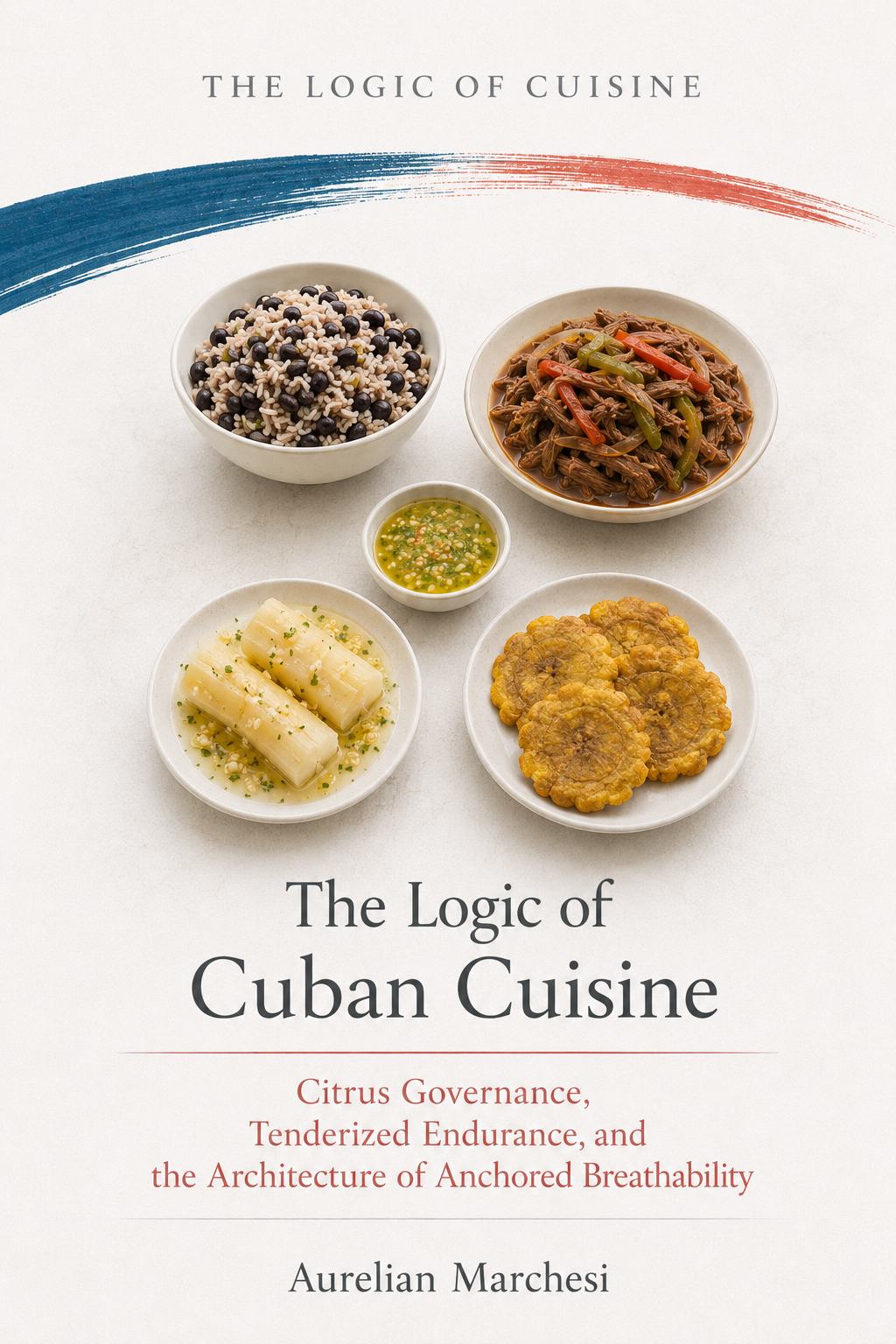
Cover of The Logic of Cuban Cuisine

Book 17 · The Logic of Cuisine

The Logic of Cuban Cuisine

Citrus Governance, Tenderized Endurance, and the Architecture of Anchored Breathability

By Aurelian Marchesi

Citrus enters Cuban food as a force that changes the meaning of richness. It penetrates a marinade, wakes a braise, gives yuca an edge, and keeps roast pork from closing the palate. Yet the meal does not float on brightness. Rice, beans, maize, plantain, and roots provide the weight that allows acid, smoke, fat, and tender meat to travel. The volume examines this partnership between anchor and breath. Hurricane cycles, scarcity memory, sugar economies, migration, coast, and interior supply pressure; braise and charcoal supply transformation. What is often remembered as simple comfort emerges as an engineered capacity to soften resistance and preserve satisfaction without letting endurance harden into heaviness.

The central question

How do starch anchors, citrus regulation, smoke, braise, and migration-shaped adaptation create a Cuban cuisine able to endure scarcity and abundance without losing breathability?

The work argues that Cuban coherence depends on paired structures. Starches and legumes stabilize appetite while citrus reopens richness. Long braising turns resistant cuts and scarcity into tenderness; smoke and grilling create decisive surfaces. Coastal brightness and inland density are not rival cuisines but different loads carried by the same anchoring and corrective grammar. Migration adds layers, yet those layers become Cuban when they are routed through familiar relations among starch, fat, acid, gentle heat, and shared distribution.

What this work explores

Anchors turn intensity into a meal

Rice, beans, maize, plantain, yuca, and other roots carry more than calories. They receive braising liquid, rendered fat, citrus, smoke, and concentrated seasoning, distributing those forces across a plate that can sustain ordinary appetite. Their repetition is structural continuity rather than imaginative failure. Moros y Cristianos and the plato cubano make the principle visible: components remain distinct, but starch and legume provide the ballast that lets meat or sauce be forceful without needing to dominate every bite.
Citrus governs richness

Sour orange, lime, and other acidic forms do not merely brighten a finished plate. They alter meat before heat, carry garlic and aromatics, draw boundaries around fat, and restore appetite after braise or roast. Mojo demonstrates how acid can be both preparation and correction. The book treats citrus as irreplaceable because it allows tenderness and richness to remain generous without becoming sealed or dull. Breathability is the sensory consequence of acid keeping dense materials in motion.

Braise transforms endurance

Long, moderate cooking is a response to resistant cuts, fuel realities, time, and the need to distribute protein. Ropa vieja becomes the volume's concentrated example: fibers surrender without disappearing, sauce carries their flavor across anchors, and a difficult material becomes generous through patience. Tenderness is therefore not luxury alone. It is a way of converting constraint into a texture that can feed many and survive repetition, while the plate's citrus and starch prevent the result from becoming monotonous.

Feast scale depends on shared correction

Lechón asado concentrates the problem of abundance: surface, smoke, fat, tender meat, and ceremonial scale can overwhelm unless the surrounding meal distributes them. Rice and beans, yuca with mojo, breads, vegetables, and acidic condiments give the roast routes into the table. Nochebuena succeeds when the centerpiece remains part of an architecture rather than becoming the whole event. Scale is managed by preserving correction and shared access as the quantity of food and number of diners increase.

Anchor, tenderize, reopen

The volume moves from island pressure and material history to three recurring operations. Staples first establish carrying capacity. Braise, smoke, and grill transform resistant or rich materials into concentrated forms. Citrus, gentle heat, accompaniments, and plate composition then keep those forms breathable. Ropa vieja demonstrates tenderness under constraint; lechón tests surface and scale; the plato cubano and portable forms show how the grammar survives daily and mobile eating. Coast and interior, scarcity and feast, inheritance and migration are read through these operations rather than flattened into a single origin narrative.

Place in the series

This volume adds an island system in which breathability emerges from the partnership of dense anchors and acid governance. It shares rice-and-bean infrastructure with other Caribbean and Latin American traditions, but within The Logic of Cuisine its distinctive emphasis falls on citrus as the regulator of tenderized endurance. It also extends the series' treatment of migration by showing adaptation held together through recurring material relationships rather than purity claims.