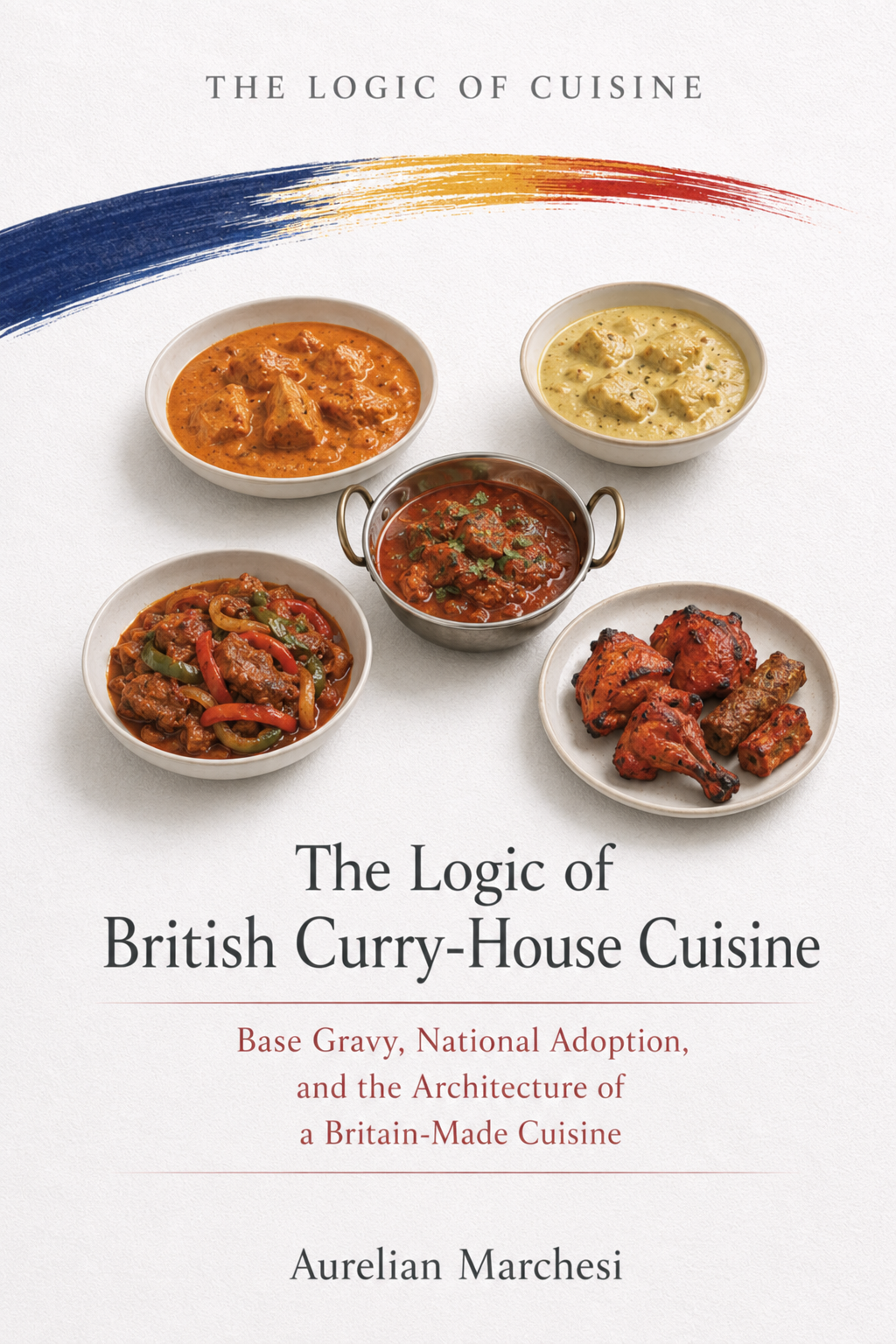
Cover of The Logic of British Curry-House Cuisine

Book 18 · The Logic of Cuisine

The Logic of British Curry-House Cuisine

Base Gravy, National Adoption, and the Architecture of a Britain-Made Cuisine

By Aurelian Marchesi

The curry-house menu presents variety as if each sauce began in isolation. Behind the dining room, the opposite is true. A shared base carries cooked onion, aromatics, liquid, and time; a fast pan finish branches that infrastructure into recognizable families with different heat, sweetness, texture, and aroma. Rice, naan, grills, pickles, chutneys, and shared ordering enlarge the system beyond any one curry. This volume enters the kitchen through that apparent contradiction: standardization makes variation possible. It argues that decades of diaspora labor, British service pressure, repetition, and public adoption produced not a weak imitation of another cuisine, but a stable Britain-made grammar whose identity lies in infrastructure, velocity, and collective recognition.

The central question

How did diaspora practice, restaurant service pressure, base-gravy infrastructure, fast finishing, and British public ritual produce a distinct and reproducible cuisine?

The book proposes that curry-house identity resides in a production and meal architecture. Base gravy stores common work without deciding the final dish. Rapid pan finishing turns that common base into sauce families legible to diners. Grills, starters, rice, breads, condiments, and group ordering provide contrast and correction. Repeated across cities and decades, this grammar becomes publicly recognizable and socially adopted. Adaptation is treated not as dilution by default but as disciplined invention under the combined demands of labor, speed, consistency, and appetite.

What this work explores

Base gravy separates infrastructure from identity

The common base is not presented as a finished sauce or a shortcut that makes every dish identical. It stores labor in a fluid foundation capable of receiving different finishing decisions. Its neutralized onion body, aromatics, and consistency allow a pan to move quickly while still supporting multiple branches. The distinction between infrastructure and final identity explains how a broad menu can remain operational under service pressure. Variety is credible because the shared layer is designed to disappear into the specific heat, fat, sweetness, reduction, and additions of each family.
The finish branches a stable grammar

Batching prepares components upstream; the pan creates the moment of differentiation. Heat, reduction, spice, cream or coconut, tomato, fresh aromatics, pre-cooked protein, and oil can be sequenced to produce sauce families whose names carry reliable expectations. Korma, madras, bhuna, and jalfrezi are read as branches with distinct balance geometry rather than disconnected recipes. Velocity matters because the finish must create adhesion, aroma, and recognizability before service rhythm breaks. Speed is therefore the consequence of preparation and practiced decision, not evidence of carelessness.

The meal exceeds the curry bowl

Rice and naan absorb and pace sauces; pickles and chutneys cut or redirect richness; grills offer smoke and drier texture; starters establish a shared rhythm before mains arrive. Group ordering permits diners to move among mild, hot, rich, dry, crisp, and cooling elements. The book's meal architecture therefore explains why judging one curry in isolation misses the system. Satisfaction is routed across contrasts, and the table can correct the excess of one branch with another element designed for relief.

Adoption turns adaptation into cuisine

Diaspora cooks, restaurant economics, regional experiments, and British diners repeatedly negotiated what could be produced quickly and recognized reliably. Flagship forms such as chicken tikka masala and balti demonstrate different kinds of adaptation, but their significance lies in recurrence across a public system. National adoption does not erase South Asian origins or labor; it describes the point at which a developed restaurant grammar becomes part of British social life. The cuisine is made through relation, repetition, and recognition rather than through a claim of untouched domestic inheritance.

Infrastructure, branching, public recognition

The volume connects kitchen organization to cultural identity. Service pressure first establishes the need for scalable preparation. Base gravy and batching store common work; fast pan finishing creates recognizable branches; rounded heat, clinging sauce, rice, bread, condiments, grills, and shared ordering make those branches satisfying at table. Chicken tikka masala and balti test adaptation in different forms, while mass-market drift reveals what disappears when finish, texture, or distinction are simulated without the underlying system. The framework judges cuisine through stable production, sensory legibility, and repeated public use rather than through purity alone.

Place in the series

This volume gives The Logic of Cuisine its most explicit account of a modern restaurant system becoming a nationally adopted cuisine. It belongs beside the Indian volume but does not claim to summarize Indian domestic or regional food. Its subject is the Britain-made grammar produced through diaspora, commerce, adaptation, and ritual. That makes it central to the series' wider inquiry into migration, identity, and reinvention.