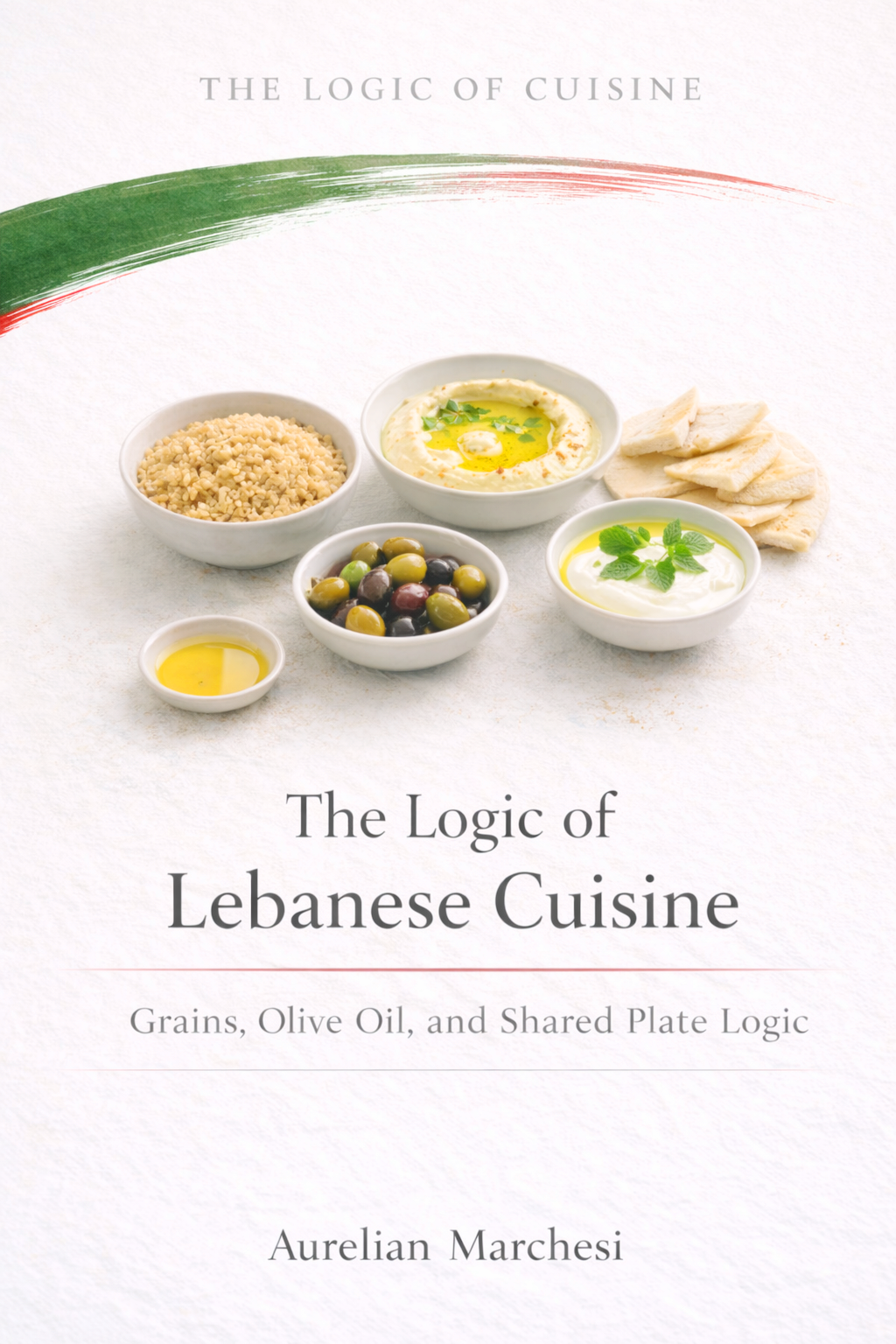
Cover of The Logic of Lebanese Cuisine

Book 14 · The Logic of Cuisine

The Logic of Lebanese Cuisine

Grains, Olive Oil, and Shared Plate Logic

By Aurelian Marchesi

A Lebanese table does not ask one plate to be complete. Bread travels between bowls; a spoonful of pulse or grain gives weight to herbs and acid; olive oil carries garlic or spice until lemon, yogurt, brine, or a raw vegetable opens the palate again. What appears to be profusion is a distribution system. The meal can grow through additional modules without losing its center because hunger, richness, freshness, and intensity are handled by different actors. This volume reads the shared table as a form of culinary governance. It moves from mountain and coast to bread, emulsion, grill, meze, feast, and diaspora, asking how abundance remains bright when every plate is designed to repair or complete another.

The central question

How does Lebanese cuisine distribute hunger, richness, acid, freshness, and social choice across a shared table so that abundance remains coherent rather than exhausting?

The book proposes modular distribution as the cuisine's central strength. Bread routes bites and sauces; grains and legumes secure appetite; olive oil binds; acid, cultured dairy, herbs, and brine prevent fatigue; meat can remain an accent because other elements carry satiety. Meze is therefore not a picturesque collection of small plates but a system of portion, timing, correction, and shared agency. The table holds when each module performs a limited role and remains available to combine with the rest.

What this work explores

Bread routes the meal

Bread is treated as an active interface between eater and table. It gathers hummus, salad, grilled meat, oil, and juices; it changes portion and sequence; it lets several dishes occupy one bite without requiring a fixed course. Because it is shared and repeatedly torn, bread also distributes access. Removing it leaves a set of plates but weakens the grammar that joins them. The volume's insistence on routing makes clear that a staple can organize movement and relation, not merely supply bulk.
Staples make generosity sustainable

Grains, chickpeas, lentils, and other legumes do more than support celebrated dishes. They carry hunger reliably and allow more volatile or expensive elements to remain accents. Hummus illustrates buffered abundance: pulse density and tahini richness are opened by lemon, garlic, oil, and the movement of bread, producing satisfaction that can be revisited rather than endured. The argument relocates luxury from meat volume to the quality of relations among staple, fat, acid, and shared access.

Brightness is engineered correction

Olive oil creates continuity across grains, vegetables, emulsions, and grilled foods, but it is not left unchecked. Lemon, yogurt, brine, raw onion, tomato, and herbs create exits from richness. Their work differs: acid sharpens boundaries, cultured dairy cools and rounds, herbs lift aroma, and crisp vegetables restore texture. Brightness therefore results from correction repeated across the table. The palate stays alert because every dense bite can be answered by another module with a different temperature, texture, or direction.

Sharing is a scaling mechanism

Meze and feast are connected by the same capacity to add modules without forcing every diner into an identical sequence. A table can expand through more dips, salads, grills, grains, breads, and pickles while preserving familiar routes among them. Shared timing distributes choice and risk: one plate can compensate for another, and each person can regulate richness or intensity. Scale succeeds not by making one centerpiece ever larger, but by preserving the network as the number of participants grows.

Modules, routes, and correction

The work maps the Lebanese table as a network. Material conditions explain why stored staples, seasonal vegetables, oil, and portable bread matter. Transformation engines such as emulsion, chopping, simmering, and grilling give those materials distinct functions. Balance geometry then tracks how bulk, fat, acid, herbs, cultured dairy, and brine regulate one another. Hummus and kibbeh provide focused proofs, while meze and feast show the same principles under social load. The framework asks less whether a dish is present than whether the routes among dishes still permit hunger, pleasure, relief, and sharing to remain in balance.

Place in the series

This volume expands The Logic of Cuisine from the architecture of a dish to the architecture of shared choice. Mediterranean staples and olive oil connect it with the Italian, Greek, Spanish, and Turkish volumes, but Lebanese logic is distinguished by the explicit routing work of bread and by a table whose modules correct one another in real time. It demonstrates that coherence need not require a fixed sequence or dominant center.