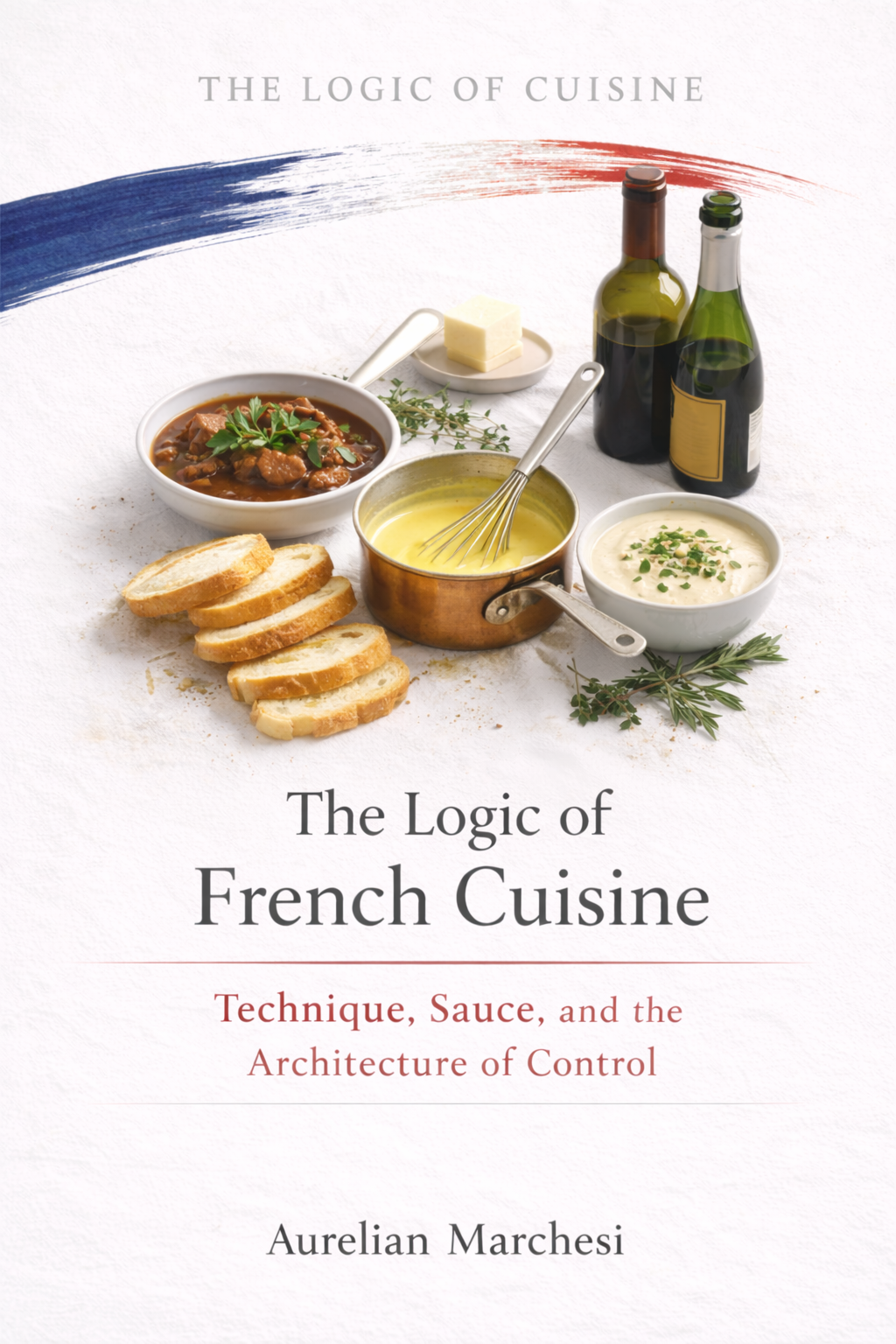
Cover of The Logic of French Cuisine

Book 6 · The Logic of Cuisine

The Logic of French Cuisine

Technique, Sauce, and the Architecture of Control

By Aurelian Marchesi

The polished plate arrives at the end of the story. This volume begins earlier, with unstable seasons, perishable food, crowded kitchens, repeated service, and the moment when intuition alone can no longer guarantee the same result. French cuisine is read here as an answer to that problem. Methods acquire names, steps become transferable, stocks preserve and concentrate value, sauces regulate texture, and a hierarchy of labor makes correction possible under pressure. Refinement appears, but as the consequence of a system that has rehearsed away uncertainty. The book's interest is not in teaching a canon of techniques. It is in understanding why technique became an authority capable of outliving particular ingredients, institutions, and even the cuisine's own borders.

The central question

What happens when a cuisine makes repeatability, correction, and control over heat, time, liquid, and labor more important than individual improvisation?

The book proposes that French culinary influence rests on a portable operating language. Ingredients and circumstances may vary, but codified methods define expected behavior: stocks extract within controlled time, sauces bind and stabilize, cuts are matched to heat, courses pace appetite, and the brigade assigns responsibility. This system reduces failure and enables knowledge to move between cooks and kitchens. Elegance is not dismissed, but relocated: it is what disciplined structure can look like once the work supporting it has become nearly invisible.

What this work explores

Method becomes a shared language

Naming and repeating technique allows one cook's judgment to become institutional knowledge. A method specifies order, temperature, texture, and signs of correction, giving the next practitioner more than a finished example to imitate. Ingredients can change while the operation remains intelligible. This codification makes scale possible because a kitchen does not have to rediscover its standards during every service. The volume treats such language as governance: it narrows uncertainty, clarifies responsibility, and creates a basis for teaching, comparison, and repair.
Sauce exercises structural authority

A sauce is judged by the relations it can maintain. Reduction concentrates while controlling water; emulsification holds unlike phases together; thickening changes adhesion and movement; seasoning places the liquid in proportion to the food it connects. These mechanisms make sauce load-bearing rather than decorative. It can unify separate elements, regulate dryness, and carry the history of a stock without requiring ingredients to disappear beneath it. When the system fails, over-reduction, broken emulsions, or excess fat make the error tangible. Control is therefore sensory as well as procedural.

Stocks turn time and remnants into capacity

Bones, trimmings, aromatics, and water become useful not by concealment but by controlled extraction. Slow heat releases gelatin and soluble flavor while skimming and timing protect clarity. The resulting stock is both economy and stored potential: material that might have been discarded becomes the basis for sauces, soups, braises, and corrections elsewhere in the kitchen. Depth is built in advance, making later service faster and more reliable. The stock pot reveals how French control links thrift to authority; it makes time available for reuse.

Sequence governs appetite and labor

The architecture extends beyond the pan. Course order regulates escalation, relief, portion, and duration for the diner, while the brigade distributes preparation and accountability among the people producing that sequence. These are related solutions: both divide complexity into manageable intervals. A meal can build without exhausting appetite because no course must carry every sensation; a kitchen can repeat service because no station must perform every task. The institution and the table mirror one another in their reliance on pacing, delegation, and clear transitions.

Standardize, observe, correct

The volume's framework follows the cycle by which control becomes transferable. A method first establishes a standard for behavior. The cook then observes texture, temperature, concentration, color, and timing against that standard. Correction returns the process toward its intended state before failure becomes irreversible. This cycle applies to an emulsion, a stock, a cut of meat, a course sequence, or an entire kitchen. It also explains why French technique travels: the framework is not tied to one pantry, even though its historical forms emerged from particular climates and institutions.

Place in the series

For the wider series, this book examines cuisine as an institution of reproducible knowledge. Its focus on codification and correction differs from systems whose continuity depends more visibly on household memory, seasonal guardianship, or table-side adjustment. The volume shows how a local response to uncertainty became a technical vocabulary used far beyond its original cultural setting.