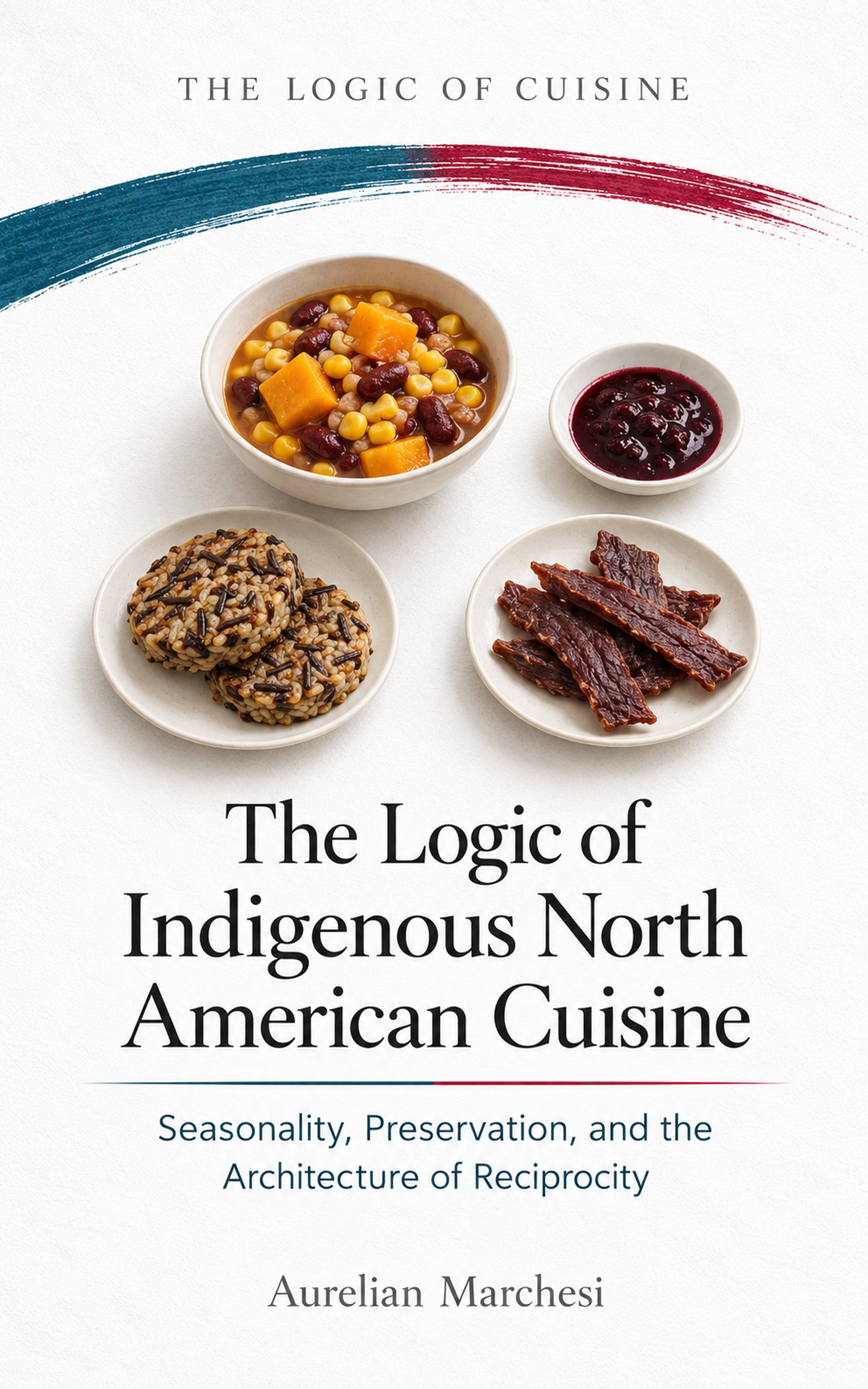
Cover of The Logic of Indigenous North American Cuisine

Book 25 · The Logic of Cuisine

The Logic of Indigenous North American Cuisine

Seasonality, Preservation, and the Architecture of Reciprocity

By Aurelian Marchesi

Coming Soon

This book examines selected Indigenous North American foodways through a deliberately limited comparative lens. It begins with specific lands and waters, brief abundance windows, long scarcity windows, and the knowledge required to decide what can be eaten now, what must be kept, and what may bridge both moments. The examples do not define a single Indigenous cuisine, speak for distinct nations, or establish authenticity or community endorsement. Their comparative value lies in relationships that can be examined without erasing difference: place-fit staples, seasonal timing, preservation, portable density, distribution, and reciprocity. The governing discipline is to keep every structural insight attached to its ecological and cultural limits.

The central question

Across selected and distinct foodways, what can comparison reveal about seasonality, preservation, distribution, and reciprocity without claiming universal authenticity, community endorsement, or cultural authority?

The volume proposes a bounded sequence for reading selected cases. Begin with what a particular land and water system can repeatedly support. Distinguish immediate foods from materials able to dry, smoke, parch, cellar, or otherwise cross seasons, while recognising bridge foods such as salmon or berries whose fresh and preserved forms do different work. Examine how a local staple carries the meal, how concentrated stores are reopened through broth, berries, herbs, or other contrast, and how abundance is routed among people and future needs. Comparison remains valid only while distinct nations, places, and community authority are not replaced by a universal claim.

What this work explores

Distinct foodways, bounded comparison

The singular title names an interpretive frame, not one Indigenous cuisine. Wild rice belongs to particular waters; salmon runs, maize systems, desert seeds, roots, game, and gathered plants arise from different ecologies and histories. A recurring structural question—how brief local abundance can support continuity—does not make the answers interchangeable. The page therefore treats each example as a bounded evidence field and does not use resemblance to imply a universal practice. The reader may compare the jobs performed by season, storage, movement, and sharing, but must return every claim to the people, place, and source limits that make the case specific.
Abundance is a time-bound responsibility

Abundance is time-bound responsibility because foods do not share the same window or storage behaviour. Fresh greens, tender berries, or delicate fish may be now-foods whose value lies in immediacy. Dry beans, grains, squash, roots, or carefully prepared meat may become store-foods that form a year-round backbone. Salmon and berries can also act as bridge foods: vivid in their brief season, then transformed into smoked fish or concentrated dried forms that return later with a different role. The distinction directs attention from harvest as event to the decisions that prevent a pulse of plenty from becoming later hunger or waste.

Land-fit staples perform structural work

Land-fit staples perform structural work only in relation to the places that sustain them. In selected agricultural contexts, corn, beans, and squash form complementary field and meal relations: support, protein, starch, fresh use, and storage connect cultivation to the pot. In particular lake and river systems, wild rice or fish may anchor a different seasonal architecture; in drier regions, seeds, roots, or drought-tolerant fruits answer another pressure. The argument does not promote one food as a universal marker. It asks which recurring material carries nourishment, can be responsibly renewed, and remains accountable to the local cycle from which it comes.

Preservation carries relationship forward

Drying, smoking, parching, rendering, and related keeping methods convert a narrow window into later capability. Removing moisture can make grain, fish, meat, or seeds safer to store and easier to transport; smoke and heat alter both keeping behaviour and the concentrated flavour that later cooking must receive. A dense module can travel, be eaten directly, softened in water, or enter broth with other stored materials. Preservation is therefore not a detached technique but a change in the social and temporal life of food. The comparison remains bounded: no single method, preparation, or portable form is presented as representative of every community.

Reciprocity includes routing and whole use

Reciprocity is examined through routing rather than treated as an ornamental value. In selected examples, abundance can create obligations to limit taking, leave future capacity, distribute food, preserve surplus, reopen stores carefully, and use bones, skins, connective tissue, or less celebrated portions in later meals. Feast scale intensifies those questions because access, arrival time, portioning, and what remains afterward become visible. This analysis does not claim community approval or prescribe practice. It identifies a relationship the sources foreground: continuity depends not only on keeping food, but on decisions about who receives it, what is carried forward, and whether the source can renew.

A comparative lens with explicit limits

The framework is a comparative lens with explicit limits. For each selected case, ask four questions: what does this specific place and season support; which foods are immediate, storable, or able to bridge both states; how are concentrated stores balanced, recombined, and distributed; and what obligations accompany abundance and future renewal? Concrete examples—Three Sisters combinations, wild rice preparations, smoked fish or meat, berry corrections, broths, and portable density—remain evidence of particular cases, not a universal menu. The framework permits structural comparison only when it refuses authenticity policing, community endorsement, cultural authority, and the substitution of one nation's knowledge for another's.

Inside the work

Refusal of stereotype

The opening movement refuses stereotypes and begins with land, water, season, and distinct foodways. It replaces a list of iconic foods with the pressure created by narrow harvest windows, perishability, storage, mobility, and future access.

Season, storage, and correction

The argument then distinguishes now-foods, store-foods, and bridge-foods; follows place-fit staples; and examines drying, smoking, parching, broth, berries, herbs, and restorative contrast as different responses within selected cases.

Selected forms as evidence

Selected forms such as Three Sisters stew, wild rice preparations, fish-and-grain combinations, smoked foods, berry sauces, and portable meat preparations test how anchor, preservation, recombination, and distribution may interact without becoming exhaustive symbols.

Colonial pressure and adaptation

Chapters 14–15 follow colonial pressure, substitution, adaptation beyond original ecologies, and contemporary continuity. The public editorial page then applies the blurb's explicit boundary to that material: selected comparison cannot establish authenticity, speak for distinct nations, or replace present community authority.

Place in the series

Within The Logic of Cuisine, this volume makes the limits of comparison part of the analytical architecture. It asks how selected relationships among land, season, preservation, movement, sharing, and renewal can be discussed while distinct peoples and places remain visible. Its contribution is methodological as much as culinary: a recurring pressure does not create a single culture, and a shared technique does not authorize a universal claim. The series' vocabulary is useful here only when it increases resolution, preserves bounded evidence, and refuses to convert selected cases into a universal Indigenous identity.