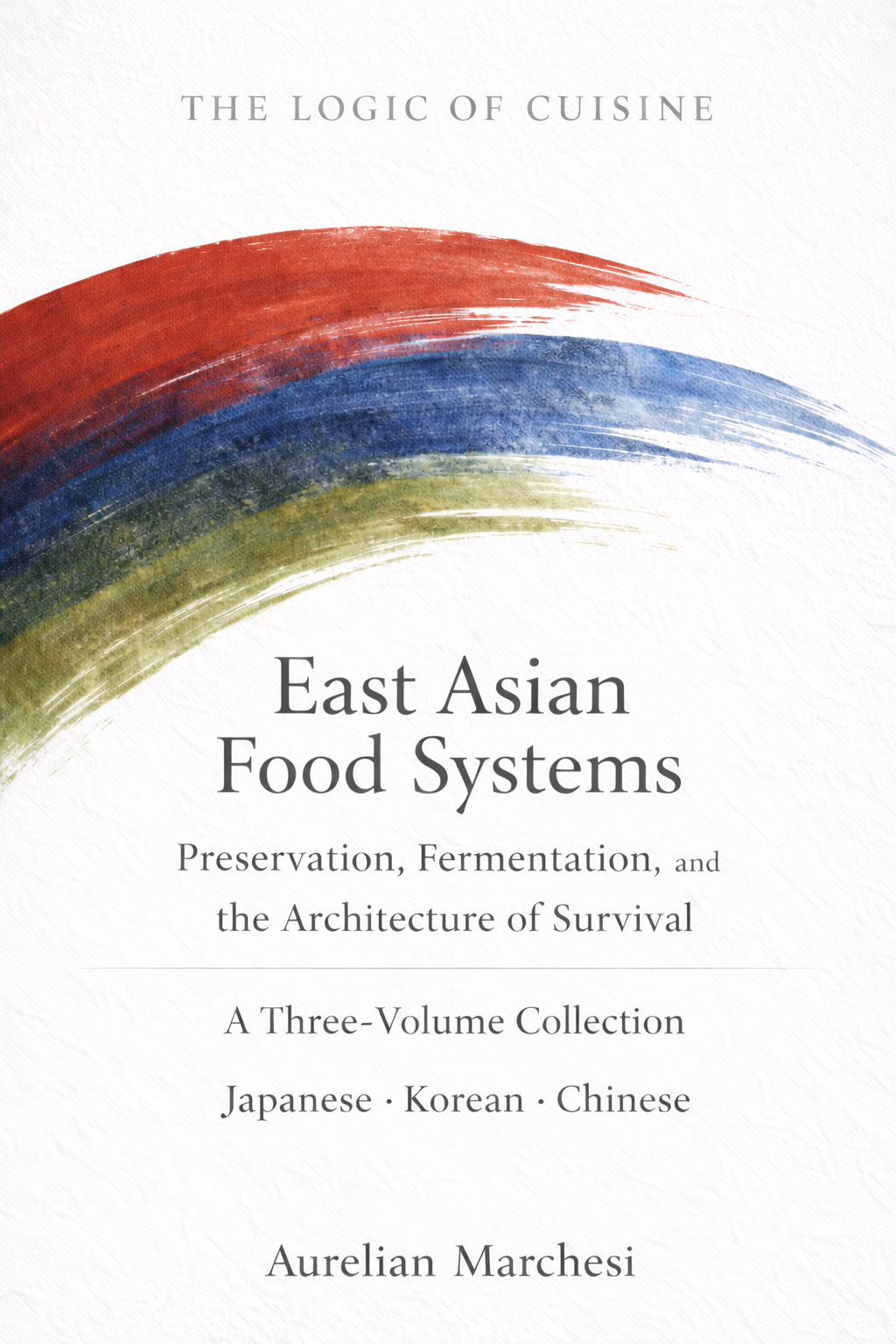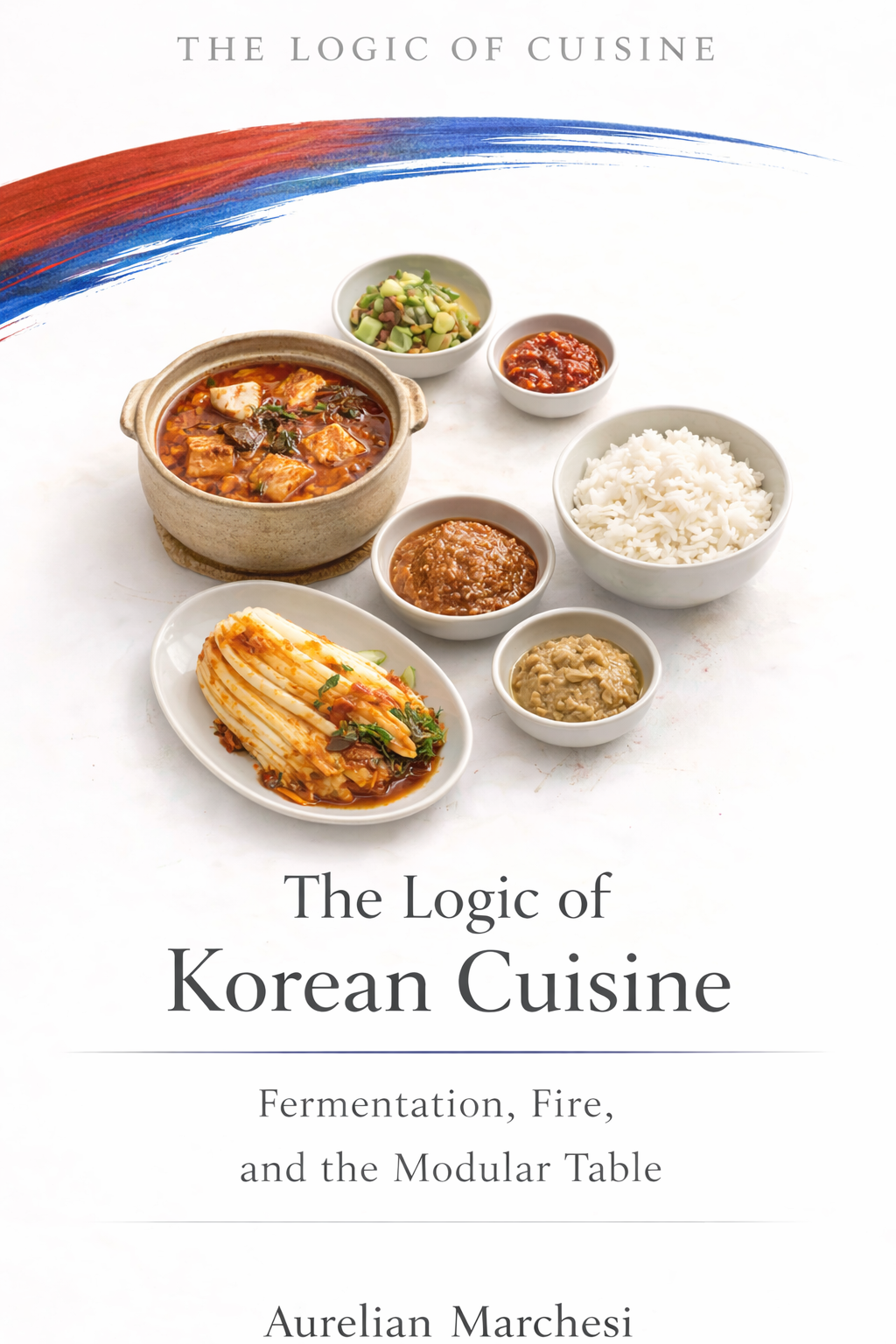
Cover of The Logic of Korean Cuisine

Book 11 · The Logic of Cuisine

The Logic of Korean Cuisine

Fermentation, Fire, and the Modular Table

By Aurelian Marchesi

A Korean meal can look crowded before it becomes intelligible. Bowls and small plates seem to compete until rice steadies one bite, soup clears the next, kimchi restores acidity, and a fermented paste joins what might otherwise remain separate. The volume begins with an even quieter architecture: winter, salt, clay vessels, and time. Under seasonal pressure, preservation becomes more than defense against loss. It creates a pantry in which depth already exists before the stove is lit. From that stored time, the table can distribute strong flavors without allowing any single one to seize control. The book follows this movement from jar to fire to shared table, showing how Korean abundance stays readable because its intensity is assigned roles, buffered by anchors, and renewed through alternation.

The central question

How does Korean cuisine store seasonal time in fermentation, then distribute that accumulated depth across a modular table without producing heaviness or sensory collapse?

The work recasts fermentation as infrastructure and the Korean table as a network rather than a display. Jang supplies ready depth; kimchi carries acidity, texture, and continuity; controlled heat activates rather than obscures; rice and soup create a route back to calm; banchan distribute contrast and correction. Dishes therefore emerge as coordinated outcomes of a pantry and table designed for repetition. The proposition is not that Korean food avoids force, but that force becomes sustainable when time is stored upstream and each element is disciplined by what surrounds it.

What this work explores

Winter writes the pantry

Cold seasons make freshness unreliable and turn storage into a governing condition. The volume treats salt, microbial transformation, placement, temperature, and breathable onggi as a domestic risk-management system. Food is not simply arrested in an earlier state; it is allowed to change within boundaries until scarcity has been converted into concentrated possibility. This distinction explains why fermentation occupies so much of the cuisine's structural space. The jar performs work across time, preserving harvests while creating the sourness, savor, and aromatic depth on which later meals depend.
Jang places the load-bearing beam

Doenjang, ganjang, and gochujang appear not as interchangeable condiments but as fermented bases with distinct structural work. One contributes body, another clarity and salinity, another rounded heat and sweetness. Because each already contains time, salt, and transformation, cooking can be comparatively brief: heat releases and binds complexity that was prepared long before. The cook is asked to choose the correct beam rather than to stack flavor endlessly. This is how soups, stews, marinades, and vegetable dishes can differ while remaining recognizably connected.

The table distributes complexity

Banchan become legible when read by function rather than by count. A fermented element provides continuity, a crisp or pickled bite clears richness, a seasoned vegetable softens an edge, and a fresh component changes pace. Shared placement lets the eater compose these relations bite by bite. Variety is therefore modular: ingredients can change while the roles remain stable. Abundance avoids confusion because no plate is expected to contain the whole argument, and social sharing becomes a form of regulation rather than mere presentation.

Intensity always builds a return path

Red color and grilled meat can obscure the cuisine's attention to recovery. Gochugaru may bring aroma and lift, while gochujang carries slower fermented warmth; neither operates alone. Rice absorbs and paces, soup resets temperature and palate, acidity reopens appetite, and crunch interrupts density. The book measures heat by its place in this sequence: it should wake the meal and then settle. Korean food can remain forceful across daily repetition because every intensifying gesture is paired with a stabilizer or release.

Stored time, assigned roles, governed intensity

The analysis moves through three linked scales. Fermentation explains how seasonal time becomes durable flavor. Thermal and sensory mechanisms show how that stored depth is activated without becoming blunt. Table architecture then reveals how anchors, fermented elements, fresh relief, and shared modules regulate one another during eating. Iconic dishes serve as tests of recurrence, not destinations: jjigae activates fermentation through simmer, bibimbap compresses modularity into a bowl, and barbecue remains answerable to wraps, pickles, rice, and soup. The framework lets a reader recognize Korean logic by relationships rather than by a fixed ingredient inventory.

Place in the series

Within The Logic of Cuisine, this volume offers the series' clearest study of time deliberately stored before cooking and complexity deliberately distributed at the table. It complements the Japanese volume's attention to clarity while rejecting the idea that clarity requires sparseness: Korean coherence can arise from many active elements when their roles remain distinct. It also prepares the East Asian collection's comparison of different ways fermentation, broth, starch, heat, and communal structure produce recognizable systems.