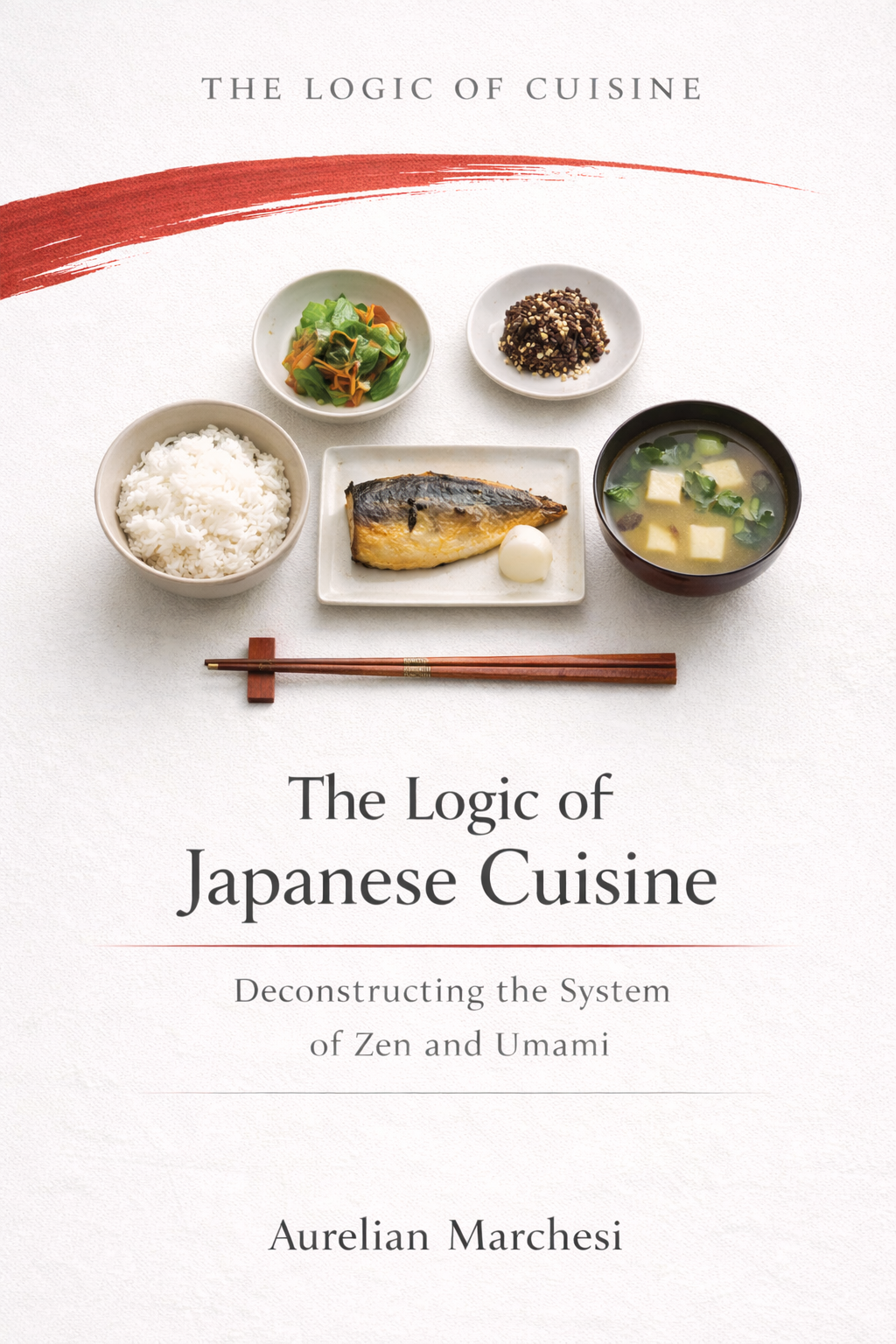
Cover of The Logic of Japanese Cuisine

Book 2 · The Logic of Cuisine

The Logic of Japanese Cuisine

Deconstructing the System of Zen and Umami

By Aurelian Marchesi

A clear broth can carry an entire culinary argument. In this volume, the apparent quiet of Japanese cooking is not treated as absence, but as the visible result of decisions made with unusual exactness. Water receives mineral and savory depth; a blade determines texture before heat begins; an ingredient appears only at the point in the year when its identity is most complete. The cook's task is therefore less to impose a signature than to guard what is already present. This changes the meaning of simplicity. Restraint is not the easy route, because every excess becomes legible when fat, seasoning, and prolonged heat no longer conceal the material. The book follows that demanding clarity from pantry and dashi through cutting, rice, domestic repetition, ritual, and adaptation abroad.

The central question

How can a cuisine create depth, continuity, and daily variety while intervening as little as possible in the identity of its ingredients?

The book proposes that Japanese culinary precision is a form of guardianship. Flavor is made durable not by piling on stronger signals, but by controlling extraction, timing, cut, temperature, and sequence so that each element remains recognizable. Dashi supplies a water-based structural beam; rice stabilizes the meal; fermentation concentrates time in the pantry; brief heat and functional knife work protect texture. These mechanisms connect ceremonial refinement to ordinary home cooking without pretending they are identical. What joins them is an internal discipline: intervene only as far as the ingredient, season, and meal require.

What this work explores

Water carries the architecture

The volume places dashi where another culinary system might place a stock enriched by fat and long reduction. Kombu and katsuobushi are used for clear extraction, allowing glutamate and inosinate to create depth without opacity or heaviness. That difference is structural, not merely stylistic. A water-based savory foundation can pass through soups, simmered foods, sauces, and seasonings while leaving the primary ingredient exposed. Because there is less saturation to hide behind, extraction temperature and duration become decisive. Dashi is therefore described as an invisible beam: rarely the spectacle of a dish, yet responsible for making minimal construction feel complete.
Season is a boundary, not a theme

Shun, the moment of peak seasonality, gives time an active authority over the kitchen. It determines not simply what is available, but what is appropriate to emphasize and when that emphasis must end. This temporality prevents the repertoire from becoming static even when methods remain restrained. Fish cycles, vegetables, ceremonial foods, and plate composition register changes in the year. The book's seasonal argument is thus inseparable from continuity: the disappearance of one ingredient is as meaningful as the arrival of another. Precision includes the discipline to stop using something once its moment has passed, preserving expectation and attentiveness across repeated meals.

Preparation decides what heat may preserve

Cutting and heat are treated as consecutive forms of control. A blade changes surface area, mouthfeel, flavor release, and cooking time before the ingredient enters a pan, grill, steamer, or serving plate. Uniformity matters because it makes heat transfer predictable, not because visual perfection is an end in itself. The subsequent cooking interval can then remain brief enough to protect moisture, texture, and identity. Raw preparation, rapid grilling, and steaming appear along one continuum of intervention rather than as unrelated techniques. The cook reads the material first, establishes an exact geometry, and chooses only the degree of heat needed to reveal it.

The ordinary meal keeps the system alive

The domestic hearth corrects a view of Japanese food formed only by sushi counters or ceremonial dining. Rice anchors the meal, soup and side dishes distribute variety, pickles provide a concentrated counterpoint, and leftovers return through deliberate reuse. The one-soup, three-sides model is examined as a repeatable grammar rather than a rigid prescription. Its strength lies in making texture, nourishment, and seasonal variation manageable every day. Formal precision and home practicality occupy different registers, yet both depend on role clarity. Continuity is achieved not through constant novelty, but through patterns sturdy enough to accept small changes without losing their shape.

Guard, extract, and align

The volume's framework can be read as three linked operations. Guardianship sets the limit: preserve the ingredient's identity rather than overwhelm it. Extraction discovers depth already available in water, fermentation, sea vegetables, fish, and seasoning. Alignment places the result within season, meal structure, and social time. This framework lets the reader connect technical details to a larger cultural proposition without reducing the cuisine to Zen imagery or to a list of rules. Knife work, dashi, rice, heat, and ritual become distinct instruments serving a shared purpose: enough intervention to produce clarity, never so much that the source material disappears.

Place in the series

Within The Logic of Cuisine, this volume tests how far depth can be built through subtraction. It provides a deliberate contrast to systems organized around accumulating spice, sauce, smoke, or multiple simultaneous dishes. Its importance is not that restraint becomes a universal rule, but that it reveals one complete answer to the series' recurring question: how does a cuisine turn environmental pressure, available materials, and repeated practice into a coherent way of eating?