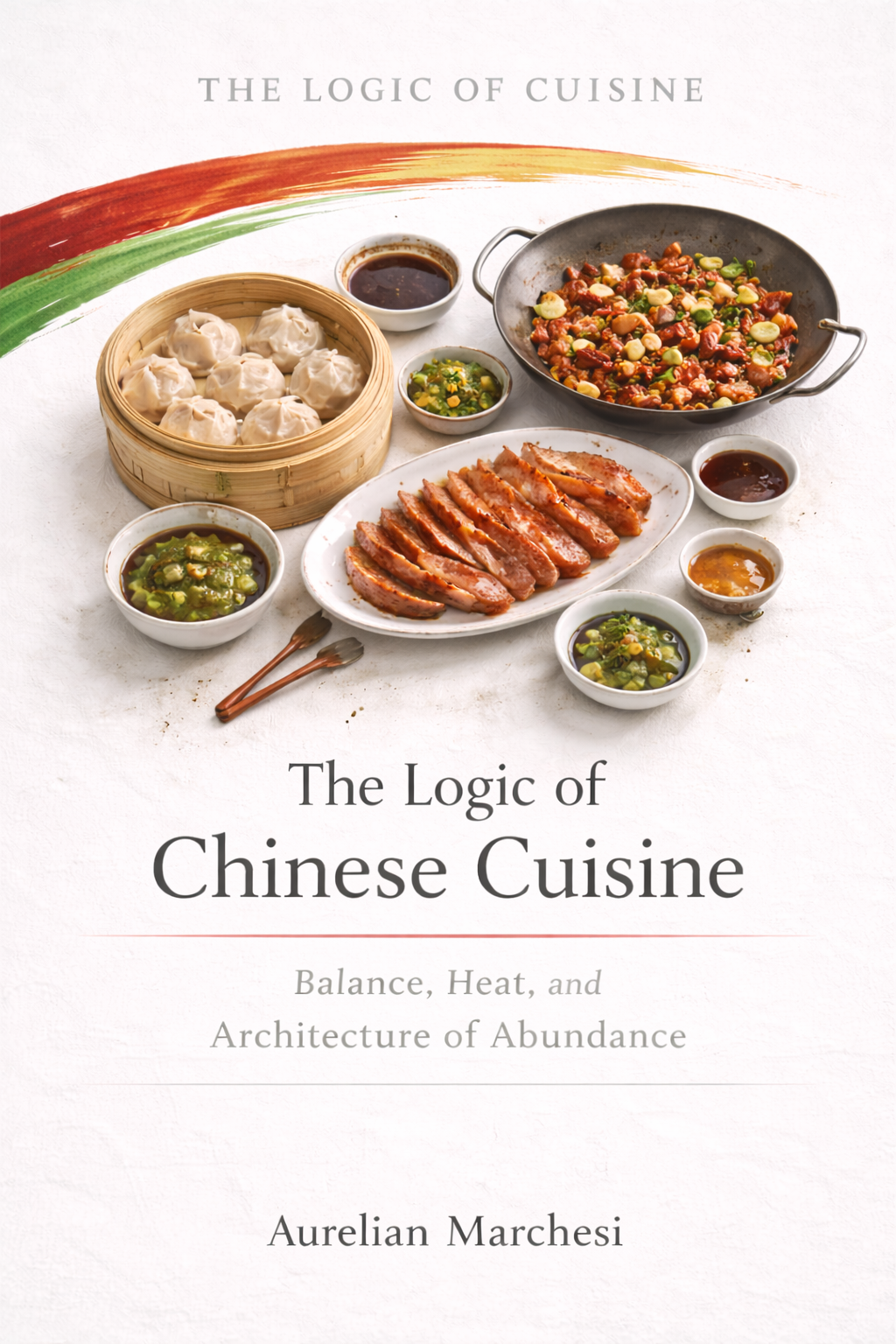
Cover of The Logic of Chinese Cuisine

Book 4 · The Logic of Cuisine

The Logic of Chinese Cuisine

Balance, Heat, and the Architecture of Abundance

By Aurelian Marchesi

A Chinese meal is not fully explained by any one plate. Its meaning emerges across the table, where crisp answers yielding, dry meets wet, a rich braise is relieved by greens, and rice or wheat gives the arrangement continuity. This volume treats abundance as a problem of governance. Dense settlement, limited fuel, regional distance, and the obligation to feed households repeatedly produced techniques that convert speed into control: ingredients are cut for rapid, even cooking; the wok concentrates heat and motion; sauce binds without erasing texture; preserved pantry materials extend the reach of fresh food. Variety remains possible because the system distributes difference rather than asking one dish to perform every role. The table, not the isolated recipe, becomes the unit of coherence.

The central question

How can a cuisine sustain immense regional and material variety while preserving balance, efficiency, nourishment, and continuity at the scale of the shared table?

The volume proposes that Chinese culinary abundance is scalable because technique governs relationships. Heat, cut, sauce, texture, staple, and dish selection are coordinated so that many elements can coexist without fatigue or waste. High heat and brief cooking conserve fuel while protecting freshness; knife geometry makes timing predictable; sauces create adhesion and continuity; shared dishes distribute appetite and nutritional roles. Regional cuisines differ profoundly, yet remain intelligible through a common attention to balance, efficiency, and the meal as a whole.

What this work explores

The wok governs energy

Wok cooking is presented as a response to practical pressure rather than as theatrical flame. Curved metal, concentrated heat, small pieces, oil, and constant movement create maximal contact in minimal time. That efficiency conserves fuel and allows vegetables and proteins to retain contrasting textures. Wok hei signals successful energy transfer, but it is not an added seasoning detached from method. The decisive achievement is coordination: preparation must be complete before cooking begins because the interval at heat is too short for hesitation. Speed becomes a form of discipline only when cut, sequence, temperature, and motion have already been governed.
The cut programs texture and time

Knife work establishes how an ingredient will meet heat, sauce, and the mouth. Slices, shreds, cubes, and chopped forms alter surface area, cooking interval, adhesion, and perceived tenderness. Uniformity therefore serves a causal purpose: pieces intended to share a pan must reach their desired state together. The volume connects this geometry to digestibility and to the broader economy of fast cooking. Texture is not rescued at the end; it is designed at the board. By the time the wok is hot, many of the meal's most consequential decisions have already been made.

Sauce binds movement into coherence

Sauce is built during cooking so it can connect aroma, oil, water, seasoning, and the surfaces produced by the cut. Viscosity regulates how those elements travel: too thin and flavor drains away; too dense and texture is buried. Starch, reduction, and oil layering are therefore tools of control rather than signs of heaviness. The sauce's authority is relational. It helps separate ingredients read as one dish while preserving enough distinction for crispness, tenderness, and freshness to remain audible. Binding succeeds when the diner perceives continuity without feeling that everything has been coated into sameness.

Shared dishes make balance collective

The family table distributes balance across several dishes rather than engineering completeness inside each one. Diners move among vegetables, protein, soup, staple, crisp textures, yielding textures, stronger flavors, and quieter intervals. Rotation changes the next bite and regulates pace. This social geometry also allows abundance without requiring oversized individual portions. Regional systems can enter the arrangement with different emphases—Sichuan layering, Cantonese clarity, northern wheat, eastern sweetness—while still participating in a recognizable grammar. Coherence is a property of selection and relation, not uniformity.

Coordinate the part, regulate the whole

The framework moves between two scales. At the level of the ingredient, cut, heat, and sauce regulate physical behavior with great precision. At the level of the meal, staples, shared dishes, contrasting textures, and regional choices regulate appetite and continuity. Neither scale is sufficient alone. Technique without table logic produces isolated virtuosity; variety without technical control produces waste and fatigue. The volume's distinctive method is to show how small acts of preparation participate in a civilization-scale solution for feeding density, adapting to region, and sustaining repetition.

Place in the series

This volume expands the series from the logic of a dish to the logic of a table and from household practice to civilizational scale. Its answer to abundance is governance: diversity remains sustainable when preparation and meal structure assign each element a role. It offers a productive comparison with neighboring East Asian systems while preserving its own emphasis on speed, shared balance, regional plurality, and infrastructural continuity.