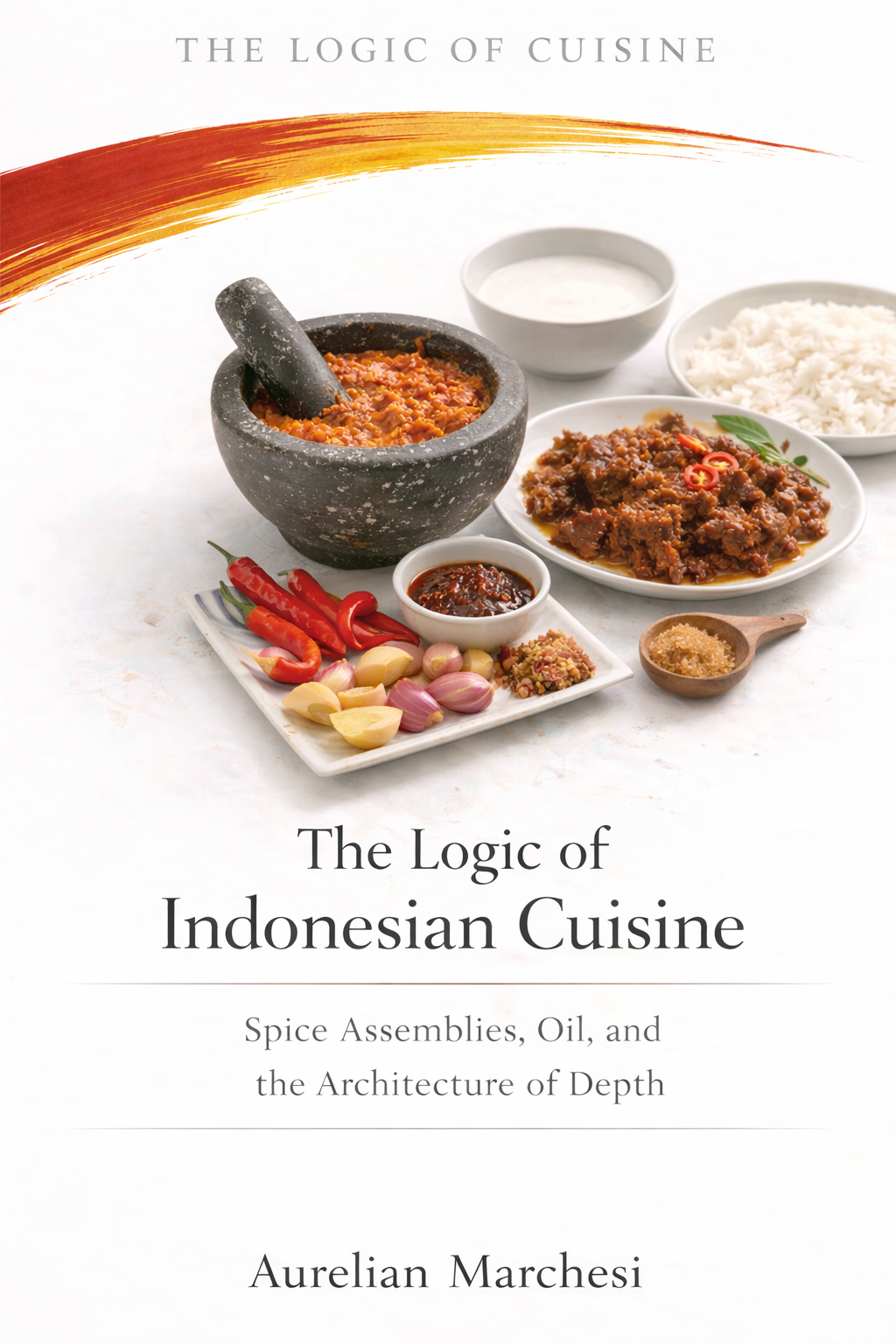
Cover of The Logic of Indonesian Cuisine

Book 13 · The Logic of Cuisine

The Logic of Indonesian Cuisine

Spice Assemblies, Oil, and the Architecture of Depth

By Aurelian Marchesi

Before the pan, there is the mortar. Separate roots, chilies, seeds, aromatics, salt, and sweetness resist one another until pressure turns fragments into a coherent paste. That transformation offers the volume its central image. Across an archipelago where ingredients and regional forms cannot be uniform, Indonesian cuisine carries identity through assemblies that can travel: bumbu, sambal, fried aromatics, sauces, and the expectation of rice. Oil then translates raw sharpness, time integrates what remains separate, and coconut or palm sugar can round intensity without erasing it. The resulting depth is not the accumulation of every spice at once. It is the outcome of deciding relationships early, then giving heat and reduction enough time to make those decisions inseparable.

The central question

How does a geographically fragmented cuisine turn volatile aromatics, trade-borne ingredients, fat, sweetness, heat, and time into stable depth that remains coherent across regional variation?

The volume proposes assembly as the durable grammar of Indonesian cuisine. Bumbu resolves relationships before cooking; oil releases and unifies aromatic compounds; reduction softens angular notes into a depth curve; coconut and palm sugar buffer without becoming automatic richness or sweetness; sambal keeps heat adjustable; rice absorbs and paces the whole. Complexity becomes readable when it is designed upstream and translated through controlled processes rather than produced by late addition.

What this work explores

Assembly supplies portable identity

Thousands of islands cannot depend on identical harvests or one canonical plate. The manuscript instead finds continuity in repeatable mechanisms. Aromatic bases, sambals, fried components, and sauces can accept local materials while preserving recognizable relationships among heat, savor, sweetness, acid, and texture. Trade introduces new inputs without automatically dissolving the system because those inputs must still pass through an established grammar. Indonesian identity therefore travels as a way of organizing variation, not as a demand that every region cook the same dish.
Bumbu solves balance before heat

Grinding changes a collection of ingredients into a structural unit. Texture controls how quickly aromatics release and whether they dissolve into a sauce or remain as competing particles. Heat, earthiness, sweetness, and aromatic lift are brought into relation before the paste reaches oil. This upstream integration explains why the first bite can seem deep rather than sequential. The paste is less a seasoning than a blueprint: one family of decisions can branch into multiple dishes while retaining a shared center.

Oil and time translate sharpness

Warm oil is treated as a medium of transformation, not a synonym for indulgence. As moisture leaves a paste, its sound tightens, raw aromas round, and volatile edges enter a unified field. Continued reduction then concentrates and integrates until separate notes become difficult to isolate. The book's depth curve depends on patience but not on indiscriminate duration: stopping before bitterness is as important as allowing enough time for cohesion. Indonesian richness is thus produced by controlled transitions from raw to bloomed, from wet to frying, and from scattered to stable.

Buffers keep depth livable

Coconut milk, palm sugar, sambal, and rice perform different kinds of regulation. Coconut can carry and soften spice while risking fatigue if allowed to dominate. Palm sugar rounds bitter or sharp edges and should disappear into balance rather than announce dessert. Sambal separates heat into a module that can supply brightness, smoke, acid, or fermented depth according to the meal. Rice receives oil and intensity, providing mass and pace. Together these elements make density repeatable: the cuisine can remain dark, aromatic, and forceful without becoming a single undifferentiated weight.

Assembly, translation, stabilization

The analytical sequence follows flavor from design to endurance. Geographic fragmentation establishes the need for portable bases. Grinding integrates ingredients into bumbu; oil translates raw compounds into aromatic depth; reduction and time stabilize the assembly; coconut, sweetness, sambal, acid, and rice govern its bodily effects. Rendang, nasi goreng, satay, coconut curries, and sambal-driven plates then demonstrate how the same engines generate different outcomes. Misreadings such as spice stacking, rushed pastes, scorched aromatics, dominant sugar, or missing rice reveal the system by showing what happens when a stage is removed.

Place in the series

This volume gives The Logic of Cuisine an archipelagic model of unity. Unlike systems that depend on a narrow ingredient canon, Indonesian coherence persists through portable assemblies and transformations. It shares tropical volatility and rice anchoring with neighboring Southeast Asian volumes, but its special contribution is the argument that complexity becomes durable when it is integrated before cooking, translated through oil, and stabilized by time.