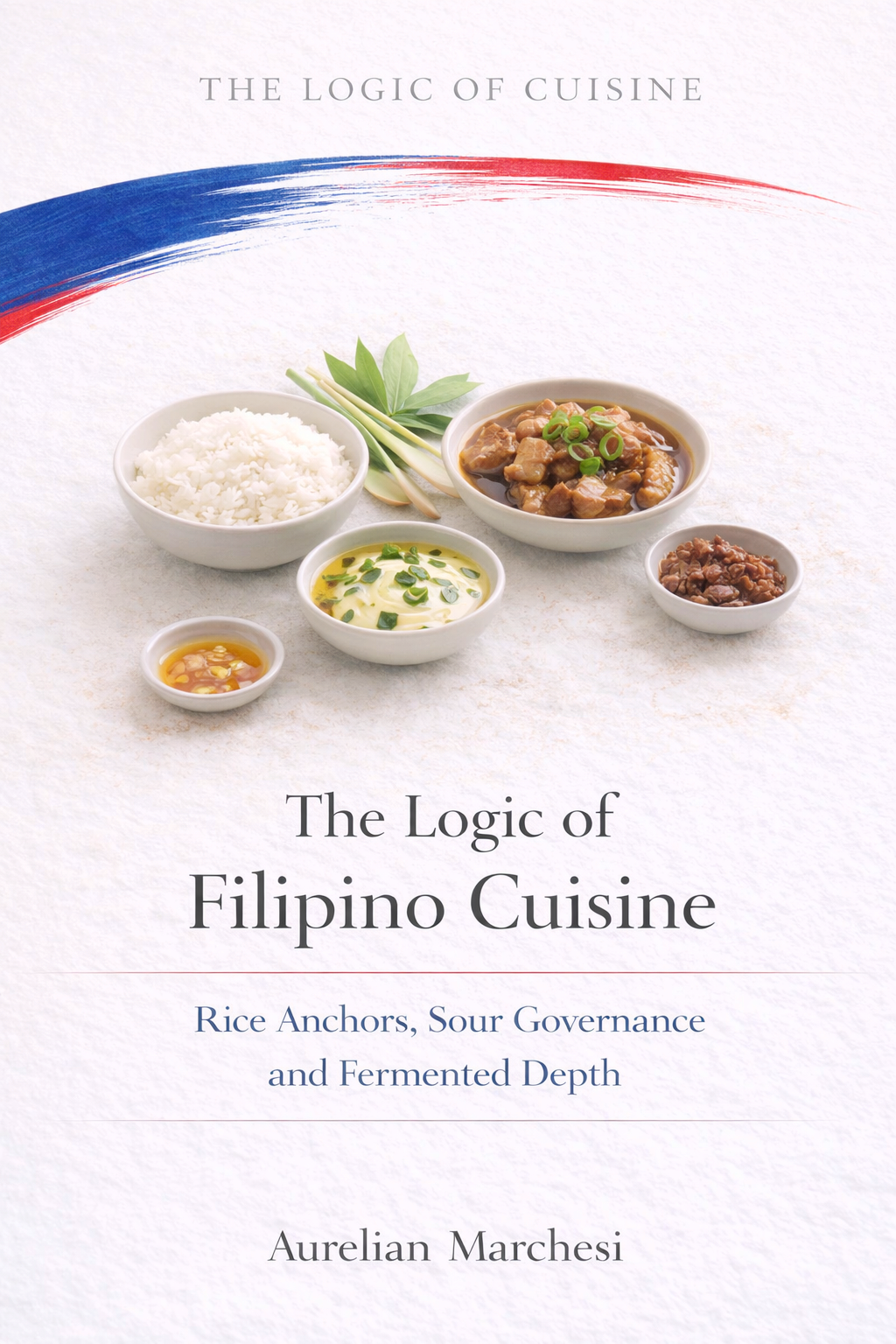
Cover of The Logic of Filipino Cuisine

Book 15 · The Logic of Cuisine

The Logic of Filipino Cuisine

Rice Anchors, Sour Governance, and Fermented Depth

By Aurelian Marchesi

Sourness reaches the Filipino table in more than one form: clean vinegar, fruit acidity, fermented depth, or broth that wakes the body without weighing it down. Its purpose is not simply to make food tart. Against tropical heat, rich braises, fried surfaces, and the durable salinity of preserved condiments, sourness governs how far intensity can travel. Rice receives that intensity and turns a forceful dish into a repeatable meal. This volume follows the conversation among those two anchors—one stable and absorptive, the other sharp and corrective—through braise, grill, broth, street plate, feast, and diaspora. What can appear to be collision is shown as a disciplined system for keeping comfort alive under pressure.

The central question

How do rice, vinegar, fermentation, braising, broth, and shared correction turn tropical volatility and historical layering into meals that remain durable, breathable, and repeatable?

The book reads Filipino cuisine as stability through tension. Rice anchors appetite and absorbs concentrated sauces. Vinegar defines, preserves, and corrects richness. Fermented sauces and pastes store depth and continuity. Braise, grill, fry, and sour broth create distinct textures and forms of endurance, while herbs, aromatics, and fresh accompaniments restore lift. The system does not eliminate contrast; it makes contrast dependable enough to support everyday meals and large shared occasions alike.

What this work explores

Rice is the plate's stable horizon

Rice receives salt, fat, sourness, sauce, and fermented intensity without competing for attention. Its neutrality is active: it stretches concentrated ulam across a meal, controls portion, and creates a predictable route through changing dishes. Because rice carries both everyday economy and sensory balance, removing it can make a sauce seem excessive or a fried element tiring. The volume treats the rice anchor as the condition that allows Filipino flavors to remain bold while still belonging to daily repetition.
Vinegar governs, preserves, and clears

Vinegar is the manuscript's irreplaceable marker because it acts at several levels at once. It extends durability in a demanding climate, defines the identity of preparations such as adobo, cuts rendered fat, and restores appetite after dense or fried bites. Its effectiveness depends on relation rather than maximum acidity: salt, aromatics, sweetness, fat, and rice change what sourness does. Used structurally, vinegar produces a clean boundary and a longer life; reduced to garnish, it loses the governing role that holds the system together.

Fermentation concentrates continuity

Fermented sauces and pastes carry salt, savor, aroma, and time in compact form. They allow changing fresh ingredients to enter a meal without forcing the cook to rebuild depth from the beginning. This backbone can be assertive, but rice, sourness, coconut, broth, and fresh lift keep it from becoming blunt. Fermentation thus supplies both historical continuity and practical efficiency: a small amount can connect a dish to the larger grammar while leaving enough space for regional and household variation.

Transformation alternates endurance and release

Braising creates tenderness, concentration, and keeping power; grilling supplies smoke and a firmer edge; frying creates a surface that needs correction; broth can deliver sour depth with less weight. The cuisine gains range not by abandoning its anchors but by exposing them to different physical problems. Adobo demonstrates regulated survival at household scale, while lechon tests surface, richness, and shared correction under feast conditions. In each case, texture and fat remain answerable to sourness, starch, condiments, or fresh accompaniments.

Anchor, tension, correction

The volume organizes its inquiry around a sequence of decisions. Material pressure makes durability essential. Vinegar and fermented depth establish continuity; rice secures the meal's carrying capacity; braise, grill, fry, and broth transform texture and concentration; sour-salt tension and fresh or coconut-based correction determine whether richness remains breathable. Everyday rice-and-ulam architecture and feast-scale lechon then test the same grammar at different loads. The framework explains Filipino coherence without pretending that regional and historical layers collapse into a single flavor profile.

Place in the series

Within The Logic of Cuisine, the Filipino volume makes sourness a primary governing intelligence rather than a finishing note. It shares rice infrastructure and tropical pressure with Indonesian, Malaysian, Vietnamese, and Thai systems, yet distinguishes itself through the durable partnership of vinegar, fermented salinity, and the rice-centered plate. It also shows how a cuisine can absorb historical layers without losing the corrective grammar that makes them livable.