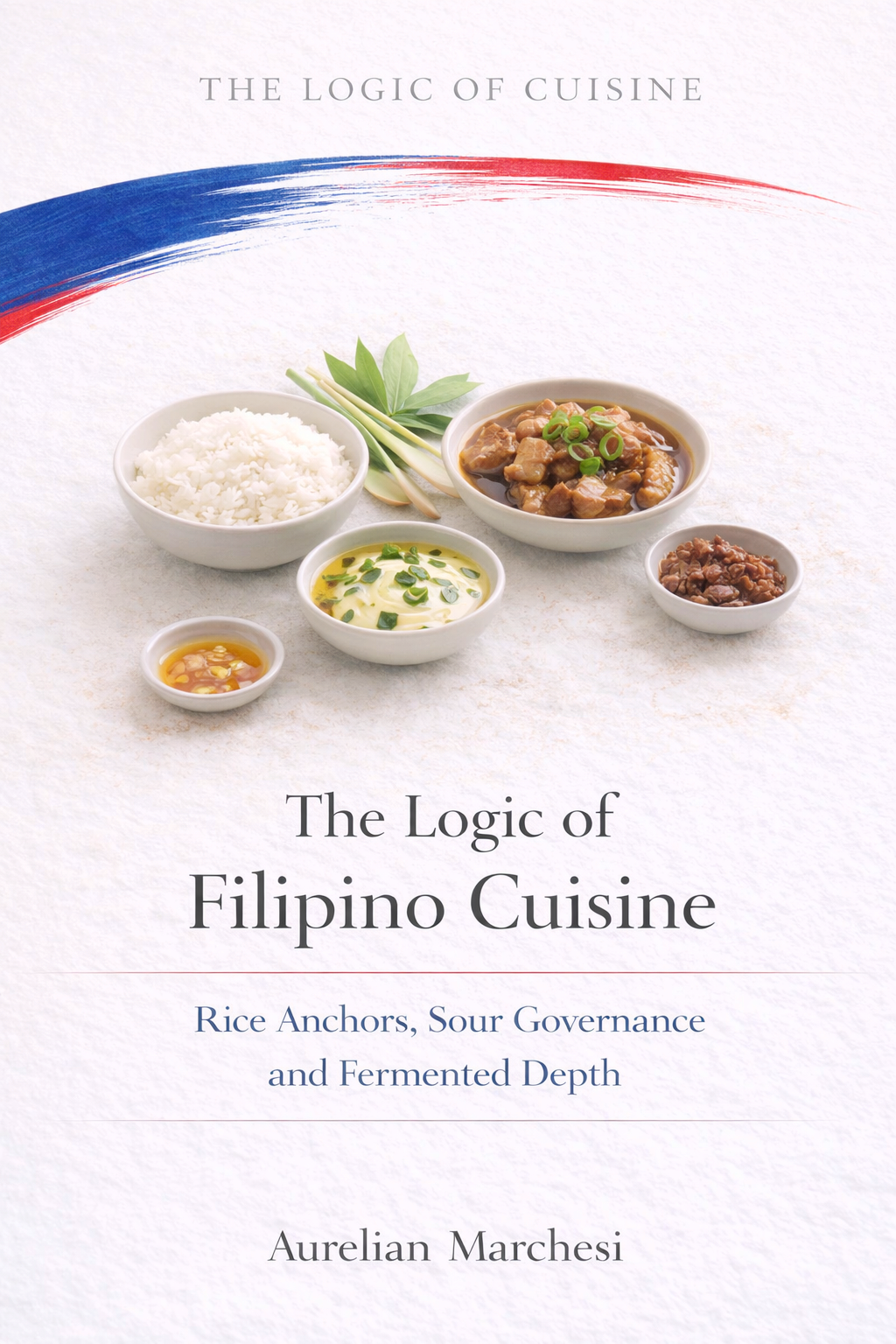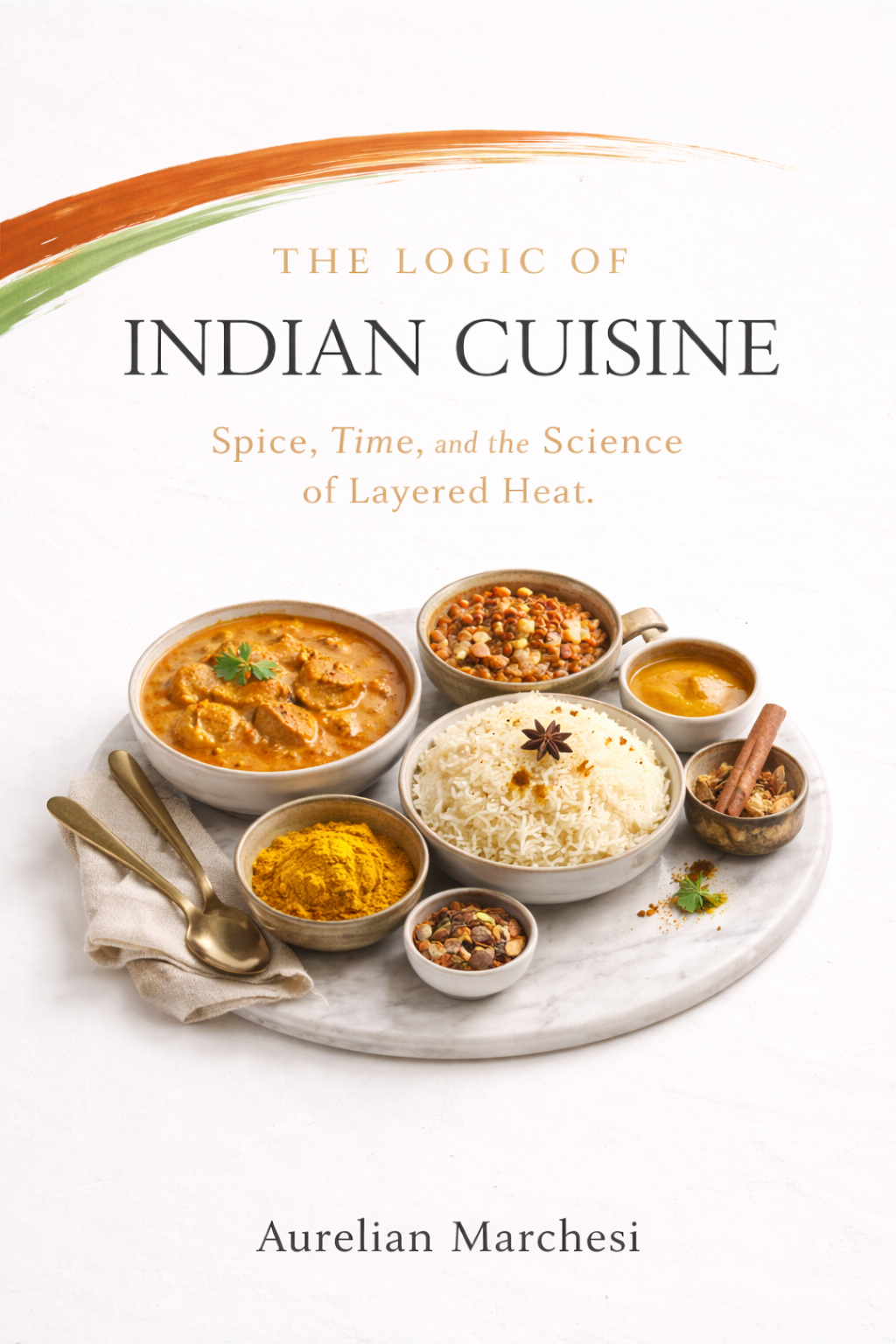
Cover of The Logic of Indian Cuisine

Book 5 · The Logic of Cuisine

The Logic of Indian Cuisine

Spice, Time, and the Science of Layered Heat

By Aurelian Marchesi

A spice does not have one voice. Added whole to hot fat, ground into a paste, simmered in water, or scattered at the end, it enters the meal at a different speed and remains for a different duration. This volume listens to those changes in time. It rejects the idea that Indian cooking is defined by the sheer quantity of spice or by an undifferentiated burn. Instead, flavor is constructed as a sequence: fat awakens volatile compounds, aromatics establish a base, simmering integrates, a late tempering restores high notes, and rest allows sharp edges to become coherent. Grains, legumes, dairy, and vegetables steady that movement. The result is an architecture experienced not all at once, but as warmth and aroma unfolding across the meal.

The central question

How does Indian cuisine use timing, form, fat, heat, fermentation, and rest to make spice arrive in layers rather than as a single overwhelming signal?

The book proposes that time is the principal organizing variable of Indian flavor. Spices are differentiated not only by taste, but by physical form, solubility, volatility, and the moment at which they meet fat or water. Heat is distributed among chiles, pepper, ginger, and aromatic warmth; stabilizing grains, legumes, yogurt, and breads keep that complexity repeatable. Regional cuisines employ different time signatures, yet all demonstrate that depth depends on paced transformation rather than simultaneous accumulation.

What this work explores

Blooming gives aroma a direction

Tempering begins with a threshold: the fat must be hot enough to release aromatic compounds, but not so hot that they turn acrid before they can circulate. Whole spices crackle and infuse; ground spices expose more surface and demand shorter contact; ghee and neutral oils carry different sensory weights. This is not a decorative flourish performed at the start or finish of a dish. It determines which aromas become foundational and which remain vivid above the slower body of the food. Reading sound, movement, and scent in the pan is therefore part of the system's technical literacy.
Spice form is a grammar of release

Whole, ground, and pasted spices behave as different grammatical forms rather than interchangeable quantities. Whole seeds and bark release slowly and can remain as low notes. Grinding accelerates extraction and distributes flavor more completely, while pastes combine spice with water, aromatics, or fat to alter adhesion and integration. The same ingredient can therefore serve a different sentence depending on its form. This grammar explains why replacing a sequence with a generic powder produces flatness: the cook loses contrast between early depth, middle-body warmth, and finishing aroma.

Heat has more than one path through the body

The volume distinguishes the sustained burn of dried chile, the greener immediacy of fresh chile, the nasal lift of black pepper, and the spreading warmth of ginger. Because these sensations begin and fade differently, they can be arranged dimensionally rather than merely increased. Aromatic heat may precede capsaicin, dairy may cool one interval, and a finishing spice may return attention after a long simmer. Management of burn is thus a problem of placement and duration. A dish can feel powerful without trapping the diner in one unchanging sensation.

The thali distributes regulation

At the everyday table, layered flavor is balanced by a modular arrangement of rice or bread, legumes, vegetables, yogurt, pickles, and chutneys. These elements do more than provide variety. A neutral grain absorbs sauce, dal extends satiety, yogurt cools and adds acid, and a condiment redirects the next bite. Repetition makes the system practical, while regional changes in fermentation, souring, dryness, and gravy create distinct rhythms. The thali demonstrates that balance can be achieved across a meal rather than forced into every preparation independently.

Flavor as a temporal score

The book reads cooking as a score in which entry, duration, and recurrence matter as much as ingredient identity. Fat infusion establishes a bass line; ground spices and aromatics develop the middle; simmering and rest integrate; late tempering, herbs, or acid restore definition. The framework also attends to the eater's body, asking how warmth, cooling, satiety, and digestion change through the sequence. This temporal reading avoids reducing Indian cuisine either to a pantry of exotic materials or to a map of regional dishes. It shows why the same materials can produce radically different results when their timing changes.

Place in the series

The volume gives The Logic of Cuisine its most explicit account of flavor as duration. It complements systems organized around rapid heat, water extraction, or direct ingredient clarity by showing how sequence can be the primary architecture. Its wider contribution is a method for asking not only what a cuisine uses, but when each element becomes active and how long its effects remain.