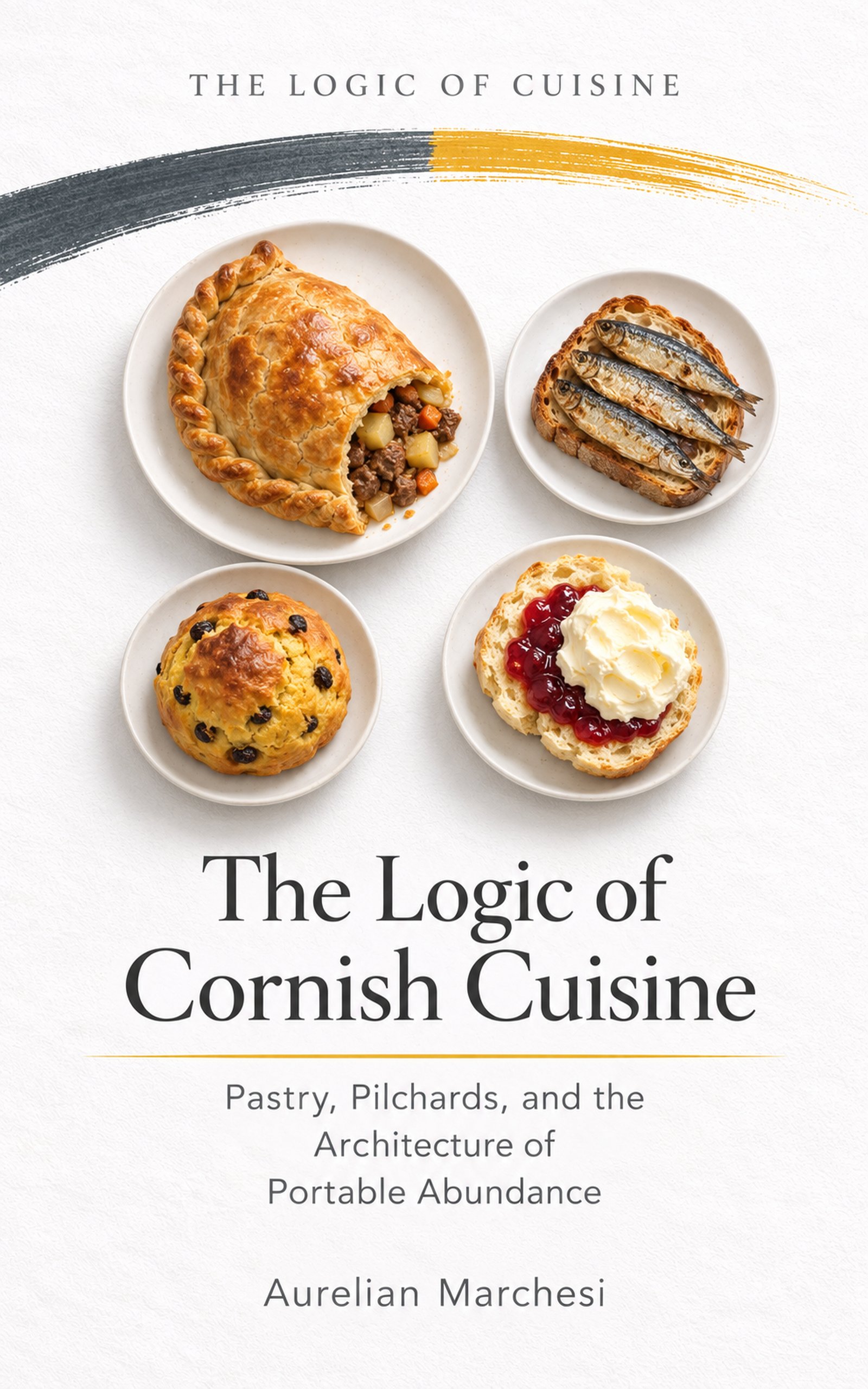
Cover of The Logic of Cornish Cuisine

Book 22 · The Logic of Cuisine

The Logic of Cornish Cuisine

Pastry, Pilchards, and the Architecture of Portable Abundance

By Aurelian Marchesi

Cornish food is easy to recognize by silhouette: a crimped pasty, fish beneath crust, a saffron bun, a cream-topped split. The volume asks what those forms had to accomplish before they became heritage images. Mine, tide, distance, damp weather, irregular catch, costly oven heat, and workers away from a table create a demand for food that can be enclosed, carried, held, and divided. The sea arrives in pulses that must be salted, pressed, baked, or stewed; dairy must finish a stable base without making it collapse. Cornish cuisine becomes an architecture of portable abundance when form protects both nourishment and the timing of its use.

The central question

How does a cuisine shaped by mine, coast, travel, and uneven abundance make nourishment portable without separating it from place?

Cornish cuisine is read as an architecture of portable abundance. Pastry replaces plate by creating a boundary strong enough to protect a moist filling through handling and delay. Pilchards turn the sea from scenery into daily infrastructure because quantity, perishability, salting, pressing, and later distribution connect one catch to many meals. Batch-fired ovens and bakery counters organize serious hand-food and restorative pause across the day. Cream and butter arrive as bounded finishing decisions on bases already able to stand. At ceremony, Stargazy Pie magnifies the same obligation: transform a volatile catch into a coherent form that can be portioned and shared.

What this work explores

Enclosure makes a meal movable

A pasty is not merely filling wrapped in crust. The dough creates a carrier, boundary, portion, and pocket of retained heat. Its robust bake and crimp must resist knocks, damp, cooling, and the pressure of a filling that still contains enough moisture to remain edible. Cut and proportion matter because free liquid can migrate into the pastry and weaken it after steam stops escaping. The filling therefore has to cooperate with the shell rather than behave like a bowl stew trapped by accident. Enclosure makes a complete meal movable, allowing structure to replace the absent plate without making the food illegible when opened or divided.
The catch enters ordinary time

Pilchards make the sea part of ordinary time because a large landing is both abundance and emergency. Salting draws water and prepares the fish to wait; pressing, barreling, drying, baking, or stewing direct the catch toward later meals. A preserved fish can return flaked on bread, dispersed through broth, or enclosed beneath crust, so handling at the quay already anticipates domestic form. Structural importance therefore follows quantity, keeping capacity, and distribution rather than prestige. Fish becomes infrastructure when it can feed the household after the tide has changed and can also support the economy that keeps boats, workers, and coastal settlements in motion.

The bakery counter organizes the day

The bakery counter is a schedule as well as a display. Pasties answer work and travel; splits and sturdy breads wait to receive butter or cream; saffron buns, fairings, hevva cake, and heavy cakes create pauses that remain portable and keepable. Costly oven heat encourages batches: savoury enclosures, loaves, and sweet forms share the same firing so food exists for people absent at the moment of baking and for days when labor leaves little time. The counter coordinates meal-sized forms and restorative forms without requiring a seated service. It translates household production into public availability while preserving the cuisine's discipline of carrying and waiting.

Cream belongs to a boundary

Cornish cream belongs to a boundary because the base must be complete before dairy arrives. A split, scone, bread, or dense cake is built with enough crumb and surface strength to remain legible under a thick, placed layer. Clotted cream rounds dry texture, extends satiety, and buffers sugar, spice, or salt at the point where tongue meets starch, yet its viscosity keeps it from soaking through like a loose liquid. Internal fat and external dairy perform different jobs: one shapes the bake, the other changes its final mouthfeel and occasion. Richness succeeds when it finishes the architecture; it fails when it smothers or disguises a weak base.

Ceremony must still distribute the catch

Stargazy Pie turns catch into public symbol, but ceremony does not suspend the everyday grammar. Fish still has to meet pastry, moisture still has to be governed, and the finished pie still has to distribute abundance across servings. The visible heads declare origin and collective memory, while the enclosed body performs the practical work of carrying, holding, and portioning. Festival scale therefore amplifies rather than replaces Cornish logic. As with the pasty and bakery counter, a successful ceremonial form transforms vulnerable material into a bounded unit that can move from coast to hall and from one catch to many people without losing the relation to tide and county.

Follow what the form carries

Follow what the form carries. First identify the pressure: work away from a table, a volatile catch, costly heat, delayed eating, or public celebration. Then locate the carrier—pastry, bread, pot, cake, or pie—and the boundary that prevents moisture, filling, or richness from destroying it. Ask how time is stored through salting, pressing, batch baking, dense crumb, or enclosure. Finally, identify the finish or correction that changes the eating experience without obscuring the base. This sequence connects pasty, pilchards, bakery forms, cream, and Stargazy Pie while keeping their different scales visible. Portability is not shape alone; it is governed abundance over distance and time.

Inside the work

Tin, tide, and pressure

The opening movement reconstructs the pressure field beneath the postcard: mining, fishing, peninsula distance, weather, perishability, costly fuel, and workers who may eat without a table. It establishes why survival through movement and waiting precedes decoration.

Carriers and corrections

The argument then follows pastry, pilchards, bread, dairy, salt, saffron, and sweetness through separate jobs. Enclosure protects; preservation extends a catch; batch baking stores labor; dairy finishes a base whose structure is already sound.

Everyday and ceremonial forms

Full readings of the Cornish pasty and Stargazy Pie test the system at individual and ceremonial scale. Fish stew, splits, saffron buns, cream tea, fairings, and hevva cake show how coast, counter, pause, and public symbol remain connected.

Travel with limits

The closing movement separates portable function from branding alone. It asks what can travel through substitution and what still depends on Cornish source, protected naming, coast, county, and the exact relationship between a carrier and what it carries.

Place in the series

This volume adds mobility and bounded finish to the series' comparative vocabulary. Cornish pastry equips a meal to leave the table; preserved pilchards let a short-lived catch reappear across time; the bakery counter coordinates work and pause; cream claims a stable base without dissolving it. That architecture differs from Northern English industrial plates, Scottish compression and softening, and Welsh continuity around pot and hearth. The work's distinctive question is not simply what Cornwall eats, but how coast, labour, oven, boundary, and distribution turn abundance into food capable of moving, waiting, and returning without losing its regional relation.